What should you look for when choosing?
First, check whether a single USB-C cable can carry video and provide enough power for your laptop. Then compare the screen space, gaming performance and power consumption of the complete setup.
| What to consider |
What should you check? |
Who is this important for? |
| Laptop power over USB-C |
Check that the monitor, laptop and cable support USB-C video, and that the Power Delivery output is suitable for your laptop. |
If I want to avoid a separate laptop charger, video must work over the same connection and the charging power must be sufficient. Around 36% of consumers prioritise doing away with that charger. |
| Workspace and readability |
Compare resolution, aspect ratio, screen width and text clarity; check that your software makes good use of the aspect ratio. |
If I want to see my design, references and tools at the same time, screen space and easy-to-read text are important. Around 29% of consumers prioritise workspace for design. |
| Smooth gaming |
Check which combination of resolution and refresh rate your computer supports through the connection you’ll use. |
If I play fast-paced games as well as doing design work, I want to know whether my computer can achieve the refresh rate I want. Around 21% of consumers prioritise smooth gaming above all else. |
| Power consumption |
Compare the EU energy label for the exact screen model and consider the laptop or desktop as part of the same setup. |
If I want to take power consumption and running costs into account, information about both the screen and the computer is relevant. Around 14% of consumers consider power consumption their main buying concern. |
Joybuy products for design and gaming
This Joybuy selection includes gaming and ultrawide monitors for design work, with models that specify USB-C power delivery and options where this feature is not a key focus. Check whether the connection and charging output of each model are suitable for your laptop.
 No image available
LG UltraGear 34GX900A-B.AEU 34-inch curved WQHD OLED gaming monitor
A good fit if you want to combine a wide design workspace with gaming and USB-C laptop power.
34 inches, 3440 × 1440, 21:9 and up to 240 Hz; LG lists USB-C Power Delivery of up to 65 W. Check that your software makes good use of the aspect ratio and that 65 W is enough for your laptop.
View at Joybuy
 No image available
INNOCN CB27U1 27-inch 4K UHD IPS monitor, 120 Hz, USB-C 90 W PD
A good fit if you’re looking for a 27-inch 4K screen and want to combine video and laptop power over USB-C.
The product name lists 3840 × 2160, IPS, 120 Hz and USB-C 90 W PD. Check that your laptop supports video over USB-C and that 90 W is enough for your needs; the monitor itself needs mains power.
View at Joybuy
 No image available
KTC M27P6 27-inch 4K MiniLED gaming monitor, 4K 160 Hz/FHD 320 Hz, USB-C 65 W, KVM
A good fit if you want to combine gaming with a workspace for several devices; the product name also lists KVM.
The product name lists 4K 160 Hz/FHD 320 Hz and USB-C 65 W. Check which refresh mode you need, whether your computer supports it and whether 65 W is enough for your laptop.
View at Joybuy
 No image available
iiyama ProLite 34-inch UWQHD curved monitor with USB-C dock, LAN and KVM
A good fit if you’re looking for a wide screen and features that make it easy to connect and switch between devices.
The product name lists a curved UWQHD screen, USB-C dock, LAN, KVM and a height-adjustable stand. Check USB-C video support and the charging output for your laptop.
View at Joybuy
 No image available
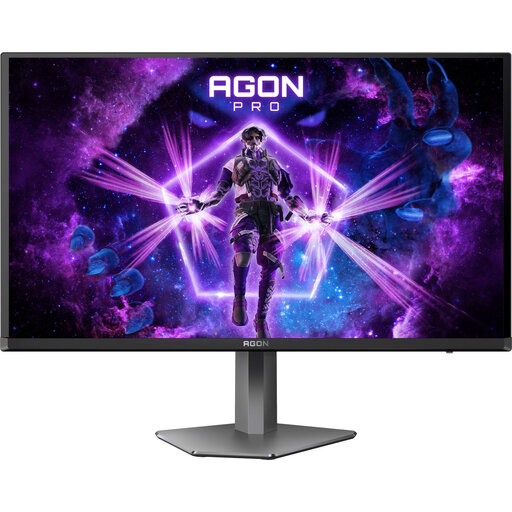
AOC AGON PRO AG276QZD2 27-inch QHD gaming monitor
A good fit if you want to combine QHD design work and gaming on a 27-inch screen, without making laptop power a top priority.
The product name lists 2560 × 1440, DisplayPort up to 240 Hz and HDMI up to 144 Hz. Check which connection you’ll use and which combination your computer supports.
View at Joybuy
Frequently asked questions
Can a USB-C gaming monitor free up a socket?
You may be able to free up the socket used by your separate laptop charger, but not the one used by the monitor. This is only possible if your laptop and cable support USB-C video and the monitor provides enough power. Gigabyte lists up to 18 W for the MO27Q2A; BenQ lists 65 W for the EX321UX.
How can you connect a monitor safely when sockets are in short supply?
Don’t automatically plug every device into an extension lead. Brandweer Nederland advises plugging high-power devices directly into a socket where possible, and fully unwinding any cable reel in use. Also check the load and connection instructions for your own setup.
Where can you compare monitor power consumption?
Check the EU energy label and model information in EPREL. For computer monitors, the European Commission describes an A–G scale and label information for SDR and HDR, among other things. The label does not measure the entire system, including a laptop or desktop.
Are you automatically entitled to exactly two years’ legal guarantee in the Netherlands?
No. According to the Dutch government, there is no fixed statutory guarantee period in the Netherlands: you’re entitled to a product that works as it should, depending on what you can reasonably expect from it. If there’s a fault, contact the seller; the manufacturer’s guarantee is separate.


