
Designer who uses lots of windows
You want to read small text and controls while making room for several windows. So, consider screen size, resolution and text clarity, not just the refresh rate.


Start by checking the space available on your shared desk and how easy your design interface is to read. An adjustable 27-inch QHD monitor could be a good middle ground if the screen and stand fit, while a more compact screen may make more sense if space is tight. Choose 4K only if your computer can handle it at your preferred settings. Then consider viewing angles, room lighting and menus that stay on screen for long periods when choosing a panel.
You want to read small text and controls while making room for several windows. So, consider screen size, resolution and text clarity, not just the refresh rate.
You need the monitor to fit on your part of the desk, and may want to adjust it or view it alongside someone else. Measure the monitor stand too, not just the screen diagonal.
You also use the monitor for gaming and care about motion and detail in dark scenes. Balance this against changing room light and any design menus that stay on screen for long periods.
First, measure the available space. Then assess text clarity and your preferred resolution, and finally compare panel performance and gaming modes with your own device.
| What to consider | What to look for | Who is this important for? |
|---|---|---|
| Readable design windows | Check the diagonal, native resolution and text clarity of the exact model at your usual viewing distance. | If you want to read small labels and use several design windows side by side, usable screen space is your priority. Around 29% of consumers give readable design workspace top priority. |
| Positioning on a shared desk | Measure the available width and depth, then compare them with the dimensions including the stand. Also check adjustability and any VESA mounting options. | On a shared desk, you want enough room left for your own things and the other person. Around 29% of consumers prioritise the physical space taken up by the screen and stand. |
| Panel and room lighting | Check the model’s viewing angle, coating and reflections. For OLED, also consider static elements that remain on screen for long periods. | If you view the screen with someone else, or have changing light and fixed design toolbars, panel performance is an important consideration. Around 24% of consumers give lighting and panel performance top priority. |
| Gaming visuals and connections | Check the resolution and Hz combination for each input, and compare it with the output of your computer or console. | If smooth motion in games matters most to you, check which mode your own device can actually output. Around 18% of consumers prioritise gaming motion and the compatible connection. |
The stand takes up space too, especially on a shared desk. A screen that looks like it will fit based on its diagonal may still take up too much room once you include the stand.
Measure the available space and compare it with the full dimensions of the model, including its stand.
According to LG, the UltraGear 27GR83Q-B is an example of a 27-inch QHD IPS gaming monitor with a 240 Hz refresh rate.
The MOBIUZ EX2710Q is a documented 27-inch QHD IPS monitor with height adjustment.
The G27U is an example of a 27-inch 4K IPS monitor with different stated refresh rates for different resolution modes.
The G2725D is a useful example for comparing inputs and available adjustment on a 27-inch QHD IPS monitor.
These options focus on 27-inch gaming monitors for design work and gaming, with QHD and 4K resolutions and IPS or OLED panels.
 No image available
Worth considering if you want to combine QHD design work and fast-paced gaming on one monitor.
27 inches; 2560 × 1440; 200 Hz; Rapid IPS; HDR support.
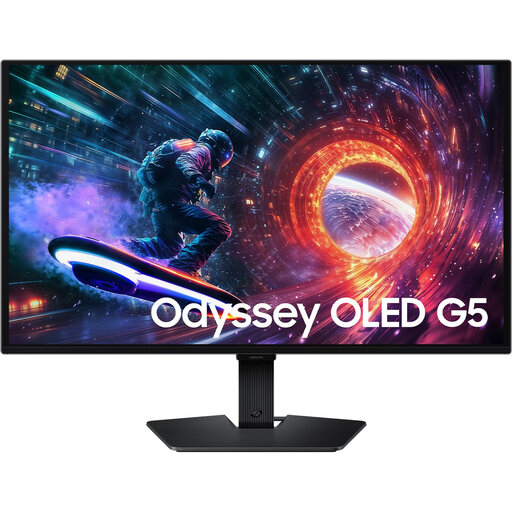 No image available
Could suit anyone considering a 27-inch OLED model for design and gaming; static interface elements left on screen for long periods need careful consideration.
2560 × 1440; 180 Hz; OLED; HDR10; AMD FreeSync; stated 178° viewing angle; tilt adjustment.
If the same static elements remain on screen for long periods, the general risk of OLED burn-in is worth considering.
 No image available
A 4K option for anyone who values fine detail and can pair their preferred gaming mode with their own computer.
27 inches; 3840 × 2160; IPS; 4K up to 180 Hz and a separate FHD mode up to 360 Hz.
The 360 Hz rate applies to FHD, not 4K.
 No image available
A QHD option to compare if you use design windows and play games on a 27-inch screen.
2560 × 1440; 144 Hz; IPS; Adaptive Sync; HDMI 2.0; DisplayPort 1.4; VESA mounting and tilt adjustment.
 No image available
A 27-inch IPS model to compare if you want QHD, gaming features and an adjustable stand.
2560 × 1440; 180 Hz; IPS; VESA DisplayHDR 600; NVIDIA G-SYNC and AMD FreeSync Premium Pro support.
Measure the part of the desk you can use and compare it with the width and depth of the exact model, including the stand. Then check whether height adjustment or compatible VESA mounting would work for your setup.
No, it depends on the combination of resolution, input and your device’s output. Dell lists different maximum rates for DisplayPort and HDMI on the G2725D, while GIGABYTE lists separate UHD and FHD modes for the G27U.
For a standard online purchase by a Dutch consumer, ACM ConsuWijzer generally says there is a statutory cooling-off period of up to 14 days after delivery. Check the applicable terms and any exceptions relating to your purchase.
No. According to the Dutch government, there is no fixed statutory guarantee period in the Netherlands: what you can expect from a product also depends on the product itself. If there is a fault, the seller must provide a solution.
Compare the energy label and product information for the exact models. The European Commission describes an energy label scale from A to G for electronic displays. Only estimate annual consumption if you have comparable consumption figures and know how many hours you use the monitor.