For stealth games in a dark room, OLED is a good fit if deep blacks and fast pixel transitions are your priorities. Mini-LED LCD is an alternative if you’d rather avoid the specific risk of OLED burn-in. Whichever technology you choose, compare tests of the exact model for dark motion smearing, black levels and blooming. A high quoted refresh rate alone won’t tell you how the screen performs in your games.
Who is this for?
For gamers who play in dark settings
If you mainly play story-led stealth games in a darkened room, you’ll want to make out shadows and small light sources clearly. RTINGS.com describes black uniformity as a factor that can affect how visible blooming or uneven dark areas are.
For gamers sensitive to motion blur
If you also play fast-paced games, smearing or blurred motion can be distracting when you turn or sneak around. RTINGS.com explains that slow response times can cause motion blur or inverse ghosting.
For gamers with static on-screen elements
If you use the same monitor for long periods with games that have a static HUD, or for desktop work, factor in the risk of OLED burn-in and the warranty terms for the specific model. Tweakers discusses this risk for OLED screens.
What should you look for when buying?
OLED, including QD-OLED
A good fit for playing in the dark when deep blacks and fast pixel transitions matter most.
Trade-off static HUD elements and prolonged desktop use make the risk of burn-in and the model-specific warranty important considerations.
Mini-LED LCD
A good fit for high-contrast HDR scenes if you’d rather avoid the specific risk of OLED burn-in.
Trade-off dimming zones can cause blooming around small bright objects, so check tests of the exact model.
VA LCD, possibly with mini-LED
A good fit for if you’re looking for an LCD and dark-scene contrast matters to you.
Trade-off VA panels can show noticeable motion smearing during transitions between dark shades.
Standard IPS LCD
A good fit for if, alongside stealth games, you also care about fast motion and general desktop use.
Trade-off an IPS model without effective local dimming may display dark scenes with less depth.
| What to consider |
What should you look for? |
Who is this important for? |
| Black levels and blooming |
Compare black uniformity tests and, for LCDs with local dimming, blooming around small light sources. |
When I play dark scenes, I want to be able to make out shadows and small light sources; around 36% of consumers prioritise black levels. |
| Motion clarity |
Check measurements for dark pixel transitions and overshoot at the refresh rates you use. |
When turning and sneaking, I want as little distraction as possible from dark motion smearing; around 29% of consumers prioritise motion clarity. |
| Static HUD and mixed use |
Check the image maintenance features and written warranty terms for the exact OLED model. |
If the same HUD or desktop elements stay on screen for a long time, I factor in the risk of OLED burn-in; around 21% of consumers prioritise longevity for mixed use. |
| Resolution and connection |
Check the supported resolution and refresh rate for each input on the monitor and gaming device. |
I want my gaming device to support the resolution and frame rate I’m aiming for; around 14% of consumers prioritise connectivity and device compatibility. |
Common buying mistakes
-
Choosing based only on ‘1 ms’ or the maximum Hz figure
A quoted figure doesn’t show how dark transitions or overshoot look at the frame rate you actually use.
Check independent motion measurements for the exact model and the settings you plan to use.
-
Assuming an HDR logo guarantees good dark-scene performance
With LCDs, local dimming, contrast and blooming also affect what you see around small light sources.
Compare test images and measurements of HDR contrast and black uniformity, and check how the monitor performs in SDR games too.
-
Overlooking the risk of OLED burn-in or the warranty
Static HUD and desktop elements affect whether OLED is the right choice. An additional manufacturer’s warranty does not replace your statutory consumer rights in the Netherlands.
Check the written cover for the exact model and consider how often static on-screen elements are displayed.
Brands to consider
Gigabyte
The MO27Q2A is a 27-inch QHD QD-OLED model for comparing contrast and fast motion.
- Gigabyte lists a maximum refresh rate of 280 Hz for the MO27Q2A.
- Tweakers rates its response times positively, but also notes less impressive colour reproduction and that blacks may look greyer in ambient light. This applies to the MO27Q2A, not every model from the brand.
AOC
AOC has models here with a range of LCD technologies, including mini-LED with IPS or VA, as well as standard IPS.
- Tweakers found the HDR performance of the U27G4XM to be high in contrast.
- Tweakers notes that the U27G4XM’s response times aren’t the fastest. AOC lists 336 dimming zones for the Q27G3XMN/BK; this specification doesn’t prove that this variant achieves the same test results as a model without the /BK suffix.
Dell Alienware
The AW2725D is a 27-inch QHD QD-OLED model to compare if you’re looking for an OLED monitor with a different feature set.
- Dell specifies 280 Hz and 0.03 ms GtG for the AW2725D.
- These manufacturer specifications aren’t independent measurements of dark pixel transitions. Also check the warranty terms for the exact OLED model.
MSI
The MAG 271QPX QD-OLED E2 is a 27-inch QHD QD-OLED alternative.
- MSI specifies a refresh rate of 240 Hz for this model.
- MSI says OLED Care 2.0 helps reduce the risk of burn-in; it doesn’t guarantee that burn-in is impossible. Check the terms for the specific variant.
Joybuy products
These OLED or QD-OLED gaming monitors are for anyone who values black levels in dark scenes. If you use your monitor for long periods with static on-screen elements, also consider the risk of OLED burn-in.
 No image available
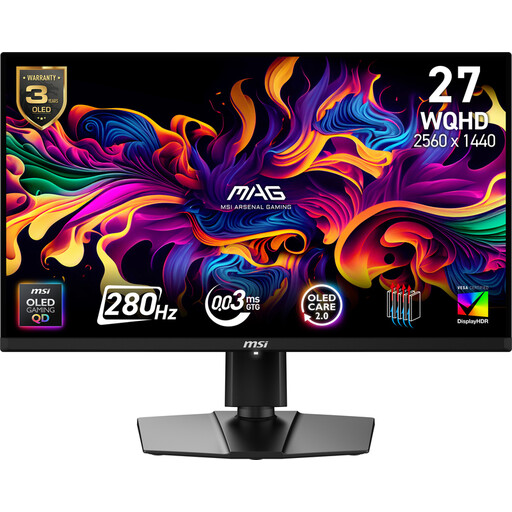
MSI MAG 271QP X28 27-inch WQHD OLED gaming monitor
The product listing mentions QD-OLED and deep blacks, features that suit gamers who want to pick out shadows in dark games.
Listed specifications: WQHD, 280 Hz and 0.03 ms GtG. These are product listing details, not independent motion measurements. The general risk of OLED burn-in remains a consideration if you use the monitor for long periods with static HUD elements.
Joybuy
 No image available
AOC GAMING Q27G4ZDR 26.5-inch QHD QD-OLED gaming monitor
The product information mentions QD-OLED and per-pixel dimming for buyers who take black levels in dark scenes into account.
Listed specifications: 2560 × 1440, 240 Hz and 0.03 ms GtG. These quoted figures aren’t independent test results. Static HUD elements make the risk of OLED burn-in relevant.
Joybuy
 No image available
LG UltraGear 34GX900A-B 34-inch curved WQHD OLED gaming monitor
The product information mentions a WOLED panel and black levels, which are relevant if dark-scene performance is a priority for you.
Listed specifications: 3440 × 1440, 240 Hz and 0.03 ms GtG. These are product listing details, not independent measurements of dark transitions. Consider the risk of OLED burn-in if static elements remain on screen for long periods.
Joybuy
 No image available
MSI MAG 341CQP QD-OLED X28 34.18-inch curved UWQHD monitor
The product description mentions QD-OLED and deep blacks, matching the priority of making out shadows in dark scenes.
Listed specifications: 3440 × 1440, 280 Hz and 0.03 ms GtG. These figures don’t confirm measured performance during dark transitions. Static on-screen elements make the risk of OLED burn-in worth considering.
Joybuy
 No image available
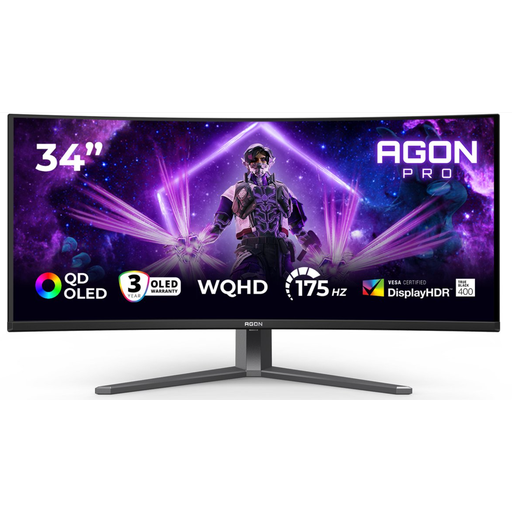
AOC AGON PRO AG346UCD 34-inch QD-OLED monitor
The product information lists QD-OLED, a relevant panel technology if black levels in dark scenes are a priority.
Listed specifications: 3440 × 1440, 175 Hz via DisplayPort and 100 Hz via HDMI. The stated refresh rate varies by connection, so check which input you’ll use for your gaming device. Also consider the risk of OLED burn-in with static HUD elements.
Joybuy
Frequently asked questions
Is a high quoted contrast ratio enough for good stealth scenes?
No. For the exact model, also compare measured black uniformity and, for LCDs with local dimming, blooming around small bright objects.
How can you reduce the risk of static HUD elements remaining on an OLED screen for a long time?
Use the image maintenance features as described in the manual for your chosen model and read its specific warranty terms. This won’t eliminate the risk; if you display static on-screen elements for long periods, you could also consider an LCD.
What rights do you have in the Netherlands if a monitor bought online disappoints or develops a fault?
For consumer purchases made at a distance, you’ll often have a 14-day cooling-off period; check the applicable exceptions and the seller’s information. You’re also entitled to a product that works as it should. According to the Dutch government, there is no fixed statutory warranty period in the Netherlands, and the seller is your point of contact if a fault develops. A manufacturer’s warranty may provide additional cover.
Does a monitor need an energy label in the Netherlands?
EU energy labelling rules cover electronic displays, including computer monitors, when they fall within the scope of the rules. The European Commission explains that the label provides information about energy efficiency; check the product information for the specific model.


