Start by positioning your screen to limit incoming light, then compare its surface finish with its stated typical SDR brightness. Next, choose the resolution and screen size based on the details you want to see, and check that your PC and connection can handle your preferred combination. A higher refresh rate won’t, by itself, prevent reflections.
Who is this relevant to?
Builder with daylight on the screen
You play in a bright room and want to make out buildings, terrain and menus without distracting reflections. Start with the screen’s position, surface finish and adjustable brightness. EIZO explains how light sources can be reflected in a screen; ASUS lists an anti-glare finish for the VG27AQL3A.
Strategy player who values detail
You want to see small map elements and menu items clearly. Compare resolutions at the same screen size and check that your PC can handle your chosen setting. ASUS and Dell offer different resolution options for their 27-inch models.
Builder who also plays fast-paced games
You’re looking for one screen for relaxed building sessions and games where smooth movement matters. Check the refresh rate for each resolution and connection: ASUS and LG list model-specific requirements.
What should you look for when choosing?
Start by checking visibility where you’ll use the screen. Then decide how much detail you want and check which settings your PC and connection can support.
| What to consider |
What should you check? |
Who is this important for? |
| Reflections and daylight |
Check the listed screen finish and compare the typical SDR brightness with the stated SDR brightness. Also consider where windows and lamps are in relation to the screen. |
If daylight falls on my screen, I want to see the map and menus without distracting reflections. Around 31% of consumers put daylight visibility first. |
| Map details and menus |
Compare resolutions at the same screen size and check that your PC can handle your preferred resolution. |
If I want to see small map elements and text clearly, I look at the resolution for the screen size I’m considering. Around 25% of consumers make detail their top priority. |
| Smoothness and connection |
Check the resolution and refresh rate in Hz for the input you’ll use, as well as your PC’s video output. |
If I want to use the same screen for fast-paced games, I want to know which settings my PC actually supports. Around 19% of consumers put smoothness and compatibility first. |
| Screen position |
Check whether the height is adjustable and, if you want to use an arm, check the VESA size. |
If I’m building for longer periods, I want to be able to set the screen at a comfortable height. Around 13% of consumers prioritise adjustability. |
| Total cost |
Compare models that meet your main needs, check the energy label and see which accessories are included. |
If I want to weigh up my spending, I look beyond the monitor itself to power consumption and any extras I might need for my setup. Around 12% of consumers put total cost first. |
Common pitfalls
-
Confusing peak HDR brightness with everyday brightness
A peak HDR figure describes a different picture mode from typical SDR brightness. On its own, it also doesn’t tell you how strong reflections will be in your room.
Compare SDR specifications like for like, and consider the screen finish and positioning separately.
-
Looking only at the highest Hz figure
The highest refresh rate may apply at a different resolution or over a different connection. The Dell AW2725QF reaches 360 Hz in Full HD, not 4K; ASUS and LG also list requirements for each input.
For the exact model, check your preferred resolution and refresh rate, your PC’s output and the cable.
Brands to compare
ASUS
The TUF Gaming VG27AQL3A is an example of a 27-inch QHD IPS monitor with an anti-glare finish.
- ASUS lists 2560 × 1440 resolution, 350 cd/m² typical brightness, height adjustment and 100 × 100 mm VESA mounting.
- The listed 400 cd/m² is a peak HDR figure. ASUS specifies up to 180 Hz via DisplayPort and an HDMI signal range of up to 144 Hz; the specifications don’t prove how easy the screen is to see in a particular room.
Dell Alienware
The AW2725QF is a 27-inch 4K IPS option with a separate Full HD mode.
- Dell lists 4K at 180 Hz and Full HD at 360 Hz.
- The 360 Hz mode isn’t the 4K mode. These specifications don’t tell you how the screen will handle reflections in a bright room.
LG
The UltraGear 27GR83Q-B is a fast 27-inch QHD IPS option.
- LG lists 240 Hz at QHD for this model.
- For QHD at 240 Hz, LG requires a PC with DisplayPort 1.4 with DSC or HDMI 2.1. The refresh rate alone doesn’t indicate how visible the screen will be in daylight.
Philips
The Evnia 27M2C5501/00 is a curved QHD Fast VA model to compare with flat screens.
- Philips lists a 27-inch screen and a 180 Hz refresh rate.
- There’s no direct measurement comparing this model’s daylight visibility with the flat IPS models mentioned above. So don’t choose a curved screen on the basis of its Hz figure alone.
Gaming monitors at Joybuy
This selection of Joybuy products includes gaming monitors with QHD or 4K resolution for anyone weighing up map detail, refresh rate or both. If you’ll be using your monitor in a bright room, it’s still important to check the finish and brightness for the exact model.
 No image available
AOC Gaming Q27G42XNE 27-inch QHD monitor
An option to compare if you want to see map and menu details on a 27-inch screen.
QHD, 2560 × 1440; 180 Hz; VA panel; FreeSync Premium.
View at Joybuy
 No image available
LG UltraGear 27G810A-B 27-inch 4K IPS gaming monitor
A 4K option to compare if you want extra detail on a 27-inch screen and are also considering a separate fast Full HD mode.
4K at 180 Hz or Full HD at up to 360 Hz; IPS panel.
View at Joybuy
 No image available
MSI Pro MAX 271UPX12G 27-inch 4K QD-OLED monitor
A 4K option to compare with other 27-inch models if extra detail matters to you.
4K, 3840 × 2160; QD-OLED; 120 Hz. The product information lists gaming and professional use.
View at Joybuy
 No image available
AOC GAMING Q27G4ZDR 26.5-inch QHD QD-OLED gaming monitor
An option to compare if QHD detail and a listed anti-glare finish matter to you. That finish doesn’t guarantee visibility in every bright room.
QHD, 2560 × 1440; QD-OLED; 240 Hz; adjustable stand.
View at Joybuy
 No image available
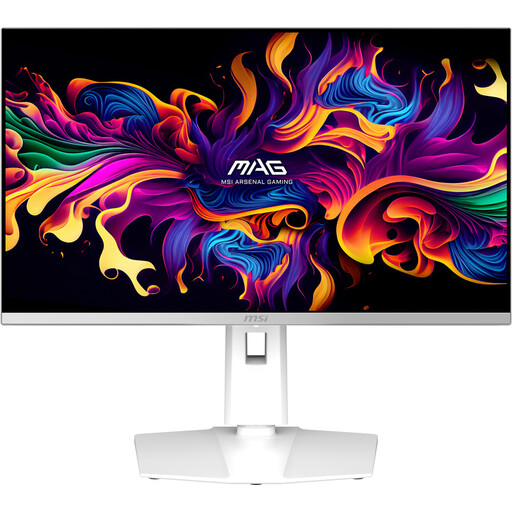
MSI MAG 272QPW QD-OLED X28 27-inch QHD gaming monitor
A QHD option to compare if you want map detail and a high refresh rate on a 27-inch screen.
QHD, 2560 × 1440; QD-OLED; 280 Hz. The product information lists HDMI 2.1, DisplayPort 1.4a and USB-C, as well as an adjustable stand.
View at Joybuy
Frequently asked questions
Should you focus mainly on peak HDR brightness for a bright room?
No. For everyday viewing, compare typical SDR brightness and screen finish separately. ASUS lists 350 cd/m² typical brightness and 400 cd/m² peak HDR brightness for the VG27AQL3A. These are different specifications and don’t guarantee protection from reflections.
How should you position a monitor when the light in the room changes?
First, check whether windows or lamps are reflected directly in the screen, then adjust its position and brightness. EIZO describes brightness settings for bright and dark environments. This is general guidance, not evidence of how a specific gaming model performs.
Will you always get the maximum Hz figure over HDMI?
No, it depends on the model, resolution and connection. ASUS lists an HDMI signal range of up to 144 Hz and a maximum of 180 Hz via DisplayPort for the VG27AQL3A. LG says QHD at 240 Hz on the 27GR83Q-B requires a PC with DisplayPort 1.4 with DSC or HDMI 2.1. Check your PC’s output too.
What cooling-off period and warranty apply to an online purchase in the Netherlands?
For online consumer purchases from a business, a 14-day cooling-off period applies in many cases. The Dutch government lists exceptions and distinguishes these purchases from those made from a private individual. In the Netherlands, there’s no fixed period for the statutory guarantee: you’re entitled to a product that works as it should, and the retailer is your point of contact if there’s a problem. A manufacturer’s warranty is separate.
Where can you check a monitor’s energy use?
Compare the energy label and information for the exact model. Electronic displays in the EU have an energy label ranging from A to G; the European Commission provides model information through EPREL. The label rating says nothing about visibility in daylight.


