Choose a 32-inch 4K screen if fine design details and vertical workspace are your priorities. An ultrawide is a better fit if you mainly want to keep windows side by side and enjoy a wider view in games, provided your game supports that aspect ratio. Then check the frame rate your PC can handle, the resolution and refresh rate supported by your chosen connection and, if you’ll have design windows on screen for long periods, the care instructions for the exact OLED model.
Which type of screen is right for you?
Designer focused on fine details
If you want to assess components, text and the height of your design workspace clearly, compare 4K with the vertical resolution of an ultrawide. The Samsung Netherlands Odyssey G70D is one example of a 32-inch 4K screen.
Multitasker with several windows open
If you want to keep design windows open alongside your game, consider an ultrawide and check in advance that your game supports its aspect ratio. Tweakers recommends checking support for each game.
Gamer and long-session designer
If you switch between games and interfaces that stay on screen for long periods, consider the connections, the frame rate your PC can handle and any care instructions specific to the model. For example, MSI publishes different maximum refresh rates for each connection on the models it has tested.
What should you look for when choosing?
First decide whether vertical pixel space or extra width matters more to you. Then check that your game supports the screen, and look at what your PC and connection can handle.
| What to consider |
What should you check? |
Who is this important for? |
| Design detail and vertical workspace |
Compare the native resolution, screen size and vertical pixel space with the details you want to assess. |
If I want to view small components and text, I focus on resolution and usable height. Around 33% of consumers say design detail is their top priority. |
| Width for windows and games |
Check the aspect ratio and resolution, the space available on your desk, and whether your game supports ultrawide. |
If I want to place design windows side by side or enjoy a wider view in games, I first check that my software can make use of it. Around 27% of consumers say extra workspace width is their top priority. |
| Frame rate and connection |
Compare your desired resolution and refresh rate with what your PC and chosen port support; your game also needs to deliver enough frames. |
If smooth movement in my game is most important, I want to know what my PC and connection can actually handle. Around 20% of consumers say smooth gaming visuals are their top priority. |
| Interfaces that stay on screen for long periods |
Check the instructions for the exact panel and model; if you choose OLED, also follow the recommended care steps. |
If my design windows stay in the same place for a long time, I take the panel type and any necessary care into account. Around 20% of consumers say extended design use is their top priority. |
How to avoid common buying mistakes
-
Buying an ultrawide without checking your game
Extra screen width doesn’t give you a wider field of view in every game; some applications benefit more from extra vertical space.
Check which aspect ratios your game supports and decide whether you need more width or vertical design space. Tweakers recommends checking support for each game.
-
Assuming the highest Hz figure applies over HDMI
On the MSI ultrawides tested, the stated maximum at native resolution is lower over HDMI than over DisplayPort.
Compare the modes available for each port with the connections on your PC. MSI lists the maximum resolution and refresh rate separately for each connection.
-
Looking only at screen size
The MSI MAG401QR (40-inch) and MAG 342CQR E2 (34-inch) models tested both have 3440 × 1440 pixels. So, with these models, a larger screen doesn’t mean more pixels for your design work.
Compare the physical size with the native resolution, and measure your desk space in advance.
-
Choosing OLED without considering fixed interfaces
LG says that the 34GS95QE-B may show temporary image retention after static elements have been visible for a long time, and provides instructions for pixel cleaning.
Read the care instructions for the exact OLED model and weigh them against an LCD alternative. LG notes that the settings menu may differ between models.
Brands to consider for different screen types
Samsung
The Odyssey G70D LS32DG702EUXEN is a 32-inch 4K option for anyone who values detail and vertical workspace.
- Samsung Netherlands lists 4K UHD, Fast IPS and a 144 Hz refresh rate for this model.
- The stated 144 Hz doesn’t guarantee that your game will reach that frame rate; it also depends on your PC and the game.
MSI
The MAG 342CQR E2 and MAG401QR show two screen sizes for a 3440 × 1440 ultrawide.
- MSI describes the MAG 342CQR E2 as a curved 34-inch VA model, while the flat MAG401QR is a 40-inch IPS model.
- For the MAG 342CQR E2, MSI lists a maximum of 180 Hz over DisplayPort and 100 Hz over HDMI. For the MAG401QR, the maximums are 155 Hz over DisplayPort and 100 Hz over HDMI. Check the figures for the model and port you’re using.
Xiaomi
The G34WQi is a 34-inch ultrawide option for anyone looking for extra width.
- Xiaomi Netherlands lists a resolution of 3440 × 1440 pixels, a maximum refresh rate of 180 Hz and an adjustable tilt stand for the G34WQi.
- Check the exact model number: the G34WQi isn’t necessarily the same model as the separately listed G34WQi 2026.
LG
The UltraGear 34GS95QE-B is an OLED model included here as a technical example only.
- LG lists a 34-inch screen, 3440 × 1440 pixels and a maximum refresh rate of 240 Hz for the 34GS95QE-B.
- LG Netherlands marks this model as discontinued. LG also describes temporary image retention after static content has been displayed for a long time, and includes a pixel-cleaning function for this model.
Dell Alienware
The AW3423DWF is an example of a 34-inch QD-OLED ultrawide.
- Dell lists a resolution of 3440 × 1440 pixels, a maximum of 165 Hz over DisplayPort and a maximum of 100 Hz over HDMI for the AW3423DWF.
- Dell Netherlands says that this model is currently unavailable. These specifications don’t automatically apply to other Alienware models.
Gaming monitors at Joybuy
This selection includes 16:9 screens and ultrawides in a range of sizes and resolutions for design and gaming. If you’re considering an ultrawide, check that your specific game supports its aspect ratio.
 No image available
GIGABYTE MO32U 31.5-inch 4K OLED monitor
A good fit if you’re looking for one large screen for design details and gaming. If fixed interfaces will be visible for long periods, check the care instructions for the exact OLED model.
31.5 inches; 3840 × 2160 pixels; 4K UHD; OLED.
View at Joybuy
 No image available
INNOCN 40C1U 40-inch 5K ultrawide IPS monitor
A good fit if you want a large ultrawide workspace for several windows. Check that your game supports the aspect ratio and that the screen will fit on your desk.
40 inches; 5120 × 2160 pixels; 21:9; IPS; 100 Hz; PIP and PBP.
View at Joybuy
 No image available
Samsung Odyssey G5 G50F 32-inch IPS 180Hz (LS32FG502EUXEN)
A good fit if you want a large 16:9 main screen without needing an ultrawide. Check that the resolution suits your design work and PC.
32 inches; IPS; 180 Hz.
View at Joybuy
 No image available
CRUA 49-inch curved ultrawide gaming monitor, 5120 × 1440, 165 Hz
A good fit if you want an extra-wide view for work and gaming. Check that your game supports 32:9 and that your desk or monitor arm has enough space and can support the weight.
49 inches; 32:9; 5120 × 1440 pixels; 165 Hz; VA panel.
View at Joybuy
 No image available
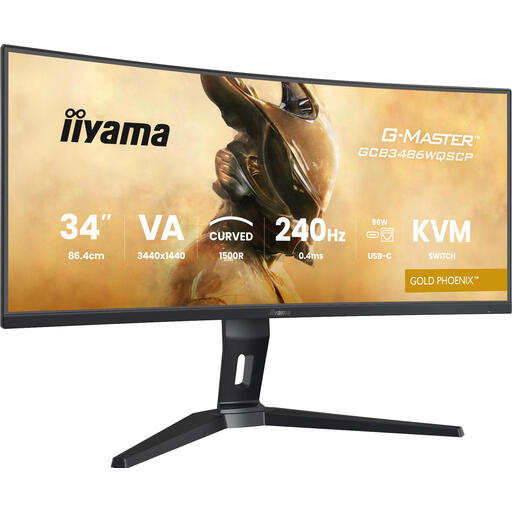
iiyama G-MASTER GCB3486WQSCP-B1 Gold Phoenix, curved 240Hz monitor
A good fit if you’re looking for a curved gaming monitor with a high stated refresh rate and want to use design windows alongside your game. Check that your game supports the screen’s aspect ratio.
240 Hz; 0.4 ms response time; KVM switch.
View at Joybuy
Frequently asked questions
Will every game fill an ultrawide screen without black bars?
No, don’t assume it will. Check whether your specific PC game supports the 21:9 or 32:9 aspect ratio. A wider panel doesn’t automatically mean the game will show a wider view. Tweakers recommends checking support for each game.
How do you set the stated maximum refresh rate?
First check which combination of resolution, port and cable is supported. Then select the corresponding refresh rate in your PC’s display settings. For example, MSI lists a maximum of 180 Hz over DisplayPort and 100 Hz over HDMI for the MAG 342CQR E2, both at 3440 × 1440; your game also needs to deliver enough frames.
What should you do if fixed menus leave visible marks on an LG OLED monitor?
Follow the instructions for your exact model. LG says the 34GS95QE-B may show temporary image retention after taskbars or game menus have been visible for a long time, and provides instructions for pixel cleaning. The settings menu may vary by model.
Are you entitled to a cooling-off period and a legal guarantee when buying a monitor online in the Netherlands?
For a standard online purchase, you generally have a legal cooling-off period of up to 14 days after delivery; check whether a legal exception applies. ACM ConsuWijzer also explains that you’re entitled to a product that does what you could reasonably expect it to do. If a product is faulty, the seller is responsible for providing an appropriate solution; the legal guarantee doesn’t have a fixed two-year period for every monitor.
Which energy label applies to a monitor in the Netherlands?
The European Commission states that computer monitors are covered by the rules for electronic displays and have an energy label graded from A to G. Compare the label and the model information, including HDR power consumption, for the version you’re buying; the energy rating doesn’t tell you how well a monitor displays games.


