Creating 2D tilesets alone doesn’t automatically call for a powerful gaming GPU: Aseprite supports tilesets in tilemaps, while the requirements of your other software and the size of your projects may vary. Start by choosing a clear screen, the right ports and a workspace you can adjust. If you also work on more demanding 3D or game projects, compare the exact configuration, check noise levels under your workload and find out which power adapter is included.
Who is this choice relevant to?
Creator in a shared workspace
You spend long periods creating 2D tilesets alongside colleagues and want to consider comfort and fan noise before opting for extra graphics power. Arboportaal also sets out workplace requirements for employees who work at a screen for extended periods.
Pixel artist who cares about the screen
You compare tiles, colours and windows in your editor and want to know the screen specifications for the exact model, rather than just those for an entire product range.
Creator who also makes games or 3D projects
Alongside tile editing, you use a game engine or 3D software and want to match your laptop to the requirements of those applications and the scale of your projects. Blender, for example, publishes its own system requirements.
What should you look for?
Mainly 2D tilesets
A good fit if: creating tiles and running simple 2D tests are your main tasks.
Consider: minimum requirements for simple projects don’t predict how your entire workflow will perform. Aseprite supports tilesets in tilemaps, and Godot Engine lists system requirements for simple projects.
Tilesets plus more demanding 3D or game projects
A good fit if: Blender or a more demanding game project is genuinely part of your work.
Consider: compare your software’s requirements with the laptop’s full configuration. More graphics power doesn’t prove that a laptop is quieter.
| Purchase concern |
What to look for when buying |
Who is it most relevant to? |
| Fan noise |
Look for noise information for the exact model under a similar workload. Noise suppression for calls doesn’t tell you how loud the fans are. |
If I work in a shared office, I want to know how much noise the laptop makes during my own tasks; fan noise is the main purchase concern for around 31% of consumers. |
| Screen and visibility |
Check the resolution, aspect ratio, reflections and stated colour gamut for the exact model. |
I want to view tiles and editor windows clearly and compare the screen details of the model I’m buying; around 25% of consumers prioritise screen quality. |
| Performance for your software |
Compare your software, project size and renderer with the published requirements. Godot Engine and Blender list requirements for their own applications. |
If I create more demanding 3D or game projects as well as tilesets, I want to choose a suitable configuration; project performance is the main purchase concern for around 19% of consumers. |
| Portability and workspace |
Check the weight, ports and included adapter. According to Arboportaal, employees who work at a screen for more than 2 hours a day must be able to use a separate monitor or keyboard when using a laptop. |
If I move between workspaces, I want to be able to connect a suitable screen and input devices; around 25% of consumers prioritise portability and workspace setup. |
Pitfalls to avoid
-
Assuming pixel art always needs a dedicated gaming GPU
Godot Engine lists minimum requirements for simple projects, while Blender has different requirements for 3D work. The tasks you actually do make a difference.
Before comparing configurations, distinguish between 2D drawing, simple game testing and more demanding 3D work.
-
Confusing call noise suppression with quiet cooling
A communications feature doesn’t measure the laptop’s fan noise.
Look for noise information about the exact model under a workload similar to your own.
-
Assuming a suitable power adapter is included
For the TUF A16 model reviewed, ASUS says that no adapter is included. The same product page mentions both a 380 W and a 240 W adapter, so don’t assume that a single wattage has been confirmed.
Before buying, get confirmation of which adapter is required for the exact model and what’s included.
You may need to source a suitable adapter separately.
-
Thinking of the built-in screen and keyboard as a complete workspace
For employees who work at a screen for more than 2 hours a day, Arboportaal says that laptop users must be able to use a separate monitor or keyboard.
Check what workspace equipment is available and, if necessary, discuss the setup with your employer. This requirement doesn’t automatically apply to every buyer.
Brands to compare
Lenovo
The LOQ 15AHP11 range could be worth comparing if you want to connect an external screen. Always check the exact model.
- Lenovo lists HDMI, USB-C with DisplayPort, two memory slots and a choice of GPUs for the range.
- Range specifications don’t prove that every model has the same configuration, colour reproduction or noise levels.
ASUS
The TUF Gaming A16 is worth comparing if you’re considering a 16:10 screen and graphics power for more demanding projects.
- For the model reviewed, ASUS lists 16 GB RAM, an RTX 5070, a resolution of 1920 × 1200 and 100% sRGB.
- ASUS says that a power adapter isn’t included with this model. This combination doesn’t automatically apply to other TUF A16 models; there’s no model-specific noise measurement to compare gaming laptops for quietness.
HP
The Victus 15-fa2602nd is a model with specific listed specifications, which you can compare with your software requirements for the screen, memory and graphics power.
- HP lists 12 GB RAM, an RTX 4050 and a 15.6-inch FHD screen for this model.
- These model specifications tell you nothing about the configuration or fan noise of other Victus models.
Joybuy laptops for more demanding projects
These Joybuy laptops are aimed at people creating tilesets alongside more demanding 3D or game projects. If you only draw in 2D, extra graphics power isn’t necessarily needed.
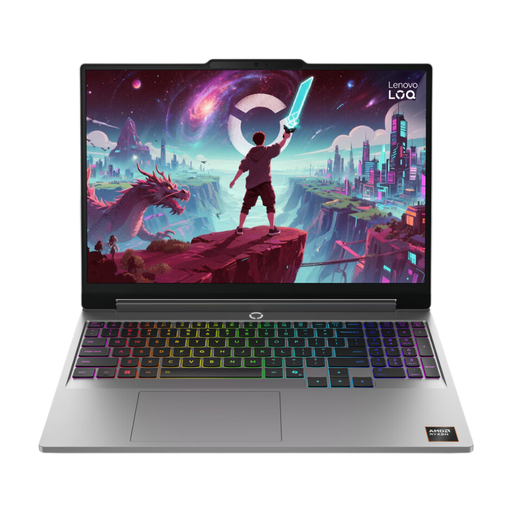 Image unavailable
Lenovo LOQ 15AHP11 – Ryzen 7 250
A model for anyone looking to run more demanding game or 3D projects as well as create tilesets.
The product name lists an RTX 5070, 16 GB memory, a 512 GB SSD and a QWERTY keyboard.
View at Joybuy
 Image unavailable
Thunderobot 16 – i7-14700HX, RTX 5070
This configuration is for anyone working on more demanding game or 3D projects as well as tile editing.
The product name lists 32 GB memory, a 1 TB SSD and a 16-inch IPS screen with a resolution of 2560 × 1600.
View at Joybuy
 Image unavailable
Lenovo Legion 5 15AHP11 – RTX 5060, Belgian AZERTY
An option to compare if you work on more demanding projects as well as tilesets; check the keyboard layout before buying.
The product name lists a 15.3-inch WQXGA OLED screen, 16 GB DDR5 memory, a 512 GB SSD and an RTX 5060.
View at Joybuy
 Image unavailable
MSI Stealth 16 AI+ B3WF-011NL
This model is aimed at anyone working on more demanding projects as well as tilesets, with the screen also a consideration.
The product name lists an Intel Core Ultra 9 386H, RTX 5060, 16 GB DDR5 memory and a 16-inch QHD+ OLED screen.
View at Joybuy
 Image unavailable
MSI Cyborg A15 AI B2HWGKG-248NL
A configuration to compare if you work on more demanding game or 3D projects as well as drawing in 2D.
The product name lists a 15.6-inch Full HD screen with a 144 Hz refresh rate, a Ryzen 9 270, RTX 5070, 16 GB DDR5 memory and a 512 GB SSD.
View at Joybuy
Frequently asked questions
Do you need a dedicated gaming graphics card to create 2D tilesets?
Not necessarily. Aseprite supports tilesets in tilemaps, and Godot Engine lists minimum configurations for simple projects. Also check the requirements of your other software and the size of your project.
How do you set up a laptop in a shared office workspace?
Check which connections are available and tailor your workspace to how you work. According to Arboportaal, employees who work at a screen for more than 2 hours a day must be able to use a separate monitor or keyboard when using a laptop; discuss the setup with your employer. This isn’t a general product specification that applies to every buyer.
How do you save or export tiles for a game project?
According to Aseprite, you can save editable work as an .aseprite file and use the export functions to output files. Then check which file format and settings your game project requires.
Who is responsible if a product is faulty or you make a consumer purchase online?
According to the Dutch government, under the legal guarantee the seller is responsible for resolving the issue, not the manufacturer. For distance sales, the seller must inform consumers about the cooling-off period, which is usually 14 days. Check whether these rules apply to your purchase, for example if you’re buying as a business.


