For 2D icons on a small desk, the laptop’s dimensions, a usable screen and enough memory for your drawing software matter more than a powerful GPU. If you also create 3D assets or play demanding games, compare the exact GPU configuration, memory and the space available for the laptop and ventilation. A larger built-in screen is worth considering if it fits on your desk and you want to work without an external monitor.
Who is this choice relevant to?
2D icon creator with a small desk
Mostly creates 2D assets and needs to fit a laptop, input device and clear space for ventilation on the same small work surface. MSI lists the dimensions of the Cyborg 14 A13V, while ASUS explains why unobstructed airflow matters.
Icon creator who also uses 3D
May create 3D objects or renders as well, so needs to choose memory and GPU capacity to suit their projects. Blender Foundation outlines its recommended specifications; ASUS lists different memory and GPU configurations for G14 models.
Creator who works on the laptop screen
Doesn’t want to set up an external monitor and is weighing up a larger built-in screen against the desk space the laptop will take up. ASUS and HP list screen specifications for specific configurations.
What should you look for?
Compact laptop for 2D work
Choose this if: you mainly draw in 2D and need to fit your laptop, input device and ventilation space on a small desk.
The trade-off: a smaller built-in screen gives you less screen space to work with. As a specific example, MSI lists the Cyborg 14 A13V chassis as measuring 314,7 × 233,5 mm.
Compact laptop for 3D and gaming
Choose this if: you model or render objects as well as working in 2D, and need to keep your laptop compact.
The trade-off: Blender Foundation recommends 32 GB RAM and 8 GB VRAM for Windows; these are recommendations, not universal minimum requirements. Check the exact configuration and whether the memory can be upgraded. ASUS states that the RAM in the G14 models reviewed cannot be upgraded.
Laptop with a larger built-in screen
Choose this if: you want to work on the laptop screen and have enough room for the larger chassis.
The trade-off: HP lists a 16-inch screen with a resolution of 2560 × 1600 pixels and 32 GB RAM for the OMEN 16-ap0614nd. HP listed this specific model as unavailable; that doesn’t apply to other OMEN models.
| Buying concern |
What to look for |
Who is this important to? |
| Will the laptop fit on my desk with room for ventilation? |
Measure the available width and depth, and keep the vents clear. |
If my desk is small, I want room for my input device and to keep the vents clear. Around 36% of consumers say desk space is their main buying concern. |
| Is the configuration suitable for 2D drawing? |
Check the requirements of your drawing software and the RAM and screen specifications of the exact model. |
If I mainly create 2D icons, I want a laptop that suits my software and has a suitable built-in screen. Around 28% of consumers prioritise 2D work and software requirements. |
| Is the laptop suitable for 3D work? |
Check the full model code, RAM, VRAM and whether the memory can be upgraded. |
If I also want to create 3D assets or play more demanding games, I want to compare the capacity of the exact model. Around 18% of consumers say 3D or gaming is their main buying concern. |
| Is the built-in screen large enough? |
Compare the screen size and resolution, and measure the chassis too—not just the diagonal. |
If I want to work without an external monitor, I need enough room on the built-in screen, while still making sure the laptop fits on my desk. Around 18% of consumers prioritise screen space. |
Common buying mistakes
-
Assuming all G14 models are the same laptop
ASUS lists different RAM and GPU configurations under the G14 name. The model name alone doesn’t tell you which configuration you’ll get.
Check the full model code and the specifications for that exact model, especially if you also use Blender.
The memory in the ASUS ROG Zephyrus G14 GA403UM-QS024W is onboard and cannot be upgraded by the user. If you choose the wrong amount of RAM for this model, you can’t put it right later with a memory upgrade.
-
Measuring only the screen diagonal
The chassis, your input device and the space around the vents all affect whether the setup will fit on a small desk.
Measure your available workspace and compare it with the dimensions of the exact model. Don’t block the vents.
-
Assuming a similar name means it’s the same model
Models within the same product family can have different model codes and specifications.
Before buying, compare the full model code and configuration on the product page with the model you’re looking for.
Brands worth comparing
ASUS ROG
The Zephyrus G14 is a compact model worth comparing if you’re looking for a gaming laptop for drawing and possibly 3D work.
- For the GA403UM-QS024W, ASUS lists 16 GB of non-upgradable RAM and an RTX 5060 Laptop GPU with 8 GB VRAM. Other G14 models listed have 32 GB RAM and different GPUs.
- Specifications vary by model and don’t represent measured performance for your projects.
MSI
The Cyborg 14 A13V series offers a compact example for comparing chassis size and ports.
- MSI lists chassis dimensions of 314,7 × 233,5 mm and two memory slots for the series.
- The GPU varies between A13VF and A13VE models. Check the model code and configuration of the specific laptop.
HP OMEN
The OMEN 16-ap0614nd is an example worth comparing if you’re looking for a larger built-in screen.
- For this model, HP lists a 16-inch screen with a resolution of 2560 × 1600 pixels, 32 GB RAM and an RTX 5070 with 8 GB VRAM.
- HP listed this specific model as unavailable. Its specifications and availability don’t automatically apply to other OMEN models.
Joybuy laptops for a small desk or a larger screen
This selection includes gaming laptops with 14, 15,6 and 16-inch screens. Compare the dimensions of the exact model with your workspace, and choose based on how you use it for 2D or 3D work.
 Image unavailable
ASUS ROG Zephyrus G14 GA403UM-QS024W
Suited to anyone looking for a compact laptop for 2D work and wanting to check that its listed dimensions fit their desk.
14-inch OLED screen, 2880 × 1800 pixels, Ryzen 9 270, RTX 5060, 16 GB RAM and 1 TB SSD. The listed chassis dimensions are 311 × 220 mm. The RAM is onboard and cannot be upgraded by the user.
Joybuy
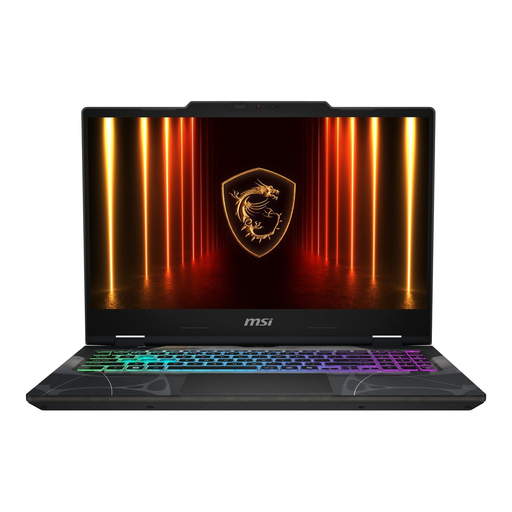 Image unavailable
MSI Cyborg 15 B2RWEKG-085NL
Worth comparing if you’re looking for a screen larger than 14 inches for 2D work and have enough room on your desk.
15,6-inch Full HD IPS screen, Intel Core 5 210H, 16 GB DDR5 memory, 512 GB SSD and NVIDIA GeForce RTX 5050. The power adapter must be purchased separately.
Joybuy
 Image unavailable
ASUS ROG Strix G16 G614FR-S5252W
Suited to anyone looking for more built-in screen space who can fit the full laptop on their desk.
16-inch screen with a resolution of 2560 × 1600 pixels, Ryzen 9 9955HX, RTX 5070 Ti with 12 GB graphics memory, 16 GB RAM and 1 TB SSD. The power adapter must be purchased separately.
Joybuy
 Image unavailable
ASUS V16 FX3607VP-RP061W
A 16-inch option worth comparing if you want to work on the built-in screen and have room for a larger laptop.
16-inch WUXGA screen with a resolution of 1920 × 1200 pixels and a 16:10 aspect ratio, Intel Core 7 240H, NVIDIA GeForce RTX 5070 with 8 GB, 16 GB DDR5 and 1 TB SSD. This model has a Dutch QWERTY keyboard.
Joybuy
 Image unavailable
Thunderobot Radiant S16
Suited to anyone looking for a larger built-in screen who has enough space to fit the laptop on their desk.
16-inch QHD+ screen with a 240 Hz refresh rate, AMD Ryzen 7 7745HX, 16 GB DDR5 RAM, 1 TB SSD and NVIDIA GeForce RTX 5060.
Joybuy
Frequently asked questions
Do I need a powerful graphics card to create a 2D inventory icon?
Not just because you’re creating an icon. First, check the requirements of your software and projects. For Photoshop on Windows, Adobe recommends 16 GB RAM or more and a screen resolution of 1920 × 1080 or higher. Blender’s recommended specifications are only relevant if you use that 3D software.
How should I set up a gaming laptop on a small desk?
Measure the space for both your laptop and input device, and keep the vents clear. ASUS warns that restricted airflow can lead to cooling and performance issues; the amount of clearance needed varies by laptop.
What can I do if a laptop I bought online isn’t right for me or develops a fault?
For many distance purchases from a business, consumers have a 14-day cooling-off period; check the applicable terms and conditions. The Dutch government also states that there is no fixed statutory warranty period in the Netherlands and that the seller is responsible for resolving issues if a product is faulty. A manufacturer’s warranty is in addition to this.


