
A builder who values quiet
You play while someone else is resting in the room, so you need to weigh fan noise against playability. ASUS describes a quiet mode on supported laptops that can limit the available power.


Start by matching your choice to the game and deciding how much fan noise is acceptable in your shared bedroom. Large Factorio factories put different demands on a system than the more graphically demanding Satisfactory. Then compare performance in any quiet mode, the laptop’s size and the full specification. A quiet mode may limit the available CPU and GPU power.
You play while someone else is resting in the room, so you need to weigh fan noise against playability. ASUS describes a quiet mode on supported laptops that can limit the available power.
You create extensive production lines and want your laptop to handle the simulation workload of your chosen game. Factorio explains how large factories can hit an updates-per-second limit; Satisfactory’s published system requirements are also worth considering.
You share a bedroom and have limited room for your laptop and power supply. Compare the dimensions of the specific configuration, not just the screen size.
First decide which factory-building game you want to play and what matters most in your shared room: noise, game workload, purchase cost or space.
| Purchase consideration | What to check before buying | Who is this important to? |
|---|---|---|
| Fan noise | Check whether the exact configuration has a quiet mode, and compare noise and gaming performance under the same game workload and operating mode. | If you play while someone else is resting, low fan noise may matter more than extra power. Around 33% of consumers prioritise quiet operation. |
| Performance for your chosen game | Choose your game first, then compare its current requirements with the processor, GPU, memory, operating system and storage of the complete configuration. | If you build large factories or play a more graphically demanding 3D game, you’ll want to match the configuration to that workload. Around 27% of consumers give gaming performance top priority. |
| Purchase cost | Compare full model codes and check what’s included, such as a compatible charger, before comparing configurations. | If you don’t want to pay for capacity or accessories your chosen game doesn’t require, the configuration can make all the difference. Around 20% of consumers prioritise purchase cost. |
| Desk space | Measure the space available and check the dimensions of the exact laptop. Leave room for the charger and ventilation, too. | On a small desk, a more compact device that fits may be more important than a larger screen. Around 20% of consumers prioritise the space available to work. |
ASUS explains that quiet mode can limit CPU and GPU power on supported laptops. This doesn’t automatically tell you how noisy another configuration will be or how well it will perform.
Compare noise and gaming performance in the same operating mode and under a similar game workload.
The developer of Factorio explains that large factories can hit an updates-per-second limit. A more powerful graphics card alone won’t tell you how a specific laptop will perform.
First decide which game you’ll be playing, then compare the processor and memory as well. That way, you won’t end up paying mainly for graphics power that doesn’t address your biggest bottleneck.
A model range may include different screen, memory and storage configurations. What’s included in the box can also vary between offers.
Check the full model code, the specifications of that configuration and which accessories are included.
The LOQ range includes configurations with different screen, memory and GPU specifications, so compare the full model code.
The TUF Gaming A16 (2025) is worth comparing if upgradeability and adjustable operating modes matter to you.
The OMEN 17-db1630nd is an example of a configuration with a larger screen, provided you have enough space for it.
The Cyborg 15 B13WFKG-806NL is a specific 15.6-inch configuration to compare with other sizes.
The Nitro V 16 AI gives you another product range to compare for screen size and configurations.
The Joybuy models below are gaming laptops to compare if you’re also considering a more graphically demanding 3D factory-building game. Check the requirements of your chosen game, as well as the size and specification of each model.
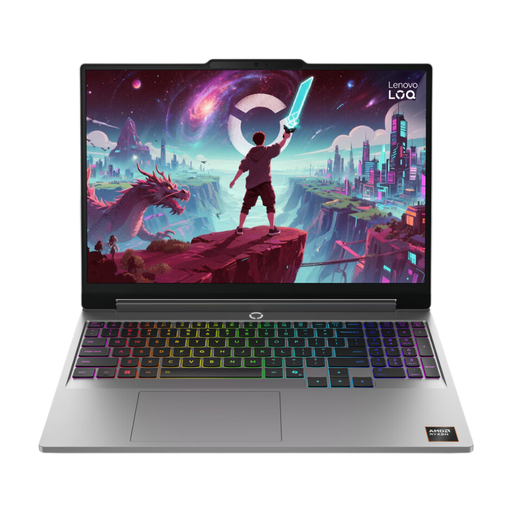 No image available
Compare this configuration with the requirements of the 3D factory-building game you want to play and the space available on your desk.
Ryzen 7 250 processor; RTX 5070; 16 GB memory; 512 GB SSD; 15.3-inch screen.
 No image available
Compare the specification listed with the requirements of your chosen game. The model number helps you distinguish this configuration from other variants.
Ryzen 9 9955HX processor; RTX 5070 Ti; 16 GB memory; 1 TB SSD; 16-inch screen.
The power adapter must be purchased separately.
 No image available
Compare the larger screen with the space available on your desk and the requirements of your chosen factory-building game.
Ryzen 9 8940HX processor; RTX 5060; 16 GB memory; 1 TB SSD; 18-inch screen.
The power adapter must be purchased separately.
 No image available
Check that this configuration meets the requirements of your chosen game and fits the space you have available.
Intel Core 7 240H processor; NVIDIA GeForce RTX 5070 8GB; 16GB DDR5; 1TB SSD; WUXGA 144Hz; Windows 11 Home; Dutch QWERTY.
 No image available
Compare the specification with the requirements of your chosen game and check that the 16-inch size suits your workspace.
i7-14700HX processor; RTX 5070; 32 GB memory; 1 TB SSD; 16-inch screen with 2560 × 1600 resolution; 240Hz.
Not necessarily. The developer of Factorio explains that large factories can hit an updates-per-second limit. Satisfactory also publishes system requirements for things such as the GPU, memory and operating system. Choose based on the game you actually want to play, not just the ‘gaming laptop’ label.
Quiet mode doesn’t guarantee that a laptop will be quiet enough while you’re playing. ASUS explains that on supported models, this mode limits CPU and GPU power. So assess noise and playability together under your intended game workload.
Check the dimensions and included power supply for the exact configuration. Keep the ventilation openings clear during use, and follow the manual for your chosen model when cleaning and maintaining it.
For a standard online consumer purchase, you generally have a legal cooling-off period of up to 14 days after delivery; ACM lists some exceptions. If a product is faulty, the seller is responsible for the statutory guarantee. Before ordering, check the applicable returns policy and who the seller is.
On 4 September 2026, the European Commission described a study in preparation for a possible energy label for computers, not a general laptop label that has already been introduced. So don’t compare assumed mandatory laptop label classes; if you’re checking energy consumption figures, ask what test conditions were used.