A gaming laptop with a built-in screen suits a training space with few spare power sockets, as you won’t need a separately powered monitor. However, check what’s included with the laptop: ASUS says the adapter is not included with the specified TUF Gaming 16 model, while HP lists an adapter for the specified OMEN laptop. A desktop may be more suitable if expandability is your priority, but it also requires a separate monitor and an additional socket. NVIDIA describes total system latency as a chain involving the input device, PC and display.
Who is this choice relevant to?
Training with one spare socket
You’re looking for a PC with a screen that doesn’t need a separately powered monitor. If you’re considering a laptop, check exactly what’s in the box too: ASUS says the required adapter isn’t included with the specified model sold in the Netherlands.
As little input lag as possible
You’re comparing the whole journey from a mouse click to the image appearing on screen, and considering the display and PC as one setup. NVIDIA distinguishes between input-device, PC and display latency.
A permanent setup with room to upgrade
You have space and sockets for a monitor, and want to be able to upgrade components later. Testaankoop describes expandability as a practical difference to consider when choosing a desktop.
What should you look for when buying?
| What to consider |
What to check before buying |
Who should pay extra attention? |
| Power sockets required |
Check whether the adapter is included and count the sockets needed for every device in your setup. |
If I have few spare sockets, I don’t want to have to connect a separate monitor. Around 36% of consumers prioritise the number of power sockets required. |
| Input-to-display latency |
Check the display’s refresh rate and connections. If latency is a deciding factor, look for measurements of the complete setup. |
If timing is central to my training, I want to assess the mouse, PC and display together. Around 29% of consumers prioritise system latency. |
| Expandability |
For the exact desktop model, check which components can be replaced or upgraded later, and factor the monitor into your setup. |
If I want to upgrade my system later, I’m happy to have a separate monitor and make space for it. Around 21% of consumers prioritise expandability. |
| Power consumption during use |
Compare measured power consumption for complete setups under similar workloads, including a separate monitor. |
If I want to take power consumption into account, I want to compare the PC and display together under similar conditions. Around 14% of consumers prioritise power consumption. |
Common buying mistakes
-
Assuming every gaming laptop comes with a suitable adapter
ASUS says the required 180 W adapter is not included with the specified TUF Gaming 16 model.
Before buying, check the exact model code, what’s in the box and the required adapter wattage.
You may need to source a suitable adapter separately for this model.
-
Taking a screen’s refresh rate as the total response time
Latency between an input and the image appearing on screen also includes the input device and PC, not just the display.
Use the stated refresh rate as one point of comparison. If latency is a deciding factor, look for measurements of the complete setup you plan to use.
-
Choosing a desktop without factoring in a monitor and safe power connections
A desktop needs a separate monitor, which you’ll need to choose. The Dutch Fire Service advises against connecting extension leads to one another, and recommends checking cables and extension leads for damage.
Before you buy, make a list of the PC, monitor, other devices and available sockets.
With a desktop, you’ll also need to source a suitable separate monitor.
Brands to consider
ASUS
The specified TUF Gaming 16 model sold in the Netherlands is a laptop with a built-in 144 Hz WUXGA screen.
- The screen specification can help you compare different models.
- ASUS says the required 180 W power adapter is not included. The screen specification is not a measurement of total system latency.
HP
The specified OMEN models include both a laptop with a built-in screen and a desktop, so the setup differs depending on the form factor.
- HP lists an included 280 W adapter and a 240 Hz screen for the OMEN 16-ap1678nd laptop.
- The OMEN TG03-0630nd is a desktop, so you’ll also need to choose a separate monitor. These stated specifications are not independent measurements of total latency.
Lenovo
Lenovo offers Legion PCs and laptops as different product types.
- The range includes both types of setup.
- For the specific model, check the screen, included power supply and connections. The product type alone says nothing about total latency.
MSI
The specified Thin 15 B13VE specifications give examples of features to compare when choosing a laptop, such as the screen, adapter and connections.
- For the specified B13VE, MSI lists a 144 Hz screen and a 120 W adapter.
- These details apply to the specified model and do not confirm the version sold in Dutch shops or its measured latency. Don’t assume they apply to other MSI models without checking.
Gaming laptops at Joybuy
This Joybuy selection features gaming laptops with built-in screens, for a training setup without a separate monitor. Check the screen specifications for each model, and whether the required power adapter is included. Other devices in your setup may still need sockets.
 No image available
ASUS ROG Strix G16 G614FR-S5252W, 16-inch, RTX 5070 Ti
The built-in screen suits a training space without a separate monitor.
Screen: 16-inch, 240 Hz. According to the product description, the power adapter must be bought separately. A 240 Hz refresh rate is not a measurement of total system latency.
Specifications: Ryzen 9 9955HX, 16 GB memory, 1 TB SSD, QWERTY keyboard.
View at Joybuy
 No image available
ASUS ROG Strix G18 G814PM-S9012W, 18-inch, RTX 5060
The built-in screen means you don’t need to connect a separate monitor for a display.
Screen: 18-inch, WQXGA, 240 Hz. According to the product description, the charger is sold separately. The screen refresh rate doesn’t measure total system latency.
Specifications: Ryzen 9 8940HX, 16 GB memory, 1 TB SSD, QWERTY keyboard.
View at Joybuy
 No image available
MSI Titan 18 HX AI A2XWJG-492NL, RTX 5090
The built-in screen suits a setup where you don’t want to connect a separate monitor.
Screen: 18-inch UHD+ Mini LED, 120 Hz. This screen specification is not a measurement of total system latency.
Specifications: Intel Core Ultra 9 285HX, 64 GB DDR5, 6 TB SSD, Windows 11 Pro.
View at Joybuy
 No image available
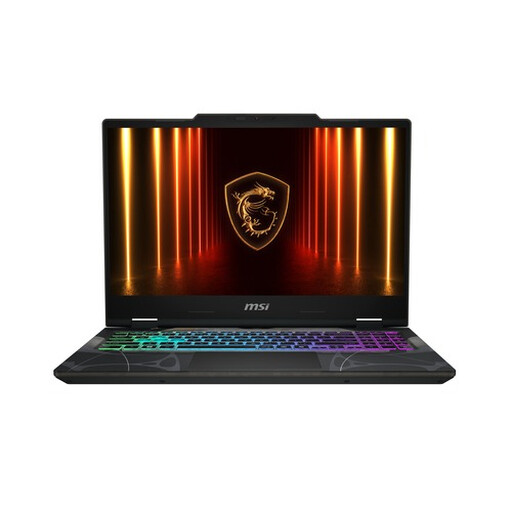
MSI Cyborg 15 B13WEKG-1223NL, RTX 5050
The built-in screen can remove the need for a separate monitor in your training setup.
Screen: 15.6-inch FHD, 144 Hz. The stated refresh rate does not measure total system latency.
Specifications: Intel Core i5-13420H, 16 GB DDR5, 512 GB SSD, Windows 11 Home.
View at Joybuy
 No image available
MSI Cyborg A15 AI B2HWGKG-248NL, RTX 5070
The built-in screen is worth considering for a setup without a separate monitor.
Screen: 15.6-inch Full HD, 144 Hz. A screen specification alone doesn’t show the total latency from input to display.
Specifications: AMD Ryzen 9 270, 16 GB DDR5, 512 GB SSD, Windows 11 Home.
View at Joybuy
Frequently asked questions
Can I run a complete training setup with one spare power socket?
A laptop with a built-in screen doesn’t need a separately powered monitor, but check the adapter and the other devices in your setup. ASUS says the required adapter isn’t included with the specified TUF Gaming 16 model; HP lists an included adapter for the OMEN 16-ap1678nd laptop.
Can I connect extension leads to each other to get more sockets?
No. The Dutch Fire Service advises against connecting extension leads to one another, and recommends checking cables and extension leads for damage. Count the sockets you’ll need for your complete setup in advance.
How do I assess latency in a reaction-time training setup?
Consider the whole chain: input device, PC and display. A stated screen specification on its own is not a measurement of total latency. If latency is a deciding factor, compare measurements for the complete configuration you plan to use.
Is the manufacturer’s warranty the only protection when buying in the Netherlands?
No. According to ACM ConsuWijzer, you have statutory rights in addition to any seller’s or manufacturer’s warranty. The rights that apply in a particular situation depend on the circumstances.
Does every gaming PC have an energy label like a monitor?
Don’t assume so: the European Commission describes ecodesign rules for computers and separate energy labelling rules for computer monitors. A monitor’s energy label doesn’t measure the power consumption of your complete gaming setup.


