
Player with no spare socket
Wants to play long squad matches without a separate power adapter for the keyboard. Weighs USB power against a rechargeable wireless model and checks how many USB ports are available.


Choose a wired USB keyboard if you have a suitable free port and don’t want to recharge a battery during long matches. A 2.4GHz wireless receiver gets rid of the cable on your desk, but still uses a USB port and means keeping an eye on the battery. For competitive gaming, USB and a receiver are generally considered more suitable than Bluetooth.
Wants to play long squad matches without a separate power adapter for the keyboard. Weighs USB power against a rechargeable wireless model and checks how many USB ports are available.
Prioritises input response and chooses a connection and switch settings to suit competitive play, without assuming that Bluetooth convenience automatically means a gaming-ready response.
Wants room to move the mouse, but checks that the arrow keys, function keys and other commands used in-game are still accessible on the chosen layout.
Start by checking how many USB ports are available and whether you’re happy to manage a battery. Then compare the gaming connection and key layout with the commands you use in-game.
Choose this if: you have a suitable free USB port and don’t want to recharge a battery during long matches.
Bear in mind: the cable and the USB port it uses; a wired connection won’t solve a shortage of USB ports.
Choose this if: you want to clear the cable from your desk and have a USB port available for the receiver.
Bear in mind: the battery and charging method; check whether the receiver is included with the exact version you’re considering.
Choose this if: switching between compatible devices matters more to you than having the most suitable connection for competitive gaming.
Bear in mind: RTINGS.com generally describes Bluetooth as less suitable for gaming than USB or a wireless receiver. Bluetooth also needs power from a rechargeable or replaceable battery.
| What to consider | What should you check? | Who is this important for? |
|---|---|---|
| Playing without an extra socket | Count your free USB ports. For wireless models, check the charging method, battery status and whether you can play while charging. | If I want to play a long match without stopping to recharge, I look at the power supply and available ports; around 36% of consumers put uninterrupted play without battery worries first. |
| Input response during combat | Compare the supported connections. Only check for adjustable actuation or Rapid Trigger if you want to use these features. | Players who prioritise quick, repeated inputs in-game also consider the connection and any adjustment options; around 29% of consumers put input response first. |
| Mouse space and access to keys | Compare your game bindings and communication keys with the exact layout and keyboard language. | If I want more room for my mouse without losing access to keys I use, I compare the layout with my commands; around 21% of consumers start with size and access to keys. |
| Simplicity and key feel | Check whether the model has membrane, mechanical or magnetic switches, and whether the features you want require software. | Consumers mainly looking for a straightforward connection and a key feel that suits them don’t need to make extra connection or adjustment features their starting point; around 14% put simplicity first when buying. |
A wireless keyboard needs a rechargeable or replaceable battery. A USB receiver may also take up a port.
Before buying, check the connection mode, receiver, battery status and charging method for the exact version.
Recharging takes time, and a 2.4GHz receiver uses a USB port.
A smaller keyboard can free up space for your mouse, but may change how easily you can access the number pad, function row or arrow keys.
Compare your game bindings and communication keys with the exact model’s layout before choosing TKL, 75% or smaller.
Products in the same range can have different connections or switches; the range name alone doesn’t tell you which version it is.
Compare the full model name, switch variant and connection specifications with the manufacturer’s product information.
The G915 X LIGHTSPEED TKL is worth considering if you’re looking for a TKL layout and a choice of connection modes.
The K65 PLUS WIRELESS TACTILE is a compact option for anyone considering the switch type and key feel.
The GXT 833 Thado is a wired TKL model for players who don’t want to manage a battery.
The Apex Pro TKL Wireless Gen 3 is worth considering if you want to play wirelessly and are looking for adjustable magnetic switches.
The wired Wooting 80HE is worth comparing if adjustable input matters more to you than wireless play.
These models include wired USB options and wireless 2.4 GHz options, with compact layouts to suit different needs around battery management, input and mouse space.
 Image unavailable
Suited to players who want a wired connection without battery management and are looking for a compact layout.
The manual specifies a USB-A connection; the model has a TKL layout and membrane switches.
The cable uses a USB port and remains on your desk.
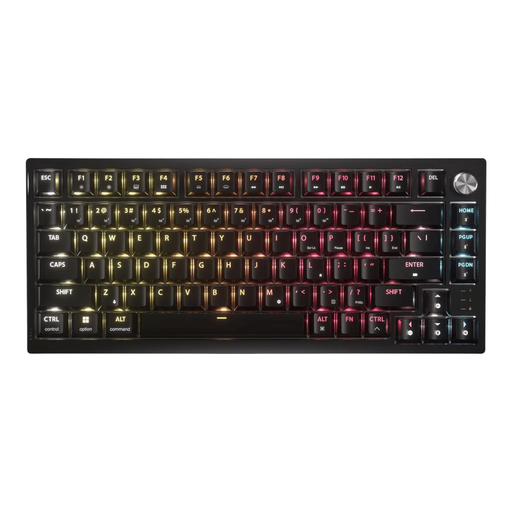 Image unavailable
Suited to players who want to combine a compact layout with wireless play via a receiver.
The product information lists 2.4 GHz, a wired USB option, a rechargeable battery and MLX Fusion Tactile switches.
The product description states up to 266 hours of use with RGB on. Actual battery life may vary depending on use and lighting. For wired play, the mode switch must be set to ‘Off’.
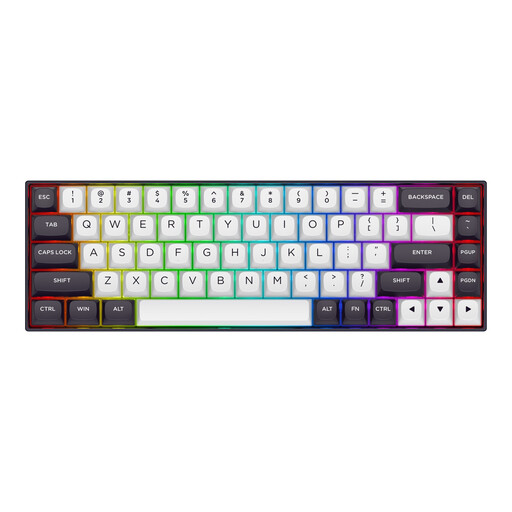 Image unavailable
Suited to players looking for a compact wired keyboard with adjustable input.
The product information lists magnetic switches, adjustable actuation and Rapid Trigger.
A detachable Type-C cable is listed for wired use, which requires a USB connection.
 Image unavailable
Suited to players who want wireless play while keeping the arrow keys and function row in a compact layout.
The product information lists 2.4 GHz, wired USB-C use, an 8000 mAh battery and up to 55 hours of use with RGB on.
Wireless use requires battery management; the stated battery life depends on the conditions of use.
 Image unavailable
Suited to players looking for a compact wired layout with adjustable input.
The product information lists 82 keys, magnetic switches and adjustable actuation.
Wired use requires a USB connection and cable.
Not if your gaming device has a suitable free USB port. The Trust manual specifies a USB-A connection for the GXT 833 Thado; check the ports on your device and the exact keyboard model.
Not while the mode switch is set to 2.4 GHz or Bluetooth: according to the Corsair manual, the keyboard remains wireless while the cable charges it. Set the switch to ‘Off’ for wired mode and check the manual for your version.
RTINGS.com generally considers USB and a wireless receiver more suitable for gaming than Bluetooth. Bluetooth is handy for switching between devices, but the buying guide describes it as a less suitable choice when gaming response is the priority; this doesn’t guarantee the performance of every model.
For distance purchases from a business, you generally have a 14-day cooling-off period in the Netherlands, subject to legal exceptions. Products must also be of satisfactory quality; according to the Dutch government, there is no fixed statutory warranty period. If a product is faulty, contact the seller.
According to the Dutch government, you can return an old electrical appliance when buying a similar new one; this also applies to online purchases by private customers. Used batteries must not go in the rubbish bin and can be taken to shops that sell batteries, among other places.