
Night-time gamer with a room-mate
You play while someone else is sleeping in the same room, so the sound of your keystrokes matters more than lighting or a high polling rate.


If your room-mate is sleeping, a keyboard with membrane or rubber-dome keys is a sensible first choice. Claims such as ‘silent’ or ‘Whisper-Quiet’ don’t guarantee that your keystrokes will be inaudible. RTINGS.com notes that mechanical and magnetic keyboards can be loud or quiet depending on their switches and construction. Next, choose a layout that keeps the keys you need for your survival game within easy reach, and don’t pay extra for adjustable actuation if you won’t use it.
You play while someone else is sleeping in the same room, so the sound of your keystrokes matters more than lighting or a high polling rate.
You want more room for your mouse while keeping the keys you need during play within easy reach.
You want to control when keys activate and weigh that setting separately against noise and ease of use.
For survival games in a shared bedroom, it makes sense to consider noise and easy-to-reach keys first; extra input settings come next.
| Priority | What to look for | Who should prioritise this? |
|---|---|---|
| Noise for your room-mate | Check the switch type and, if available, a measurement for that exact version; also consider larger keys and how you type. | If I play while my room-mate is sleeping, I mainly want keystrokes that are as unobtrusive as possible. Around 42% of consumers put quiet operation first. |
| Desk space and key access | Check which keys you use in your game and compare the physical layout with the space on your desk. | I want more room for my mouse without having to hunt for important gaming keys behind a function layer. Around 25% of consumers prioritise desk space and direct access to keys. |
| Adjustable actuation | Consider whether you really want to fine-tune actuation, and assess noise separately from that feature. | If I want to control when a key registers, I weigh that control against simplicity and noise. Around 17% of consumers prioritise adjustable input. |
| Layout and lighting | Check the key legends on the exact version and whether you can adjust the brightness. | I want a layout that suits the keys I use, and lighting I can adjust to my liking. Around 16% of consumers prioritise layout and lighting. |
Manufacturers’ descriptions aren’t directly comparable sound measurements. The case, larger keys and the way you type all make a difference too.
Where available, compare measurements for the exact version and consider how you type yourself.
A compact layout may make function keys or separate arrow keys less accessible, even though you might use them in your game.
Check your own game settings before choosing a layout; TKL keeps more keys directly accessible than even more compact layouts.
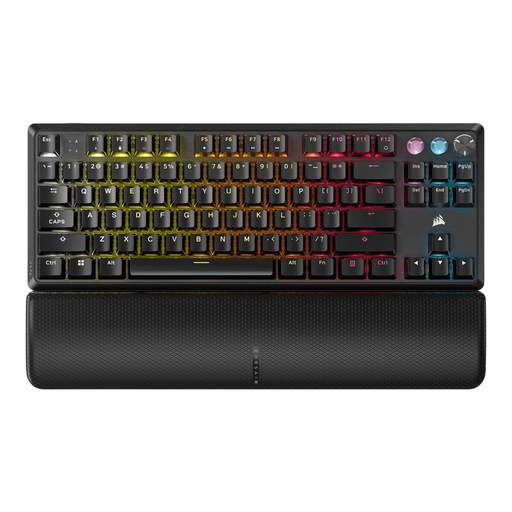
A Corsair K70 CORE TKL version may have a BE AZERTY layout. The physical key positions will then differ from those on another layout.
Check both the stated layout and the key legends on the exact version.
Your rights against the retailer don’t depend solely on the warranty period stated by the manufacturer. ACM ConsuWijzer explains that, with normal use, a product must meet what you can reasonably expect from it.
Keep your proof of purchase and contact the retailer if a problem arises during normal use.
The Apex 3 TKL is worth considering if you’re looking for a compact size without a number pad.
According to Razer, the Ornata V3 X combines quiet membrane keys with a low-profile design; make sure you distinguish this version from the Ornata V3.
The G213 Prodigy is worth considering if you’re looking for a full-size layout, media controls and adjustable lighting.
The K55 RGB PRO is worth considering if a full-size layout with dedicated macro and media keys is important to you.
The 80HE is an option if you’re interested in magnetic switches and adjustable actuation, and input control is important to you.
This selection includes compact TKL keyboards with membrane or rubber-dome features, as well as keyboards with magnetic switches and adjustable actuation. Check the layout for each model, and consider input-adjustment features separately from noise.
 No image available
The TKL layout without a number pad may suit you if you want to keep space free for your mouse.
The description specifies membrane switches, media keys and anti-ghosting for up to 10 simultaneous keystrokes.
 No image available
This model may suit you if you want to fine-tune magnetic input and are looking for a TKL layout.
The product description mentions adjustable actuation, Rapid Trigger, two layers of sound-dampening foam and pre-lubricated stabilisers. These features don’t guarantee a particular noise level. This version has a US QWERTY layout.
 No image available
The TKL layout without a number pad may suit you if you want more room for your mouse.
The product description calls the membrane switches quiet and also mentions 12-key rollover, media keys and adjustable RGB lighting. Check that the US QWERTY layout suits you.
 No image available
This compact model may suit you if you’re looking for a 68-key layout with adjustable input.
The description mentions magnetic switches, adjustable actuation and Rapid Trigger. Check that the US layout and the noise level of the exact version are suitable for your room.
 No image available
This model may suit you if you’re looking for a compact layout with adjustable actuation.
The description mentions a 75% layout with 82 keys, USB-C, adjustable actuation and five layers of noise-reducing pads. This description doesn’t guarantee how audible the keyboard will be in your room.
No. RTINGS.com notes that mechanical and magnetic keyboards can be loud or quiet depending on their switches and construction. So assess the exact version; clicky switches are less suitable if your room-mate is asleep.
Check which keys you use in your own game and make sure they’re directly accessible. On more compact layouts, some keys may be behind a function layer; a TKL layout retains a separate row of function keys.
Not necessarily. RTINGS.com notes that features like these may be less important for casual gaming. Consider them mainly if you actually want to fine-tune actuation, and assess noise separately.
For a standard online consumer purchase, you generally have a statutory cooling-off period of up to 14 days after delivery. ACM ConsuWijzer explains the exceptions and treats unpacking or trying out a product separately; check the applicable terms before using the keyboard further.
No, statutory warranty doesn’t have the same fixed two-year duration for every purchase. ACM ConsuWijzer explains that, with normal use, a product must meet what you can reasonably expect from it; if it doesn’t, the retailer is responsible for providing an appropriate solution.