
Gamer with housemates
You want to build a virtual home in the evening without the keys making a noticeable noise. Descriptions such as ‘quiet’ can help when comparing products, but they aren’t based on comparable noise measurements.


Start by considering noise, the space available on your desk and the keys you need for gaming and studying. A compact TKL membrane keyboard could be a good fit if you can do without the number pad. Some manufacturers describe their membrane keys as quiet, but this isn’t a like-for-like noise measurement. Choose a full-size keyboard if you use the number pad, or consider mechanical keys if their feel matters more to you. Always check the exact layout and connection.
You want to build a virtual home in the evening without the keys making a noticeable noise. Descriptions such as ‘quiet’ can help when comparing products, but they aren’t based on comparable noise measurements.
You want to leave room for your mouse and study materials. So, before choosing a more compact keyboard, decide whether you can do without the number pad.
You use the same keyboard for gaming and studying. The layout, connection and availability of arrow or number keys may all influence your choice.
First compare the keys and size with how you use your keyboard day to day. Then check whether the stated features and connection suit your needs.
| What to consider | What should you check? | Who should give this more thought? |
|---|---|---|
| Noise in a shared space | Check the exact switch and model type. A description such as ‘quiet’ doesn’t indicate a measured noise level. | If your housemates are nearby, you’ll want to know what to expect from the keypresses. Around 31% of consumers say noise is their main consideration. |
| Size and desk space | Measure the available space and decide whether you need direct access to the number pad, arrow keys and function row. | On a small desk, having room beside the keyboard can be important, as long as you don’t lose keys you use often. Around 25% of consumers give desk space top priority. |
| Gaming and studying | Check the key layout, which keys your game uses and whether the connection is compatible with your computer. | If you use one keyboard for gaming and coursework, you’ll want a layout and connection that work for both. Around 25% of consumers focus mainly on this combination of uses. |
| Cost and features | Compare the price of the exact variant and consider whether you really need lighting, media keys or programmability. | If you’re mainly looking for a keyboard for gaming and typing, you won’t want to pay for features you don’t use. Around 19% of consumers put purchase cost first. |
Very compact layouts may not include arrow keys or a number pad. This can be inconvenient if you need those keys for your game or studies.
First decide which keys you want to access directly, then choose between a very compact, TKL or full-size keyboard.
Some manufacturers describe their switches as quiet, but this doesn’t provide a comparable measurement of their noise levels.
Check the switch variant and, if possible, try out the sound of the version you’re considering.
Models with almost identical names can have different connections and variants. For example, the Logitech G515 TKL Wired isn’t the same version as the G515 LIGHTSPEED TKL.
Before ordering, compare the full model name, connection and key layout shown in the listing.
The K55 CORE TKL is a wired TKL membrane keyboard for anyone looking for a more compact board with media features.
The Apex 3 TKL is a compact option that the manufacturer describes as having quiet switches.
The Ornata V3 X is a full-size membrane keyboard for anyone who wants to keep the number pad.
The GXT 833 Thado is a TKL option with lighting and media keys as standard features.
The wired G515 TKL is a mechanical low-profile alternative for anyone who values mechanical switches and programmability.
This selection is aimed at compact gaming setups, with both a TKL membrane model and compact mechanical keyboards. Check the layout, connection and availability of the keys you need for each variant.
 No image available
A good fit if you’re looking for a compact TKL layout and can do without the number pad.
The product description mentions quiet membrane keys; this isn’t a noise measurement. It also lists a wired USB connection, media keys and lighting.
 No image available
A compact mechanical option for anyone who wants to save desk space.
The product description lists 68 keys, magnetic switches, Rapid Trigger and a wired Type-C connection.
 No image available
A good fit if you’re looking for a compact layout with arrow and function keys.
The product description lists an 82-key, 75% layout, magnetic switches, adjustable actuation and USB-C.
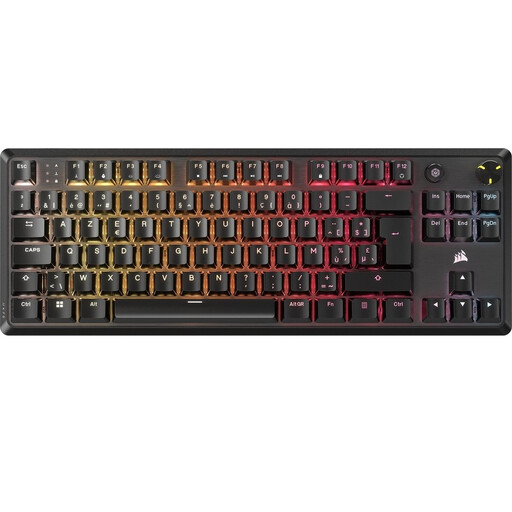 No image available
A TKL mechanical model for anyone looking for mechanical switches and happy to do without the number pad.
The product description lists linear mechanical switches, a wired USB-C connection and sound-dampening layers. The stated layout is BE AZERTY.
 No image available
A compact option for anyone who wants to keep the arrow and function keys.
The product information lists 82 keys and wired, Bluetooth and 2.4 GHz connections. It also mentions a TFT screen and sound-absorbing foam. The stated compatibility includes Windows and macOS.
Only if you can manage without direct access to the arrow keys and number pad. Check which keys and key combinations your game uses. A TKL keyboard omits the number pad but keeps more keys readily accessible.
That depends on the model and the features you want to use. Corsair lists a wired USB-A connection and iCUE for software features on the K55 CORE TKL. Check that your computer has the required port and that its operating system supports those features.
Follow the care instructions for your specific model and disconnect or switch off the keyboard first. Logitech gives this advice for its keyboards; don’t assume that the keys on every membrane keyboard can be removed.
According to ACM ConsuWijzer, online purchases generally come with a statutory 14-day cooling-off period from delivery, subject to exceptions. Faulty products are also covered by the legal guarantee: according to the Dutch government, the seller must provide a solution, and the Netherlands has no fixed statutory guarantee period.
No. Wireless equipment must comply with the relevant EU rules before it is placed on the market. For radio equipment, the European Commission lists requirements including safety and electromagnetic compatibility. According to Your Europe, CE marking is only required for products covered by EU rules that make it compulsory; it isn’t an independent quality assessment of a specific version.