
Players who prioritise quietness
You practise while someone else in the room is resting and want to keep the sound of your key presses down. Compare the switch type and construction, not just the ‘gaming’ label.


If the sound of your key presses is what bothers your roommate most, start by looking at a membrane or rubber-dome keyboard. If you need more room to aim, compact TKL and 75% layouts are worth comparing. A dampened mechanical keyboard may suit you if key feel and switch choice matter more, but dampening alone doesn’t prove it will be quiet enough for your room. Always check the exact switch variant, layout and keys you need.
You practise while someone else in the room is resting and want to keep the sound of your key presses down. Compare the switch type and construction, not just the ‘gaming’ label.
You practise routes and aim on a small desk and need room for bigger mouse movements. Make sure you also consider the keys you need.
You want a tactile or linear feel for repeated movements and assess the sound of that specific version separately.
First decide how much noise is acceptable in your shared room. Then check whether the layout gives you enough mouse space without removing keys you use.
| What to consider | What should you check? | Who is this important to? |
|---|---|---|
| Key-press noise | Check the exact switch type and construction. Where possible, compare sound measurements for the same version. | If I practise while my roommate is resting, I mainly want to avoid disturbing them with repeated key presses. Around 36% of consumers put noise first. |
| Mouse space and layout | Compare TKL and 75% layouts, and check where the arrow, function and navigation keys are. | At a small desk, I want room to aim without losing the keys I normally use. Around 29% of consumers prioritise mouse space. |
| Key feel | Check whether the version has tactile or linear switches and whether they can be swapped. | When practising movements repeatedly, I want a key feel that suits my preference. Around 21% of consumers put key feel first. |
| Connection and features | Decide whether a wired connection is enough and check which keys and connection options the version you choose has. | If I want a simple connection and don’t need extra connection modes, I prefer to keep things practical. Around 14% of consumers prioritise a straightforward purchase. |
Switch type, stabilisers and construction all affect the sound. Even a dampened mechanical keyboard can still be audible.
Check the exact switch version and compare sound measurements only when they were taken under similar conditions.
More room for your mouse can mean a different key layout or fewer keys available.
Before buying, check the function row, arrow keys and navigation keys, and compare them with the keys you use.
In the Netherlands, there is no fixed two-year period for the statutory guarantee. According to ACM ConsuWijzer, what you can reasonably expect from the product is what matters.
Keep your proof of purchase and contact the seller if a fault is covered by the statutory guarantee.
The Apex 3 TKL is worth considering if you want a compact TKL layout and quieter membrane keys.
The BlackWidow V4 75% is a compact mechanical option for those who value switch choice and a 75% layout.
The G515 LIGHTSPEED TKL may suit you if a compact mechanical design and a choice of connection options are important.
The wired GXT 833 Thado is a compact TKL option if you want a cable connection.
The Alloy Core RGB shows that a gaming keyboard with membrane keys is also available in a larger layout.
This Joybuy selection includes wired compact membrane and mechanical gaming keyboards for anyone who wants to factor in mouse space, key feel or a simpler connection while practising.
 No image available
The wired TKL layout may suit you if you want to keep space free beside the keyboard for mouse movements.
The product description specifies membrane keys and anti-ghosting for up to 10 simultaneous key presses.
 No image available
This may suit you if you’re looking for a compact wired layout and want to consider membrane keys for a shared room.
The product description mentions quiet membrane switches, 12-key rollover, a wired USB connection and four dedicated media keys. Check that the US QWERTY layout suits you.
 No image available
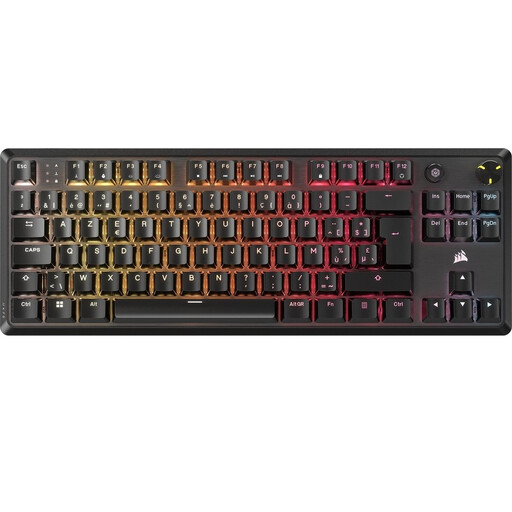
This compact mechanical version may suit you if you’re looking for a linear key feel and a dampened construction.
The product description specifies MLX Red v2 switches, two layers of sound-dampening foam and a detachable USB-C cable. The layout is BE AZERTY (BE ISO); check that it matches your preference.
 No image available
The 75% layout may suit you if you want a compact design and the option to choose a mechanical key feel.
The product description mentions linear, hot-swappable switches, PBT keycaps, a volume knob and five layers of noise-reducing material. This construction alone is not a sound measurement.
 No image available
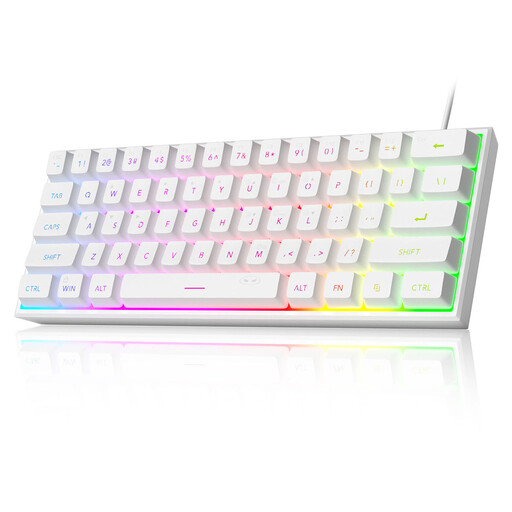
The compact 60% layout may suit you if desk space is limited and you don’t need a number pad.
The product description specifies membrane technology and RGB lighting. According to the description, the connection is not waterproof; also check that the US QWERTY layout suits you.
No. It also depends on the switches and construction. RTINGS notes that clicky switches can be loud; dampening or a manufacturer’s description such as ‘quiet’ doesn’t tell you exactly how audible the key presses will be in your room.
Before choosing a size, compare the position and availability of the keys you use. According to Razer, the Razer BlackWidow V4 75% described here has a function row and arrow keys; check the other navigation keys on each version too.
Decide whether a wired connection is enough and check that the layout matches your computer settings. Logitech specifies wired data, Bluetooth and LIGHTSPEED for the G515 LIGHTSPEED TKL; the Trust GXT 833 Thado is wired.
For an online purchase as a consumer, you generally have a statutory cooling-off period of up to 14 days after delivery, with some exceptions. ACM ConsuWijzer explains that there is no fixed two-year period for the statutory guarantee in the Netherlands: what you could reasonably expect from the product is what matters, alongside any commercial warranty.
According to the Dutch Authority for Digital Infrastructure, electrical and electronic equipment placed on the market in the Netherlands must meet the applicable European requirements and carry the required CE marking. Applicable requirements for radio equipment also apply to wireless keyboards. A CE marking doesn’t tell you how quiet a keyboard is.