
Gamers with few spare power sockets
You want to play without an extra charging adapter or interruptions to charge. Check that your computer has a suitable spare port.


A wired USB keyboard is a practical choice if you have a spare port on your computer: it doesn’t need a separate power adapter or battery. Choose wireless if avoiding a cable is your priority, but remember that you’ll need to charge it. Also consider the keys you use in your game: a compact model saves space, but may put some functions behind key combinations.
You want to play without an extra charging adapter or interruptions to charge. Check that your computer has a suitable spare port.
You want quick access to important game commands, so you’re looking at the physical keys, function row and options for assigning keys.
You want to leave room for your mouse, but should also check which functions on a compact keyboard are only available through a key combination.
Start with the connection and the keys you use in your game, then choose a size that suits your desk. A wireless connection keeps a cable off your desk, but you’ll still need to charge the keyboard.
A good fit if: your computer has a suitable spare USB port and you don’t want to charge a battery.
Bear in mind: the cable limits where you can place the keyboard; check the port and cable route.
A good fit if: you want to avoid a cable on your desk and charging fits into your routine.
Bear in mind: Bluetooth support, whether a USB receiver is included, and how the specific version is charged.
A good fit if: you need a TKL or 75% layout to save space without giving up all your readily accessible keys; 60% may work if you’re happy using key combinations.
Bear in mind: a 60% layout omits, among other things, a separate function row and number pad.
| What to consider | What should you check? | Who is this for? |
|---|---|---|
| Connection and charging | Check for spare computer ports, Bluetooth support, whether a USB receiver is included, and how the specific version is charged. | I don’t want to charge my keyboard or add another adapter to my setup; around 36% of consumers prioritise connection and charging. |
| Commands at your fingertips | Note your most important game keys and check the function row, arrow keys, any macro keys and whether configuration software is required. | I want quick access to frequently used game commands; around 29% of consumers prioritise direct access to commands. |
| Size and desk space | Compare the physical layout with the keys you use in your game and check whether you need a number pad, arrow keys or function row. | I want to keep space next to my keyboard on a small desk; desk space is the main concern for around 21% of consumers. |
| Sound and typing feel | Check the switch type on the specific version and, if possible, how the keys feel and sound to you. | I want to consider noise and typing feel in a shared space; around 14% of consumers say these are their main priorities. |
Wireless can keep a cable off your desk, but a keyboard with a battery still needs charging.
First check which ports are available on your computer, then check how the version you’re considering is charged.
If there’s no function row or navigation key, a game command may require an extra key combination.
Compare the physical layout with the commands you use and see if the secondary controls work for you.
Size, layout and switch type can vary between versions.
Check the full product name and the specifications of the version you want to buy.
The G915 X LIGHTSPEED range is worth considering if you want to compare wireless and wired use.
The wired Apex 3 TKL is an option to compare if you’re looking for a more compact size and quieter keys.
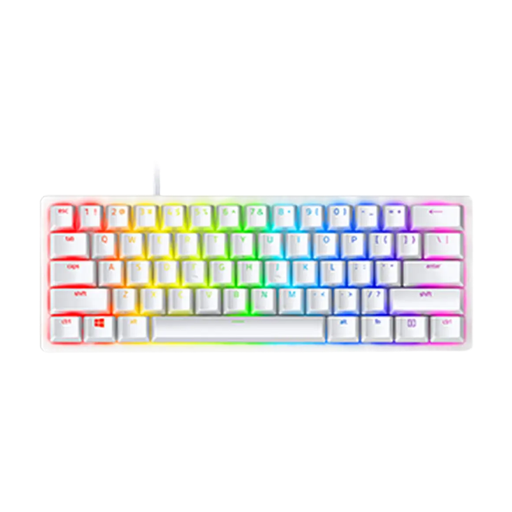
The Huntsman Mini is worth considering if a very compact layout matters more to you than separate function and number keys.
The wired K55 RGB PRO and K65 PLUS WIRELESS offer different connections and layouts to compare.
The wired Alloy Core RGB is worth considering if you’re looking at quiet membrane keys and media controls.
These wired options suit anyone who doesn’t want to charge a keyboard battery. Layouts range from compact 60% and 75% models to TKL.
 No image available
The wired TKL layout is a good fit if you want to leave room for your mouse.
QWERTY layout; listed for PC and PS5. The description mentions media keys, a gaming mode that disables the Windows key, and anti-ghosting for up to 10 simultaneous keys.
 No image available
The wired 75% layout is designed for anyone who wants to save space while keeping physical function keys.
Listed features include 82 keys, USB-C, magnetic switches, adjustable actuation and a volume knob.
 No image available
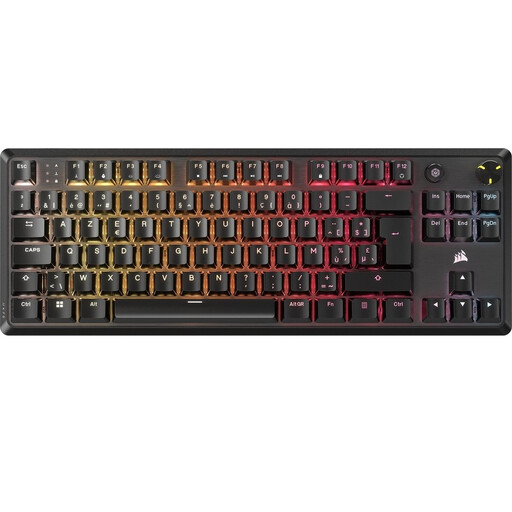
The wired TKL layout may suit you if you want a more compact keyboard without losing the function keys.
Mechanical gaming keyboard with a BE AZERTY layout and MLX Red switches. The description mentions five saved profiles, programmable macros and media controls.
 No image available
The wired 75% layout may suit you if you want room for your mouse while keeping the function keys.
83 keys and USB-C. The product name lists hot-swappable linear switches, white lighting and compatibility with PC, Windows and Mac.
 No image available
The wired 60% layout is a good fit if desk space is important and you’re happy to use secondary key combinations.
Linear optical switches and a USB connection are listed. There’s no separate function row, home cluster or number pad; functions are available through secondary keys.
Usually not: you connect a wired USB keyboard to a suitable port on your computer. Check that the port is free and that the cable will reach your computer.
That depends on your game’s key settings and whether you’re happy to use secondary keys. Razer says that functions on the Huntsman Mini are accessed through key combinations, rather than a separate function row.
Check whether the specific version can store macros on the keyboard. Corsair says the K55 RGB PRO can store macros in hardware mode when iCUE isn’t running; also check whether your game allows the inputs you want to use.
No, a wireless model with a battery needs charging. Before buying, check how the version is charged and whether you can use the keyboard in wired mode while it charges.