
Player sitting away from the PC
You’re designing on a big screen from somewhere other than your computer and want the freedom to move around. Connection and charging needs will both affect your choice.


If you play away from your computer, start with a wireless keyboard and test the connection where you plan to play. If you’re at a desk, a wired model may be all you need. Then choose a layout with the keys your game uses and enough room for your mouse. Programmable shortcuts are only worth considering if you’ll actually use them.
You’re designing on a big screen from somewhere other than your computer and want the freedom to move around. Connection and charging needs will both affect your choice.
You repeatedly use commands while building or navigating, and want quick access to the keys your game actually supports.
You sit close to your computer and are mainly choosing between room for your mouse, a full-size layout and a typing feel that suits the space you play in.
Start with the distance from your computer and the type of connection. Then decide which keys you need and how much room you want to leave for your keyboard and mouse.
| What to consider | What to check | Who should pay particular attention? |
|---|---|---|
| Connection where you play | Check that your computer supports your chosen receiver or Bluetooth, and test the connection where you play. Also check how the keyboard is charged. | If I’m not sitting next to my computer, I want to play without a cable and know the connection works where I’m sitting. Around 33% of consumers prioritise a connection that works from their playing position. |
| Frequently used commands | Check the game’s key controls and any macro rules. Make sure the configuration software is compatible with your computer. | If you often use the same supported commands, you’ll want to call them up quickly without extra keys you never use. Around 25% of consumers give quick access to shortcuts top priority. |
| Layout and mouse space | Compare the arrow, function and number keys you need with the layout, and measure the space available for your keyboard and mouse. | If I want arrow keys within easy reach and need room for my mouse, the layout has to balance both. Around 25% of consumers prioritise layout and mouse space. |
| Noise and typing feel | Check the specific switch or key type and, if possible, try the typing feel for yourself. If you use the keyboard for long periods, support your arms and change position regularly. | In a shared space, typing feel may matter more than extra gaming features. I want to know what type of keys I’m actually getting. Around 17% of consumers prioritise noise and typing feel. |
A description of how a keyboard feels to type on doesn’t prove that it has mechanical switches. SteelSeries describes the Apex 3 TKL as having a mechanical feel, while Corsair lists rubber dome switches for the K55 RGB PRO.
Check the switch type on the exact model, and choose based on the typing feel you want rather than the wording of a description alone.
A smaller keyboard may leave out keys you want close at hand for navigating or building. TKL layouts omit the number pad.
Compare your game’s key controls with the physical layout before choosing a narrower model.
The Joybuy listing for the Corsair K55 RGB PRO - US QWERTY stated that this model was out of stock. A listing doesn’t necessarily mean you can order that version.
Check availability and the exact version when placing your order.
The G915 X range includes a full-size wireless model with dedicated macro keys, as well as a more compact wireless TKL version.
The Apex 3 TKL is a wired option for anyone who wants more room for their mouse and a typing feel the manufacturer describes as quiet.
The K55 RGB PRO is designed for a wired setup, with dedicated macro and media keys.
The BlackWidow V4 Tenkeyless HyperSpeed combines a wireless TKL layout with hot-swappable mechanical switches.
This selection includes wired TKL models and keyboards with both wired and wireless connection options, in layouts ranging from TKL to 98%. Compare the layout, the mouse space you want and the connection type with your game and computer setup.
 No image available
A wired TKL option if your computer is nearby and you want to leave plenty of room for your mouse.
Wired USB connection; TKL layout without a number pad; four dedicated media keys; membrane keys described as quiet.
 No image available
A 75% layout with several connection options if you want a narrower keyboard and the freedom to play wirelessly.
Mechanical; 75% layout; wired, Bluetooth and 2.4 GHz; QWERTY US; Reaper switches; Gradient Grey with side-printed keycaps.
 No image available
A 98% layout with three connection options if you want to keep more keys and switch between wireless and wired use.
Mechanical; hot-swappable; volume knob and TFT display; 10000mAh battery; wired, Bluetooth and 2.4G; RGB lighting.
 No image available
A 75% layout with arrow and function keys if you want to leave room for your mouse while keeping navigation keys close at hand.
Mechanical; wired, Bluetooth and 2.4G; hot-swappable; volume knob; RGB lighting; 8000mAh battery.
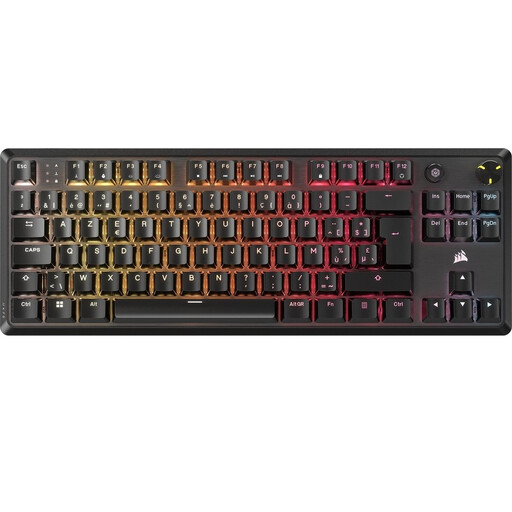 No image available
A wired TKL option if you want a more compact layout and use keyboard profiles with macros.
Mechanical, with linear MLX Red v2 switches; BE AZERTY; detachable USB-C cable; saved profiles with macros and programmable media dial.
No. Whether a cable is practical depends on where your computer is and where you play. Wireless gives you more freedom to move around, but means charging the keyboard and relying on a working connection. With a wired model, you’re limited by the cable length.
Not necessarily: check which commands the specific game supports or allows. According to Logitech and Corsair respectively, the full-size G915 X and the K55 RGB PRO have dedicated programmable keys.
Make sure your arms are supported and take breaks from staying in the same position for too long. The Dutch Arboportaal discusses repetitive actions and static strain when working at a screen; this doesn’t prove that any one keyboard prevents discomfort.
For a consumer purchase in the Netherlands, the seller is responsible for the statutory guarantee. If the keyboard doesn’t perform as you could reasonably expect under normal use, you may be entitled to a free solution such as repair or replacement. ACM ConsuWijzer states that there is no fixed statutory guarantee period that applies to every keyboard.
For a standard keyboard bought online from a business, consumers in the Netherlands generally have a statutory cooling-off period of up to 14 days after delivery. ACM ConsuWijzer explains this period; also check the statutory exceptions that may apply to your purchase.