
Student with a small desk
You switch between design work and gaming, and want room to move your mouse without losing sight of the work keys you need.


Start with the space on your desk and the shortcuts you need: a TKL or 75% layout generally keeps more keys directly accessible than a 60% board, which can free up more space. Then choose based on the feel and sound of the exact version. Check the layout, connection and included components too.
You switch between design work and gaming, and want room to move your mouse without losing sight of the work keys you need.
You sometimes type or game while others are in the room, so you want to think carefully about the feel and sound of the version you choose.
You want to access frequently used commands directly or through programmable keys, and may be open to a larger board or some configuration work.
First, measure the space available on your desk and check which design and gaming keys you need to access directly. Then compare the sound and feel of the specific version.
| What to consider | What to look for | Who is this important for? |
|---|---|---|
| Desk space and keys | Measure your desk and check whether you need direct access to the arrow keys, function row and navigation keys. | When I’m designing and gaming at a small desk, I want room for my mouse without losing essential work keys. Around 26% of consumers prioritise desk space and accessible keys. |
| Sound of the version | Check the switch type and construction; if possible, try the keyboard in a similar setting to how you’ll use it. | In a shared room, I want to be able to type or game without the sound of the keys unnecessarily disturbing others. Around 26% of consumers consider sound their main priority. |
| Shortcuts | Make a note of the commands you use most often and check the key layout, configuration method and computer compatibility. | If I often use the same design or gaming commands, I want to access them quickly. Around 21% of consumers prioritise shortcuts. |
| Features you need | Decide which keys, layout and connection you need before comparing versions. | I don’t want to pay for features that don’t suit the way I work. Around 16% of consumers focus mainly on the balance between the features they need and the cost. |
| Gaming input | Check whether a specialist input feature is actually useful for the games you play. | If a specific adjustable gaming feature matters to me, I want to weigh it against the size, sound and work keys. Around 11% of consumers prioritise specialist gaming input. |
A 60% layout has no dedicated function row or navigation cluster, so you may need to use secondary functions for some commands.
Write down the commands you use most and check how to access them on 60%, 75% and TKL layouts.
Switch types and construction vary between models and versions. A manufacturer’s description isn’t a measurement of how the keyboard will sound in your room.
Check the full model name and exact switch type, especially if you share your room.
The Keychron V1 Max is also available as a barebone version, which comes without switches and keycaps.
Before buying, check which components are included with the version you’ve chosen.
The Apex 3 TKL is a compact option if you want more room for your mouse and a keystroke designed to be quieter.
The V1 Max combines a 75% layout with customisable mechanical switches and a choice of connection options.
The Huntsman Mini is a 60% option if you want to keep the amount of desk space it takes up to a minimum.
The K55 RGB PRO has dedicated macro keys, while the K70 CORE TKL is another option with mechanical switches and a TKL layout.
The G915 X LIGHTSPEED is a full-size wireless mechanical keyboard with programmable keys.
The Alloy Core RGB is a membrane option if you’re looking for standard keys and gaming features.
This selection covers compact keyboards for gaming and work, from TKL and 75% layouts to a 68-key layout.
 No image available
The TKL layout omits the number pad and may suit you if you want extra room to move your mouse.
Membrane keys, media keys and RGB lighting; PC/PS5; QWERTY; anti-ghosting for up to 10 simultaneous key presses.
 No image available
The 75% layout is an option if you want a compact board with more keys within easy reach than a 60% layout offers.
US QWERTY; tri-mode connection via cable, Bluetooth or 2.4 GHz; Reaper switches.
 No image available
The 68-key layout is designed for anyone wanting to save space on a small desk and use a specific adjustable gaming input feature.
Mechanical; 68 keys; adjustable actuation and Rapid Trigger; 8000 Hz polling rate; US layout.
 No image available
The 75% layout is an option if you want a compact keyboard with a function row and arrow keys.
Tri-mode connection via Bluetooth, 2.4 GHz or USB-C; hot-swap; volume knob; 8000 mAh battery; US QWERTY.
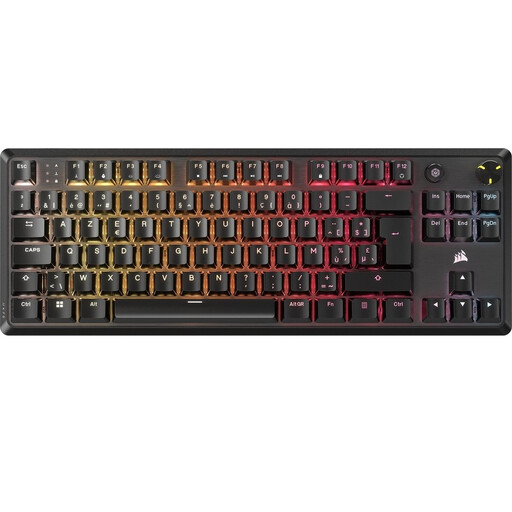 No image available
The TKL layout omits the number pad. Its described construction may be worth considering if you want mechanical keys and are also mindful of sound.
BE AZERTY; linear MLX Red switches; two layers of sound-dampening foam.
It depends on the shortcuts you use. The Huntsman Mini doesn’t have a directly accessible function row or navigation cluster, while the Apex 3 TKL omits the number pad. Check the commands you use before choosing a layout.
Check the available ports and the connection options for the exact version. Keychron describes the V1 Max as offering wired, 2.4 GHz and Bluetooth connections; refer to the instructions for the version you’ve chosen.
No. A model-specific claim about spill resistance isn’t an instruction to rinse the keyboard. Follow the manufacturer’s care instructions and disconnect the board before cleaning it as directed.
For online purchases, there is generally a statutory 14-day cooling-off period from the date of delivery, according to ACM ConsuWijzer. Exceptions may apply, so check the returns process for your purchase too.
No. According to ACM ConsuWijzer, a product must work properly for as long as you could reasonably expect it to. If it breaks too soon under normal use, the seller is responsible for providing an appropriate solution free of charge; a manufacturer’s guarantee doesn’t replace this right.