
Vandaag of morgen in huis

Kwaliteit gegarandeerd

Welkomstaanbiedingen ontgrendelen: GRATIS bezorging | Tot 80% korting | Gratis 30 dagen JoyPlus-proefperiode
Download de app
A frying pan with a lid is useful for far more than just frying an egg or a piece of meat. With the right shape and material, you can also stir-fry vegetables, reduce sauces, braise dishes and gently simmer ingredients. However, it can be difficult to see past all the marketing claims. A pan that appears versatile on paper may be too small in practice, difficult to clean or unsuitable for your hob.
A 28 cm frying pan has a generous external size, but the usable cooking surface may be smaller because of sloping sides. That is why the diameter is not the only important factor when choosing a large frying pan. Also consider the base diameter, depth and capacity.
For one or two people, 24 to 26 cm is often practical. Families may benefit from a 28 cm frying pan or a deep frying pan. Bear in mind that a larger pan is heavier and takes up more room in a cupboard or dishwasher.
A non-stick frying pan will generally remain usable for longer if you avoid metal utensils, abrasive scourers and high temperatures. Also check whether the pan is dishwasher-safe. Some models recommend hand washing, even when the manufacturer states that they are dishwasher-safe.
A ceramic frying pan usually requires extra care to avoid thermal shock. Allow the pan to cool before rinsing it and do not heat it when empty. If the coating is damaged or starts to peel, it is best to stop using the pan.
A frying pan for all hobs should be suitable for the heat source you use: induction, gas, electric, ceramic or halogen. For induction, specifically look for a magnetic base. Also check whether the pan is oven-safe and the maximum temperature it can withstand. This information varies by model and is not always clearly stated in an advert title.
A stainless steel frying pan does not have a traditional non-stick coating on the inside. According to the product description, the PURECOOK models in this selection use food-contact-safe 304 stainless steel with a three-ply construction and an aluminium heat-conducting core. This can provide more even heat distribution, but cooking with stainless steel often requires a little more attention to preheating and using enough cooking fat.
Aluminium pans are usually lighter. Many models have a non-stick coating, such as a ceramic or other type of coating. According to the product information from various brands, certain coatings are PFAS-free, PFOA-free or PTFE-free. Treat this as a product specification provided by the manufacturer; if in doubt, always check the current packaging, instructions and conformity information.
A frying pan with a glass lid allows you to keep an eye on your food without repeatedly lifting the lid. A well-fitting lid also helps with braising and simmering. Check whether the handle is heat-resistant and whether the lid has a steam vent. Use oven gloves when handling a hot pan and lid, even if the product information states that the handle is heat-insulating.
A shallow pan is suitable for frying and searing. A sauté pan with a lid or deep frying pan provides more space for sauces, pasta, stir-fries and stew-style dishes. This shape is particularly useful when cooking several ingredients at once. Do consider the weight, though: cast iron retains heat well, but can be heavy for everyday use.
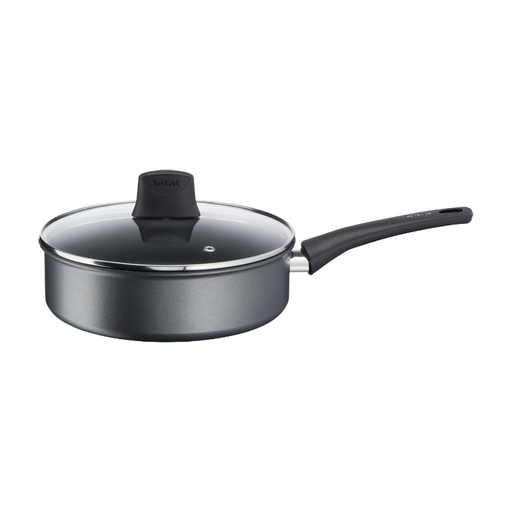
Why it suits this profile: The 24 cm size is easy to manage for smaller households and everyday cooking. According to the product information, this pan is suitable for induction, gas, electric, ceramic and halogen hobs.
The product specifications mention a glass lid, an extended induction base and an oven limit of 175 °C. This makes the main usage limitations clearer.
24 cm, glass lid, titanium-reinforced non-stick coating according to the product description, and suitable for several types of hob.
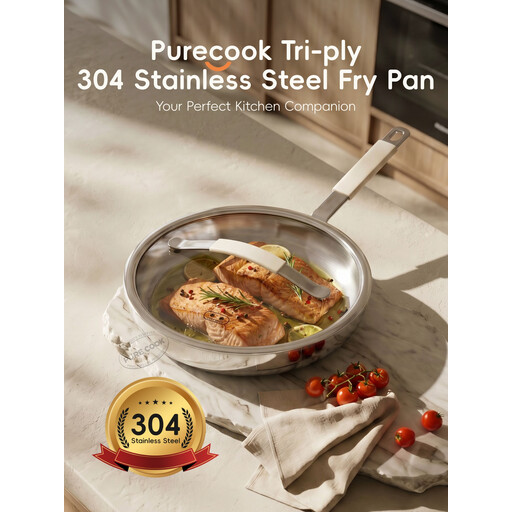
Why it suits this profile: This version is aimed at those looking for a coating-free interior and a robust three-ply construction for family meals.
According to the product information, the interior has no chemical non-stick coating. However, the manufacturer recommends soft sponges and avoiding metal utensils.
304 stainless steel, three-ply base, 26 cm cooking surface, glass lid and, according to the product description, suitable for induction and gas.
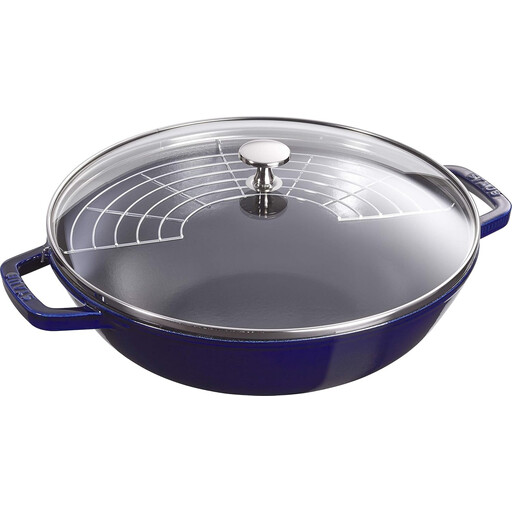
Why it suits this profile: The enamelled cast iron and 30 cm size are well suited to stir-frying, sauces and slow cooking when weight is less important.
The product information mentions a flat base for different types of hob and a glass lid. The heavy cast-iron construction does require a permanent place and careful handling.
Enamelled cast iron, 30 cm, glass lid and, according to the product description, suitable for all hobs.
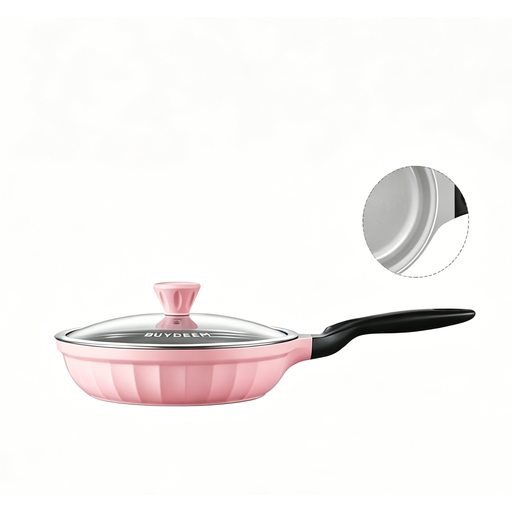
Why it suits this profile: According to the product information, this cast-aluminium pan has a ceramic coating, a capacity of 2.4 litres and room for approximately three to four portions.
According to the manufacturer, the coating is free from PFAS, PFOS and PFOA. Treat this as a product specification and follow the care instructions: hand wash, use soft utensils and do not overheat the pan when empty.
26 cm, glass lid, cast aluminium and, according to the product description, suitable for gas, electric, ceramic and induction hobs.
We have put together a complete, up-to-date list of products that fully meet these strict selection criteria and the applicable European safety regulations.
For three to four people, 26 cm and 28 cm are commonly used sizes. A 26 cm frying pan is often easier to handle. A 28 cm frying pan provides more room for vegetables, meat or one-pan dishes, but also requires more storage space and a suitably sized hob zone.
It can be, provided that the base is magnetic and the manufacturer states that it is induction-compatible. A three-ply base with an aluminium core can distribute heat more evenly, but always check the product specifications for the model you choose.
The lifespan depends on use, temperature and care. Metal utensils, heating the pan when empty and abrasive cleaning products can damage the coating more quickly. A PFAS-free frying pan or ceramic frying pan is therefore not maintenance-free: follow the manufacturer’s instructions to preserve its properties for as long as possible.
