
Vandaag of morgen in huis

Kwaliteit gegarandeerd

Welkomstaanbiedingen ontgrendelen: GRATIS bezorging | Tot 80% korting | Gratis 30 dagen JoyPlus-proefperiode
Download de app
Choosing a new frying pan seems simple, until you have to decide between aluminium, stainless steel, a ceramic non-stick coating, a wok or a sauté pan. Marketing copy often highlights terms such as “durable”, “healthy” or “scratch-resistant”, while important details are less visible. Think about the right base for induction, the actual size of the cooking surface and how the pan needs to be cleaned.
With these practical checks, you can avoid a disappointing purchase and choose a pan that suits your cooking style, household and hob.
A 28 cm frying pan does not always have a 28 cm cooking surface. This is particularly true of deeper models, woks and sauté pans, where the base may be noticeably smaller. This matters on induction: the base needs to match the cooking zone properly for even heat distribution.
For one or two people, a 22 cm or 24 cm frying pan can be practical. Families will usually benefit more from a 28 cm frying pan or a 30 cm frying pan. For larger models, also check the weight and the available space in your kitchen cupboard.
A non-stick coating reduces the need for oil and makes releasing food and cleaning easier. However, the coating depends on correct use. Sharp metal spatulas, leaving an empty pan over high heat and cooling it down suddenly can all shorten its lifespan.
A ceramic non-stick pan is an option if you are looking for a coating without PTFE. With a PFAS-free frying pan, it is wise to check the specific product information: look for clear details from the brand about the type of coating used and the recommended cleaning method.
A stainless steel pan is strong and does not have a traditional non-stick coating, but it requires more control over temperature and the amount of fat used to limit sticking. Aluminium heats up quickly and is often lighter, but a coating may be more susceptible to scratches. A three-layer pan, such as stainless steel-aluminium-stainless steel, combines heat conduction with a sturdy exterior, according to the product description.
Also consider the handle, lid, oven suitability and dishwasher information. A frying pan with a lid, for example, may also be suitable for braising, but it takes up more space.
An uncoated stainless steel frying pan is worth considering if you do not want to use a coating. In that case, preferably choose a model with a multi-layer base if even heat distribution is important.
A pan for all hobs must be explicitly suitable for the cooking surfaces you use at home: gas, induction, electric, ceramic and, where applicable, halogen. Induction requires a magnetic base. Place the pan centrally on the zone and check that the base diameter is suitable.
Not every pan can be used in the oven. Therefore, check the maximum temperature and whether the handle is oven-safe. According to the product information, the PURECOOK Tri-Ply 304 stainless steel frying pan is supplied with a glass lid and is suitable for several types of hob and oven use up to the stated temperature limit. Check the current product specifications before ordering.
A scratch-resistant frying pan does not automatically mean that every utensil is suitable. With coated pans, wooden, silicone or plastic spatulas are often a safe choice according to the care instructions. Some models are dishwasher-safe, while others must only be washed by hand.
Allow a hot pan to cool before filling it with cold water. Use a soft sponge and mild washing-up liquid. If the coating is damaged or starts to peel, replacing the pan is wiser than continuing to use it.
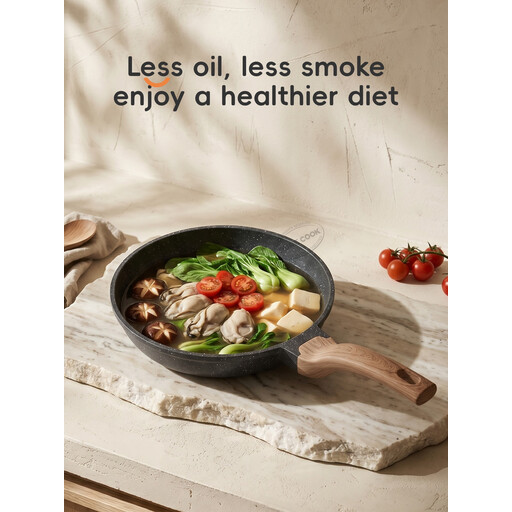
Why it suits this profile: This 24 cm aluminium pan is designed for everyday frying and light meals for one or two people. The wooden handle and low weight make it easy to handle.
The product information clearly states 24 cm, hand washing and avoiding metal spatulas. This makes the size and care requirements clear in advance.
Aluminium body, stone-effect non-stick coating and stated compatibility with induction, gas and ceramic hobs.

Why it suits this profile: This 28 cm stainless steel frying pan with three layers and a glass lid is ideal for home cooks who want to combine frying, stir-frying and braising in one pan.
The product description specifies a 304 stainless steel-aluminium-stainless steel construction, a lid and compatibility with several types of hob. This makes the material choice easy to verify.
Three layers for fast, even heating according to the product information, a glass lid and dishwasher information.
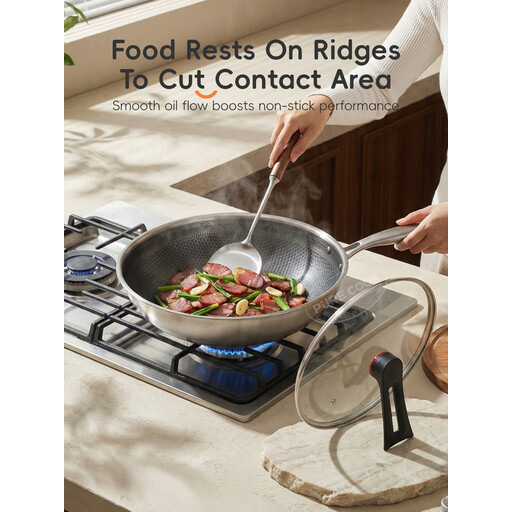
Why it suits this profile: The 32 cm wok provides plenty of room for stir-fries, casseroles and meals for several people. Its flat base is stated to be suitable for gas, induction and electric ceramic hobs.
The product information lists the diameter, hob compatibility, a honeycomb structure and hand washing as the recommended care method. This makes the usage limits clearer than a general non-stick claim.
32 cm diameter, glass lid, three layers of 304 stainless steel and a honeycomb structure which, according to the description, limits direct contact with the cooking surface.
We have put together a complete, up-to-date list of products that fully meet these strict selection criteria and the applicable European safety regulations.
For a family, 28 to 32 cm is often practical. Do check that the pan is not too large for your induction zone and that you have enough cupboard space.
Choose a model that explicitly states that it is suitable for induction. The base must be magnetic and make flat contact with the cooking zone. A pan that is suitable for gas is not automatically suitable for induction.
This depends on use, temperature and care. Do not leave an empty pan on a very high setting, avoid sharp utensils and follow the cleaning instructions. Replace the pan when the coating is visibly damaged or starts to peel.
A stainless steel frying pan may show more cooked-on residue than a coated pan, particularly if the temperature is too high or too little fat is used. Soak stuck-on residue first and use a soft sponge. The advantage is that an uncoated stainless steel interior has no non-stick layer that can wear away.
