
Vandaag of morgen in huis

Kwaliteit gegarandeerd

Welkomstaanbiedingen ontgrendelen: GRATIS bezorging | Tot 80% korting | Gratis 30 dagen JoyPlus-proefperiode
Download de app
A frying pan with a lid is useful for much more than just frying an egg or making pancakes. With the right model, you can fry, stir-fry, sauté and simmer in the same pan. However, there are clear differences between a classic frying pan, a sauté pan with a lid and a deep frying pan. You often only notice you have made the wrong choice once you start cooking: the pan is not properly suited to induction, the cooking surface is too small for the family or the non-stick coating needs more care than expected.
A pan may be suitable for gas and electric hobs but not for induction. Always check the product details. A magnetic base or an explicit reference to an induction frying pan is important. Also check whether the pan is oven-safe: a plastic, silicone or wooden handle may have limitations.
‘Non-stick’, ‘granite’ and ‘ceramic’ are not complete material descriptions. Look at:
When choosing a PFAS-free frying pan, it is sensible to check exactly what claim is being made. ‘Free from intentionally added PFOA’ is not automatically the same wording as ‘PFAS-free’. According to the product description, the manufacturer states that some ceramic models are PFAS-free. Use this information as a product specification and check the current packaging or listing.
A 28 cm frying pan will generally have a generous external diameter, but the actual cooking surface may be smaller. The height of the sides also determines whether the pan is suitable for sauces, vegetables or simmered dishes. For one or two people, 20 to 24 cm can be practical. For a household of three to four people, around 26 to 28 cm is often more convenient. A larger pan will, however, be heavier and require more storage space.
A stainless steel frying pan can withstand everyday use and usually has no non-stick coating on the inside. A multi-layer construction with, for example, an aluminium core can distribute heat more quickly and evenly. With stainless steel, cooking technique is important: heat the pan gradually and use enough fat to help prevent food from sticking.
Aluminium pans heat up quickly and are relatively light. They are often combined with a non-stick coating or a magnetic base for induction. With an aluminium pan, always check that the base is flat and suitable for your hob.
A non-stick frying pan is practical for eggs, fish, tofu and dishes requiring little oil. A coating usually calls for medium or low heat, a soft sponge and wooden, silicone or nylon utensils. Some models are dishwasher-safe, but hand washing can help extend the life of the coating.
A ceramic frying pan may, according to the product description, be PFAS- or PTFE-free. That does not mean the pan is indestructible. Avoid heating it when empty, sudden changes in temperature and abrasive cleaning products. Damage, peeling coating or a warped base are signs that you should stop using the pan.
A glass lid allows you to keep an eye on the dish without repeatedly lifting the lid. A well-fitting rim helps with simmering and reduces splashing. Check that the handle is heat-resistant and whether the lid has a steam vent. Always use oven gloves around hot metal surfaces and keep children away from the hob.
The selection below is based on the stated materials, dimensions, hob compatibility and care instructions.
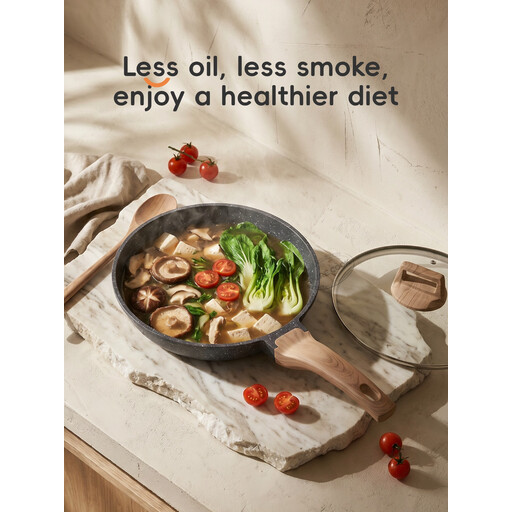
Why it suits this profile: The compact size is suitable for breakfast, an omelette, fish or a small portion of vegetables. According to the product description, the aluminium body is lightweight and designed for everyday use on induction, gas and ceramic hobs.
The product information clearly specifies hand washing, low to medium heat and avoiding metal utensils. This means you know in advance that the coating needs care.
20 cm, glass lid, wooden handle and suitable for induction, gas and ceramic hobs.
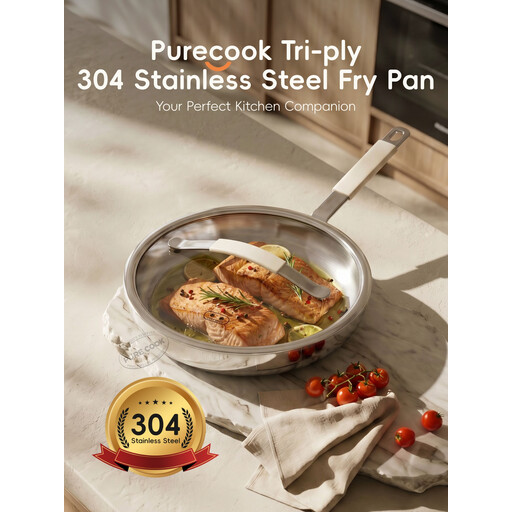
Why it suits this profile: According to the product description, this 26 cm pan is designed for three to four people. The three-layer construction with 304 stainless steel and a heat-conducting core is well suited to everyday cooking, frying and simmering.
According to the specifications, the inside has no chemical non-stick coating. The product information also states that it has a flat, evenly heating three-layer base.
304 stainless steel, 26 cm cooking surface, glass lid and, according to the listing, suitable for induction and gas.
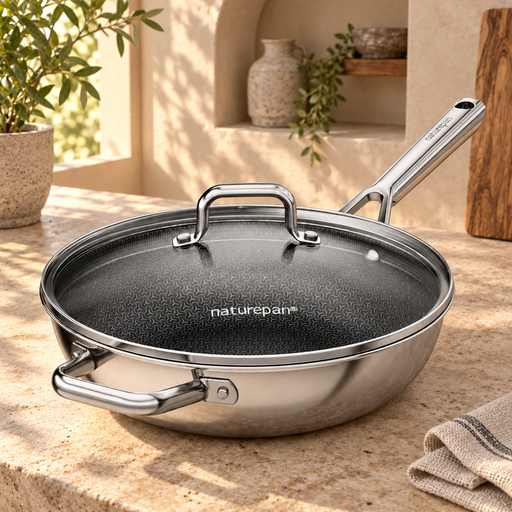
Why it suits this profile: The deep shape and 28 cm diameter provide plenty of room for stir-fries, sauces and larger portions. According to the product description, the pan is suitable for induction, gas, electric and ceramic hobs.
The specifications state a maximum oven temperature of 230 °C without the lid and recommend hand washing, low to medium heat and soft utensils.
28 cm, deep sauté shape, hybrid ceramic coating, matching lid and oven use without the lid up to 230 °C.
We have put together a complete, up-to-date list of products that fully meet these strict selection criteria and the applicable European safety regulations.
For one or two people, 20 to 24 cm is often sufficient. A frying pan for everyday cooking measuring 26 to 28 cm provides more room for several portions, vegetables or a meal with sauce. Also check the diameter of the cooking zone so that the base makes good contact with the hob.
Not quite. A deep frying pan usually has higher sides than a classic frying pan and is suitable for stir-frying and simmering. A sauté pan is often even more spacious and has a greater capacity. Names vary by brand, so focus mainly on the height, capacity and base diameter.
Do not heat the pan while empty at a high temperature, do not use metal spatulas and allow the pan to cool before washing it. Follow the manufacturer’s care instructions. With a coating-free stainless steel frying pan, different cooking techniques are required, but you do not need to protect a non-stick coating.
