
Vandaag of morgen in huis

Kwaliteit gegarandeerd

Welkomstaanbiedingen ontgrendelen: GRATIS bezorging | Tot 80% korting | Gratis 30 dagen JoyPlus-proefperiode
Download de app
A frying pan set often seems like a straightforward purchase. Yet differences in the base, coating, handle and care requirements can have a major impact on everyday use. A pan that is suitable for gas will not automatically work well on induction. And “dishwasher-safe” does not mean that a non-stick coating can withstand unlimited dishwasher cycles.
With this guide, you can compare a frying pan set based on verifiable features. That way, you can avoid paying for functions you do not use or buying a set that is not suitable for your hob.
The phrase “suitable for all heat sources” sounds clear, but always check the official product specifications. A frying pan set for induction needs a magnetic base or one specifically designed for induction cooking. An aluminium pan, for example, may conduct heat perfectly well, but without a suitable induction base it will not work on an induction hob.
Also consider the diameter of the base. A 28 cm pan may have a smaller effective base, meaning the cooking zone is not used to its full potential.
A non-stick pan set generally requires careful use. Metal spatulas, abrasive sponges and prolonged heating without ingredients can damage the coating. Even when a pan is listed as dishwasher-safe, manufacturers regularly recommend hand washing to extend the life of the coating.
Also check which type of coating is used. With a PFAS-free frying pan, the claim should come from the brand’s or manufacturer’s product information. “Ceramic” alone does not automatically mean PFAS-free.
A set of three pans is not always more practical than two individual pans. Think about your household and cooking habits:
The combination 20, 24 and 28 cm frying pans is versatile for families and couples, but it also takes up more storage space. A smaller household may sometimes have everything it needs with 22 and 28 cm pans.
Aluminium frying pans are relatively lightweight and generally heat up quickly. However, the quality of the base also determines how evenly heat is distributed. A forged aluminium pan may feel sturdier than a very thin version.
A stainless steel frying pan is often chosen because it does not have a traditional non-stick coating on the inside and offers a robust construction. Frying with stainless steel does require more technique: preheat the pan, use enough fat and choose the right moment to turn the food. A multi-layer base can help distribute heat more quickly and evenly.
Ceramic frying pans have a smooth surface and are often marketed as an alternative to traditional coatings. According to Naturepan’s product information, the ceramic coating on the set in question is free from PTFE, PFAS and PFOA. Always check such features for each model, as coatings vary between manufacturers.
Brands may also make performance claims. According to a brand’s own research, for example, a particular coating may last longer or require less oil. Treat this as information provided by the brand, not as a universal result. For everyday use, the care instructions, permitted utensils and maximum temperature are more important than the coating’s marketing name alone.
A dishwasher-safe frying pan does not automatically mean that the handle, coating and exterior will have the same lifespan under all conditions. Pay attention to the following points:
A pan that is suitable for all heat sources is also not necessarily oven-safe. Look for this feature separately.
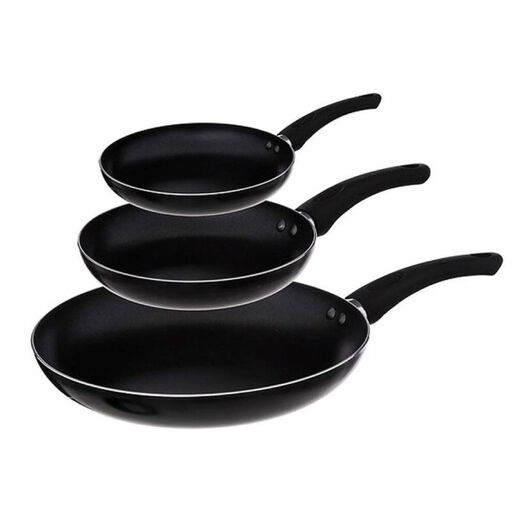
Why it suits this profile: The three popular sizes provide a practical foundation for a household preparing a variety of dishes without immediately needing an extensive cookware set.
The product information specifies aluminium, two non-stick coatings, dishwasher suitability and use on all heat sources, including induction. Hand washing is recommended for longer-lasting use.
Three sizes — 20, 24 and 28 cm; suitable for gas, electric, ceramic and induction hobs.
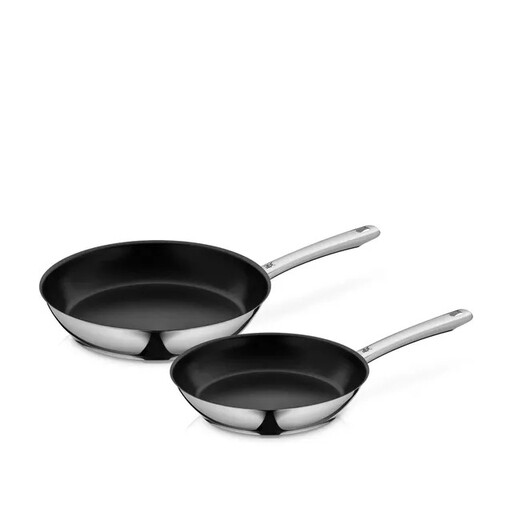
Why it suits this profile: This set is aimed at households that would rather choose two useful sizes than store several smaller pans.
The specifications list a 3-ply base, an aluminium body, a PFOA-free Croma coating and compatibility with all hobs, including induction.
24 and 28 cm sizes; multi-layer base and stay-cool handle according to the product description.
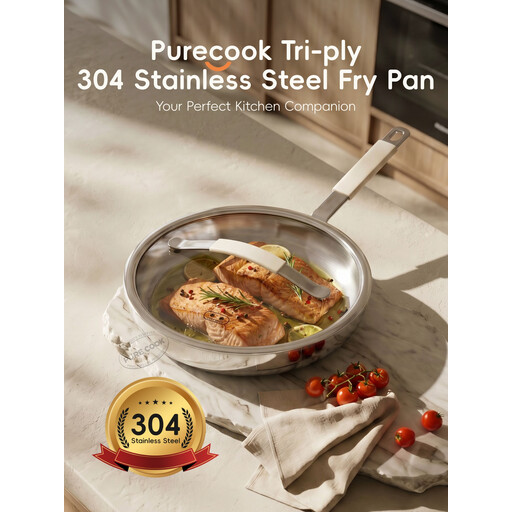
Why it suits this profile: The pan has a stainless steel construction, a lid and a 26 cm cooking surface for everyday meals for several people.
The tri-ply base is clearly specified, and according to the product information the pan is suitable for induction and gas. Use mild washing-up liquid and avoid abrasive products.
304 stainless steel, three layers for heat conduction, glass lid, and suitable for cooking, frying and braising.
We have put together a complete, up-to-date list of products that fully meet these strict selection criteria and the applicable European safety regulations.
Even a well-made frying pan set will stay in good condition for longer with the right routine:
Choose a set that explicitly states that it is suitable for induction. Also check that the base is sufficiently flat and matches the diameter of your induction zone. “Suitable for all heat sources” should appear in the product specifications; do not rely solely on the photo or product title.
Its service life depends on temperature, utensils, cleaning and frequency of use. Hand washing, moderate heat and soft spatulas help keep the coating intact for longer. There is no fixed lifespan that applies to every pan or household.
No. Ceramic refers to the type of surface, but does not automatically indicate which substances have been used in the complete coating construction. Therefore, check the manufacturer’s explicit PFAS, PTFE or PFOA information. According to the product information from Naturepan and Brabantia, specific models are offered as PFAS-free; always compare this with the exact product.
