
Vandaag of morgen in huis

Kwaliteit gegarandeerd

Welkomstaanbiedingen ontgrendelen: GRATIS bezorging | Tot 80% korting | Gratis 30 dagen JoyPlus-proefperiode
Download de app
A frying pan with a lid is useful for frying, braising, simmering and keeping food warm. However, pans vary considerably in their material, coating, size and care requirements. A pan that appears to be suitable for every hob on the packaging might be too heavy in practice, unsuitable for oven use or quick to lose its non-stick properties.
So don’t focus only on a low price or claims such as “healthy”, “durable” and “non-stick”. Check the product specifications and make sure the pan suits the way your household cooks.
An induction frying pan needs a magnetically conductive base. Aluminium on its own usually doesn’t work on induction. That’s why some aluminium pans have a separate stainless steel induction disc.
Also check whether “all hobs” really includes gas, induction, electric, ceramic and halogen. Some products only mention a selection of these heat sources.
A ceramic frying pan may be described in the product information as free from PFAS, PTFE and PFOA. However, “PFOA-free” doesn’t automatically mean “PFAS-free”. PFOA is just one substance in the wider PFAS group.
So check the exact claim. “Free from added PFOA” is not the same as “PFAS-free”. Safety and performance claims should be treated as information from the brand, not as a universal guarantee. Redchef states that its ceramic coating is free from PTFE, PFOA and PFAS. The product page remains the best source for the latest information about its composition.
A dishwasher-safe pan may technically be suitable for the dishwasher, but hand-washing is often recommended to keep the coating, colour and handle in good condition for longer. Also check:
If in doubt, follow the instructions and the latest product listing.
An aluminium non-stick frying pan is practical for cooking eggs, pancakes and fish. Use wooden, silicone or nylon utensils if the manufacturer recommends them. Metal spatulas can damage the coating.
A stainless steel frying pan without a coating takes a little more skill to use. Preheating the pan, cooking at a moderate temperature and using enough oil can help prevent food from sticking. On the other hand, stainless steel doesn’t have a non-stick coating that can wear away. A three-layer construction with an aluminium core can improve heat distribution. According to the product information, PURECOOK Tri-Ply pans consist of a layer of 304 stainless steel, an aluminium core and a second layer of steel.
A pan measuring 20 to 24 cm is often practical for one or two people. For a family, 26 to 28 cm is a common size. A 30 to 32 cm pan gives you plenty of room for stir-frying, but takes up more space and may not heat as evenly on a small induction zone.
A deep pan with a lid is often sold as a deep frying pan with a lid. It’s suitable for sauces, stews and larger portions. A wok usually has a different shape and is designed mainly for stir-frying. So don’t choose by diameter alone: consider the flat base and the size of your cooking zone too.
A glass lid lets you keep an eye on your food without losing heat every time you lift it. Look for a sturdy rim, a securely attached knob and a handle that doesn’t get unnecessarily hot.
A removable handle can be useful in a small Dutch kitchen, caravan or student room. It makes pans easier to stack, but always check that the mechanism is fully locked before lifting the pan.
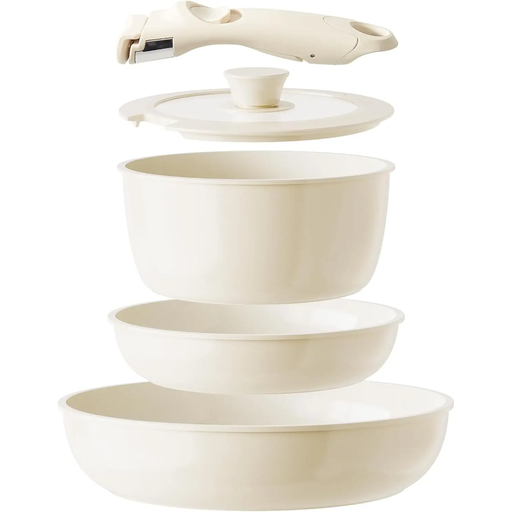
Why it suits this profile: This set includes two frying pans, a saucepan with a lid and a removable handle. It’s a practical choice if you want to cover several everyday cooking tasks with one purchase.
According to the product specifications, the set is free from PFAS, PTFE and PFOA, and is suitable for gas, electric and induction hobs. Before using it in the oven, check the instructions for the handle and maximum temperature.
Ceramic coating inside and out, stackable design, removable handle and dishwasher compatibility according to the product information.
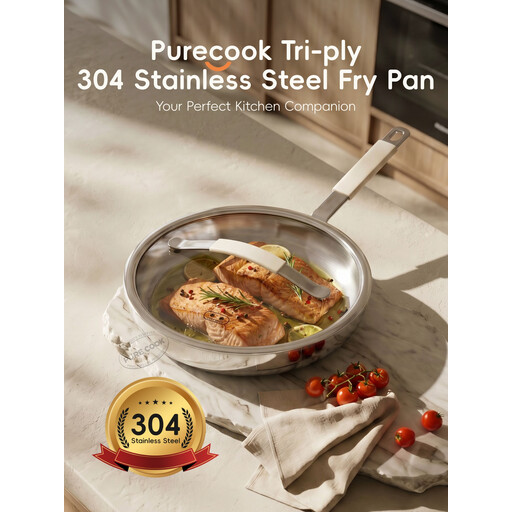
Why it suits this profile: A pan without a coating is a good choice if you value a traditional cooking surface and sturdy construction for everyday frying, searing and simmering.
The product information lists 304 stainless steel, a three-layer construction, compatibility with all the hobs mentioned and a glass lid. There’s no non-stick coating to wear away.
26 cm cooking surface, glass lid, suitable for induction and, according to the product listing, dishwasher-safe. Use the right temperature and oil to help prevent food from sticking.
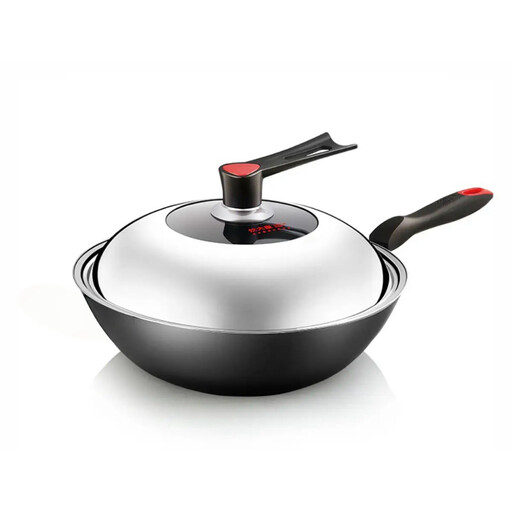
Why it suits this profile: This 30 cm wok is designed for stir-frying, searing and braising. Carbon steel is a good choice for anyone prepared to maintain their pan regularly.
The pan isn’t designed around a delicate factory-applied coating. According to the product information, its non-stick properties develop through seasoning and regular oiling. It’s designed for gas hobs and hand-washing.
30 cm size, glass lid and suitable for stir-frying, braising and steaming. Drying it straight after washing helps prevent rust.
We’ve put together a complete, up-to-date list of products that meet these strict selection criteria and the applicable European safety regulations.
A cookware set can be better value if you need several sizes. If you mainly need one pan for everyday cooking, a separate frying pan with a lid can save cupboard space that would otherwise be taken up by pieces you don’t use.
For one or two people, 20 to 24 cm is often enough. For three to four people, 26 to 28 cm is usually more practical. Choose 30 cm or larger if you do a lot of stir-frying, but check that the pan fits your cooking zone properly.
No. The pan needs a magnetic base. Look for an explicit statement that it’s compatible with induction and, ideally, check the instructions too. A pan that’s suitable for gas or electric hobs won’t necessarily work on induction.
It depends on how you use and care for it, as well as the temperature. Overheating, metal utensils, scouring pads and frequent dishwasher use can wear the coating more quickly. Stainless steel and carbon steel pans don’t have a traditional non-stick coating, but they do need a different cooking and care routine.
