
Vandaag of morgen in huis

Kwaliteit gegarandeerd

Welkomstaanbiedingen ontgrendelen: GRATIS bezorging | Tot 80% korting | Gratis 30 dagen JoyPlus-proefperiode
Download de app
Choosing a frying pan may seem straightforward, but the differences between models can be significant. A pan may appear suitable for induction on paper, while its base does not make proper contact with your cooking zone. A non-stick coating may be easy to maintain, but less suitable for high temperatures. And a large frying pan will not always sit comfortably on a smaller hob.
So pay particular attention to these three common pitfalls:
A stainless steel frying pan is suitable for frying, searing and high temperatures, but requires a different cooking technique from a coated pan. With stainless steel, it helps to preheat the pan before adding oil. Without a non-stick coating, food may initially stick more easily.
An aluminium pan generally heats up quickly and is relatively lightweight. A ceramic frying pan usually has a smooth cooking surface and is often designed for cooking with little oil. However, check whether the pan is PFAS-free according to the product information. This is explicitly stated for the Brabantia Nocta 24 cm and Brabantia Onyx 20 cm. With other products, you should not automatically assume this based on terms such as “stone effect”, “granite” or “ceramic”.
According to Tefal’s product information, the Renewal Ceramic 24 cm has a PFAS-free ceramic coating and a body made from 100% recycled aluminium. These are verifiable product specifications; they do not automatically indicate the pan’s overall environmental impact or lifespan.
The right size depends on your household and the dishes you prepare:
A deep frying pan is useful when you want to stir-fry, simmer or reduce a sauce as well as fry. A lid helps retain heat and moisture. Pay attention to the difference between a frying pan with a lid and one without: a lid makes the pan more versatile, but also makes the set heavier and more difficult to store.
Before buying, check whether the pan is suitable for your heat source:
“Dishwasher-safe frying pan” does not mean that using a dishwasher cannot affect the coating. Manufacturers often recommend hand washing to extend the product’s lifespan. When using a coated pan, do not use metal spatulas or scouring pads unless the specific product information explicitly permits this.
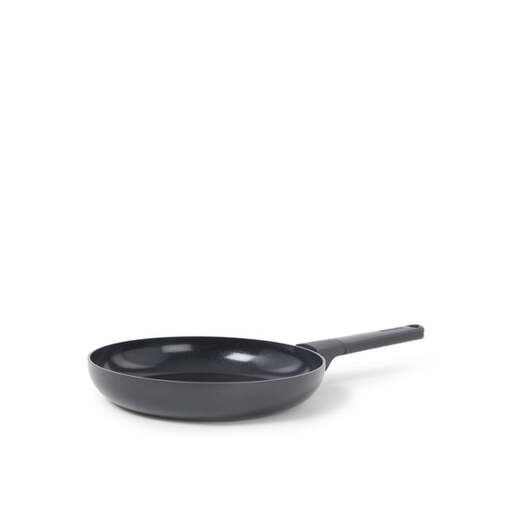
Why it suits this profile: The 24 cm size is practical for everyday portions and, according to the product information, the pan is suitable for gas, electric, ceramic and induction hobs. The ceramic coating and dishwasher-safe design help reduce maintenance.
The hob compatibility and PFAS-free claim are clearly stated in the product information. Even so, check the care instructions for the ceramic coating before use.
24 cm diameter, ceramic coating, PFAS-free according to the product information and dishwasher-safe.

Why it suits this profile: According to the product description, this 28 cm stainless steel frying pan uses a three-layer construction with 304 stainless steel and an aluminium core. The glass lid makes it suitable for frying, searing and simmering.
The specifications list the construction, lid and compatibility with gas, induction, ceramic, electric and halogen hobs. Check the current oven temperature limit before use.
28 cm size, 304 stainless steel, aluminium core, glass lid and dishwasher-safe design according to the product information.
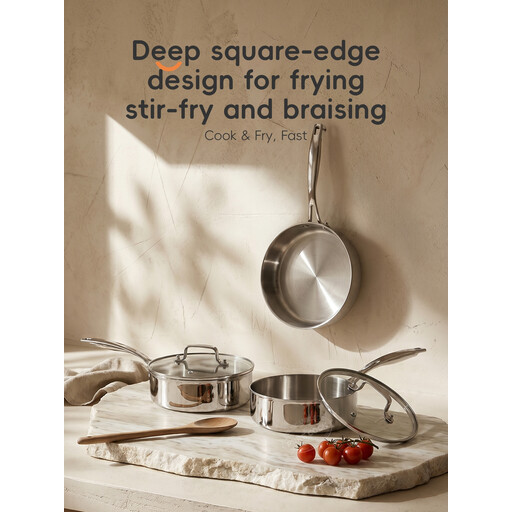
Why it suits this profile: The deep 20 cm pan is suitable for smaller households that want to fry, stir-fry, cook noodles and simmer without using a large pan.
The contents and accessories are clearly specified: a deep 20 cm pan and a glass lid. This makes it clearer what the pan is designed for.
Three-layer 304 stainless steel construction, deep straight sides, lid and suitability for induction, gas and ceramic hobs.
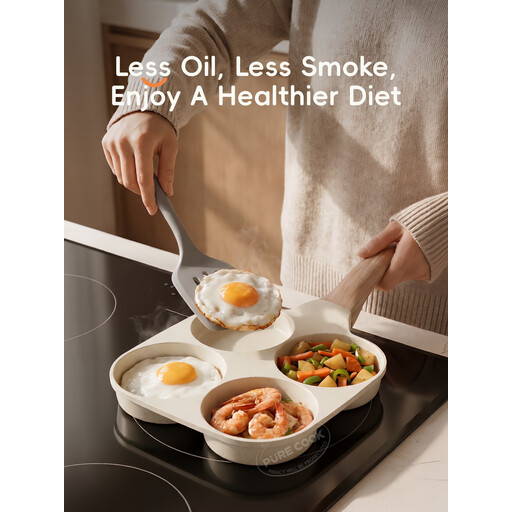
Why it suits this profile: The 19 cm model has four separate sections for eggs, mini pancakes, burgers or sausages. The aluminium body is lightweight and, according to the description, the coating is designed to help food come away easily.
The pan is not dishwasher-safe and requires hand washing. This is clearly stated, allowing you to factor maintenance into your decision.
Four sections, 19 cm diameter, lightweight aluminium and, according to the product information, suitable for induction, gas and ceramic hobs.
We have put together a complete, up-to-date list of products that fully meet these strict selection criteria and the applicable European safety regulations.
Choose a model for which induction compatibility is explicitly stated in the product information. A magnetic, flat base is important for efficient heat transfer. Also check whether the base diameter corresponds to your cooking zone. A pan may be suitable for induction but heat inefficiently if its base is much smaller than the zone.
That depends on how you plan to use it. Stainless steel is suitable for searing and higher temperatures, but requires more control when preheating and adding oil. A non-stick frying pan is practical for eggs, fish and pancakes, as food is easier to release according to the product description. Do not use metal utensils with a coating and avoid heating the pan empty for extended periods.
Its lifespan depends on the material, use and care. A coating can wear down due to high temperatures, metal spatulas and abrasive cleaning. A stainless steel frying pan without an inner coating does not have a coating that can flake off, but it can still discolour or become scratched. Allow every pan to cool before cleaning it, follow the manufacturer’s instructions and replace the pan if the coating is visibly damaged or the base becomes warped.
