
Vandaag of morgen in huis

Kwaliteit gegarandeerd

Welkomstaanbiedingen ontgrendelen: GRATIS bezorging | Tot 80% korting | Gratis 30 dagen JoyPlus-proefperiode
Download de app
A new frying pan seems like a simple purchase, until you have to choose between aluminium, stainless steel, ceramic, a non-stick coating, a lid or a complete frying pan set. Marketing terms don’t always make the choice any clearer. For example, a pan may be described as “dishwasher-safe”, even though washing it by hand can help the coating last longer.
For everyday cooking, three things matter most: the right size, compatibility with your hob and a material that suits your cooking style. Read on to find out what to look for and which popular options suit different needs.
A 28 cm frying pan gives you more room, but it also takes up more space and can feel heavy when full. For a meal for one or two eggs, a 20 to 24 cm frying pan is often more practical. For a family, a 28 cm pan or a frying pan set with several sizes is more convenient.
Also check the diameter of the cooking surface. The stated diameter is usually the measurement across the top of the pan. On an induction hob, the base should match the cooking zone for even heating.
A non-stick frying pan will stay in good condition for longer if you avoid metal utensils, don’t heat it empty at a high temperature and avoid sudden changes in temperature. A product may be dishwasher-safe, but manufacturers often recommend washing it by hand to help the coating last longer.
For a ceramic frying pan, wooden, silicone or nylon utensils are best. A damaged coating may not release food as easily during cooking. Check the pan regularly and replace it if the coating starts to peel or is badly damaged.
Terms such as PFAS-free frying pan and PFOA-free frying pan refer to specific substances and shouldn’t automatically be treated as a general guarantee of quality. Check the product information, the exact wording of the claim and the care instructions.
According to the product descriptions, no PFOA or PFOS has been intentionally added to the SENSARTE pans. For other models, the product information may state, for example, that the ceramic coating is PFAS-free or PTFE-free. These are claims made in the product information by the brand or supplier, not a general guarantee for all pans described in similar terms.
An aluminium frying pan is usually lightweight and heats up quickly. This makes aluminium a good choice for everyday frying, especially when the pan has a base suitable for induction. Cast aluminium can also feel sturdy, but always check the weight and handle.
A stainless steel frying pan without a traditional non-stick coating is a good option for high-temperature cooking and using metal utensils, subject to the specific care instructions. A pan with a multi-layer construction, such as stainless steel with an aluminium core, is designed to distribute heat more evenly. However, to stop food sticking, you’ll need to pay more attention to preheating, cooking oil or fat, and temperature.
A ceramic coating can make food release and cleaning easier, but it needs careful maintenance. According to the product information for some models, the coating is free from PFAS, PTFE and PFOA. Check the exact claim for each product.
An induction frying pan needs a magnetic base. Look for wording such as “suitable for induction” and check whether the pan is also compatible with your other hob types, such as gas, ceramic or electric. A magnetic induction base can make a pan suitable for a wider range of hobs, but heat distribution also depends on the thickness and construction of the base.
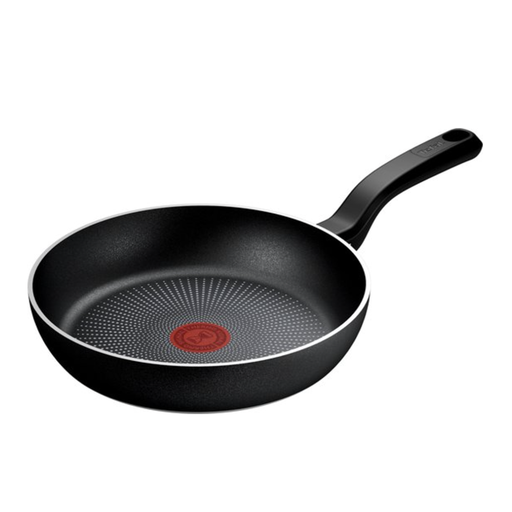
Why it suits this profile: The 24 cm size is easy to handle for everyday cooking, and according to the product information, the pan is suitable for gas, induction, electric and ceramic hobs.
The product information describes the coating as free from PFOA, lead and cadmium, and includes care instructions for cooling and cleaning the pan.
24 cm, suitable for all the hob types listed, dishwasher-safe according to the product information, and fitted with a temperature indicator.
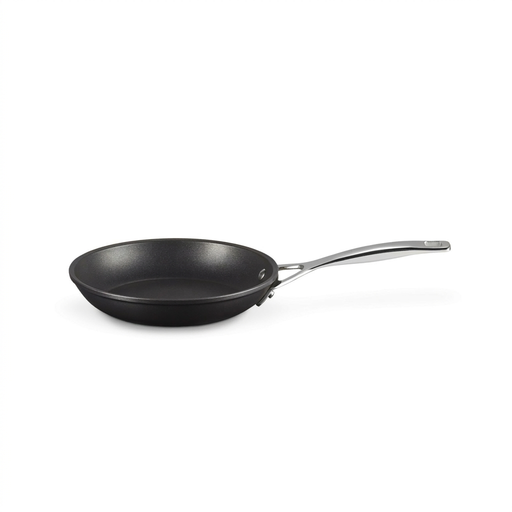
Why it suits this profile: The wide 28 cm pan gives you room to cook larger portions and, according to the product description, is suitable for induction and other hobs, as well as oven use.
The reinforced non-stick coating and advice to use soft utensils make it clear how to care for the pan.
28 cm diameter, aluminium body, stainless steel handle and, according to the product information, a PFOA-free coating.

Why it suits this profile: This frying pan with lid is designed for frying, stir-frying and simmering. Its 28 cm size works well for larger meals.
According to the product information, the three-layer construction helps distribute heat. The pan doesn’t have a delicate traditional non-stick coating.
304 stainless steel, aluminium core, lid, oven-safe up to the stated temperature and compatible with several hob types.
We’ve put together a complete, up-to-date list of products that meet these strict selection criteria and the applicable European safety regulations.
For one or two people, 20 to 24 cm is usually enough. Choose 28 cm if you’re cooking for several people or want plenty of room to spread out the ingredients. For induction, also check the size of the cooking zone and the diameter of the pan’s base.
That depends on the base. A ceramic coating only describes the inside of the pan. It also needs a magnetic base. So always check that the product information explicitly states that the pan is suitable for induction.
Its lifespan depends on how you use it, the temperature and how well you care for it. Don’t use metal utensils, don’t heat the pan empty at a high temperature, and let it cool before washing. Washing by hand with a soft sponge can help the coating last longer than regularly using the dishwasher.
