
Vandaag of morgen in huis

Kwaliteit gegarandeerd

Welkomstaanbiedingen ontgrendelen: GRATIS bezorging | Tot 80% korting | Gratis 30 dagen JoyPlus-proefperiode
Download de app
A frying pan seems like a straightforward purchase, until eggs start sticking, the base is no longer flat or the pan does not work on your induction hob at all. Marketing terms such as “non-stick”, “healthy cooking” and “suitable for all heat sources” can be particularly confusing. The practical details are often further down the product description.
For everyday frying, searing and sautéing, three pitfalls are important:
Start by checking the heat source. For a frying pan for induction, the product information must explicitly mention induction. A pan that is only suitable for gas, electric, ceramic or glass-ceramic cooking will not automatically work on induction.
Also pay attention to the shape of the base. A flat, stable base ensures good contact with the hob. With gas, it is important that the flame does not rise up the sides. This can unnecessarily heat the handle and coating.
Aluminium is popular because it is lightweight and distributes heat quickly. However, an aluminium frying pan needs a suitable magnetic base for induction. Stainless steel is generally robust, but requires more control over temperature and fat when the pan does not have a non-stick coating.
A frying pan with a non-stick coating requires less oil and is practical for eggs, pancakes and delicate fish. Do not just check the coating’s name, but also the care instructions, maximum temperature and permitted utensils.
A ceramic frying pan is often described as having a PFAS-free coating. Treat this as a product specification provided by the brand and check exactly what is being claimed. For example, Brabantia states that the DUSK frying pan has a 100% PFAS-free ceramic coating. According to the product description, this pan also has two layers and is suitable for oven use up to 200 °C.
Other brands mention similar properties. According to Naturepan’s product description, its ceramic coating is free from PTFE, PFAS and PFOA. SENSARTE’s product specifications state that its coating is free from intentionally added PFAS and PTFE. Such claims come from the manufacturer or seller and should not be extended to medical or health claims.
For any coating, pay attention to the following:
The diameter does not tell you everything: the height and usable cooking surface also matter.
A frying pan set containing 20, 24 and 28 cm pans can be useful if you regularly use several sizes. If you have limited cupboard space, one good 24 or 28 cm pan is often more sensible than a set in which two pans rarely come out of the cupboard. A frying pan with a lid is useful for simmering and keeping dishes warm. For stir-frying, you could also consider a wok; for Japanese omelettes, a separate omelette pan or tamagoyaki pan is more practical.
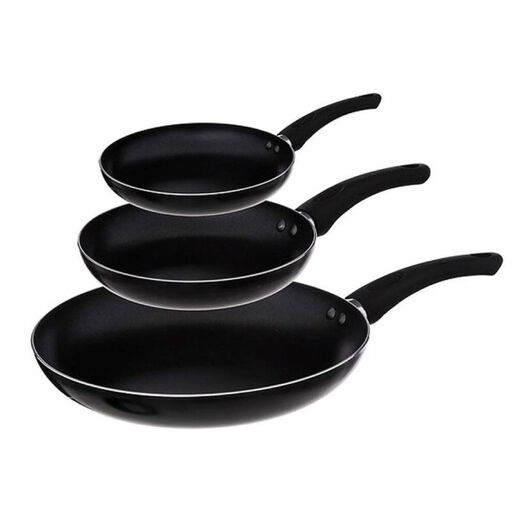
Why it suits this profile: Three popular sizes give beginners flexibility for individual portions and family meals. According to the product description, the aluminium pans are suitable for everything from gas to induction.
The compatible heat sources and diameters are clearly stated. The set is dishwasher-safe, although hand washing is recommended for a longer lifespan.
Set of three sizes, two non-stick layers and a height of 6 cm.

Why it suits this profile: This pan combines a 24 cm size with a forged aluminium body, a stainless steel handle and compatibility with all common heat sources.
The product specifications separately mention the PFAS-free ceramic coating, induction compatibility and oven use up to 200 °C.
Certified recycled aluminium according to the stated RCS information, ceramic coating and dishwasher-safe design.

Why it suits this profile: The 30 cm wok is designed for stir-frying, braising, boiling and larger portions. According to the product description, its flat magnetic base is suitable for induction, gas, electric and ceramic hobs.
The pan clearly states that hand washing is required. This means the dishwasher is not a hidden limitation for anyone who checks the care information beforehand.
Three-layer stainless steel body, ceramic honeycomb structure and a glass lid.
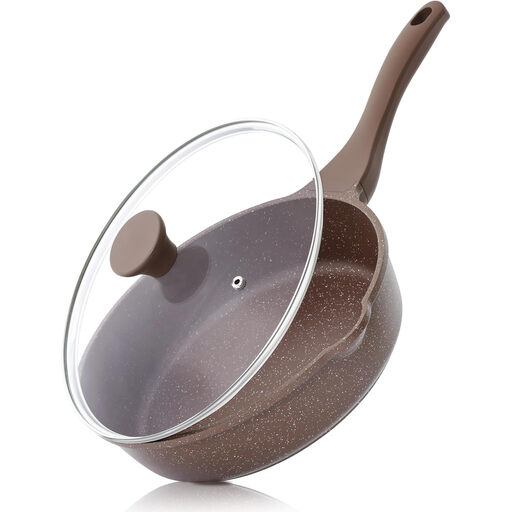
Why it suits this profile: The deep shape and capacity of approximately 3.5 quarts are practical for sauces, stir-fries and larger quantities on an induction, gas or electric hob.
The product information explicitly states that hand washing is required and that the maximum temperature is 450 °F. According to the same information, the pan is not oven-safe.
Deep aluminium pan, included lid, induction compatibility and a handle that, according to the description, stays cool during use.
We have put together a complete, up-to-date list of products that fully meet these strict selection criteria and the applicable European safety regulations.
A dishwasher-safe frying pan can technically be cleaned in the dishwasher, but always check the product instructions. Hot water, strong detergents and contact with other kitchen utensils can put additional strain on the coating and handle. A dishwasher-safe frying pan therefore does not automatically last longer than a pan that must only be washed by hand.
Use a soft sponge and mild washing-up liquid. Ideally, store pans with protection between them and do not stack them roughly when the coating is vulnerable. An oven-safe frying pan may only be used in the oven up to the specified temperature. The handle may also become hot, so use oven gloves.
Choose a model that explicitly lists induction in its product specifications. Aluminium alone is not sufficient. A magnetic base or wording such as “suitable for induction” indicates that the pan is designed for this heat source.
This depends on use, temperature, utensils and care. Avoid preheating the pan when empty, high temperatures and metal spatulas. Replace the pan when the coating becomes visibly damaged or starts to peel, or when the handle is no longer stable.
Some models are, according to the manufacturer, including certain Brabantia and Naturepan pans in this selection. Other ceramic pans, including the SENSARTE set mentioned above, must be washed by hand. Always check the specific product page rather than relying solely on the word “ceramic”.
