
Vandaag of morgen in huis

Kwaliteit gegarandeerd

Welkomstaanbiedingen ontgrendelen: GRATIS bezorging | Tot 80% korting | Gratis 30 dagen JoyPlus-proefperiode
Download de app
A frying pan for induction needs to be more than just magnetic. The pan must sit well on your cooking zone, feel comfortable in your hand, and suit the way you cook every day. For a family, the requirements are different from someone who mainly cooks an egg, a pancake or a quick meal.
Marketing copy doesn’t always make the choice easier. A non-stick coating, “suitable for all heat sources” or a dishwasher symbol doesn’t tell you everything about long-term use. With the points below, you can avoid a bad purchase and compare an induction frying pan on verifiable features.
Not every aluminium frying pan works on induction. Aluminium conducts heat well, but it isn’t magnetic on its own. It needs a suitable composite or magnetic base.
So look for an explicit mention of induction compatibility. A clear example of a wrong match is the Tefal Easy Cook & Clean 32 cm. According to the product description, this pan is suitable for gas, electric and ceramic hobs, but emphatically not for induction. Always check this before you order.
A ceramic frying pan or other non-stick frying pan can be practical, but no coating is immune to misuse. Heating an empty pan on a high heat for a long time, using sharp metal spatulas, or holding a hot pan under cold water can damage the layer.
So also look at the care instructions. Some models are dishwasher-safe, while hand washing is recommended to extend the lifespan. “Dishwasher-safe frying pan” therefore doesn’t automatically mean every part will keep the same properties for years.
A pan of 28 or 32 cm offers space for family meals, but isn’t always practical on a small induction zone. A base that’s too large can heat unevenly. A small pan on a large zone can be less efficient.
Check not only the diameter but also the base diameter. With the Brabantia Onyx saucepan, for example, a base diameter of 17 cm is stated. It should be placed on a matching induction zone.
An aluminium frying pan is generally light and heats up quickly. That’s handy for everyday cooking, but the pan needs a suitable induction base. Forged or cast aluminium can also feel different in terms of weight and heat distribution.
A stainless steel frying pan or wok is often heavier and requires more control over preheating and oil use. Models with a multi-layer base combine stainless steel with other metals for more even heat distribution. When a coating is involved, always check which layer is actually stated. A product description with “ceramic” or “honeycomb” isn’t automatically the same as a PFAS-free frying pan.
If you’re consciously looking for a PFAS-free frying pan, you need to read the product specifications carefully. According to the product description, the Brabantia Nocta 24 cm and the Brabantia Dusk set state that the ceramic non-stick coating is PFAS-free. For the Naturepan set, the supplied specifications mention that the coating is free from PTFE, PFAS and PFOA.
These are product claims from the respective descriptions; don’t treat them as a general property of every ceramic pan. Also look at care: wooden, silicone or plastic utensils are often recommended to avoid putting unnecessary strain on the coating.
A frying pan set with 20, 24 and 28 cm can be good value if you regularly make different portion sizes. A saucepan with a lid is more suitable for simmering, sauces and dishes with more volume. For stir-frying, a wok for induction with a flat magnetic base may be a better fit than a shallow frying pan.
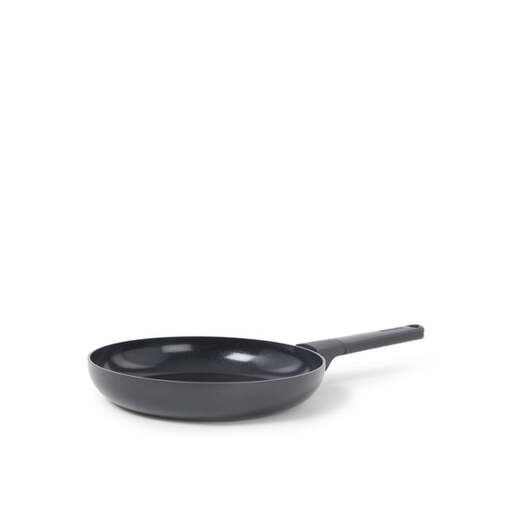
Why this fits the profile: The size is manageable for everyday cooking and, according to the product description, the pan is suitable for induction, gas, electric and ceramic hobs.
The product specifications list all common heat sources, including induction. The ceramic coating is also described as PFAS-free.
Aluminium pan of 24 cm, ceramic coating and, according to the description, dishwasher-safe.

Why this fits the profile: The combination of two sizes and oven compatibility up to 200 °C suits those who want more flexibility without buying a full set straight away.
The diameters are clearly stated and the product description mentions induction compatibility. Hand washing is recommended to keep the ceramic coating in good condition for longer.
Two pans of 20 and 24 cm, recycled aluminium, PFAS-free ceramic coating according to the product information and oven use up to 200 °C.
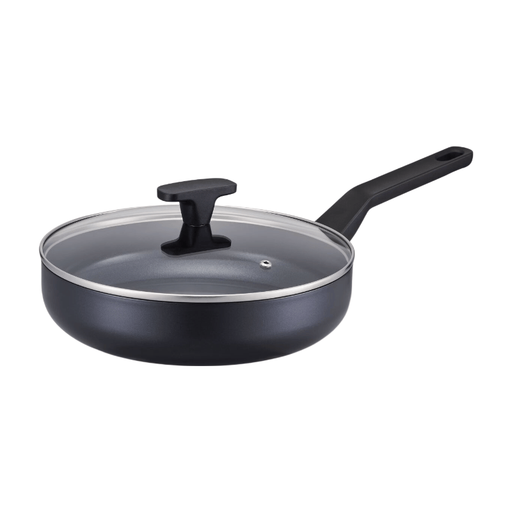
Why this fits the profile: The deeper shape and lid are practical for sauces, stews and vegetables for several people.
The description mentions a PFAS-free ceramic double non-stick coating and suitability for induction. The base diameter does require a matching cooking zone.
26 cm, glass lid, recycled aluminium and suitable for induction, gas, electric, ceramic and halogen according to the product specifications.
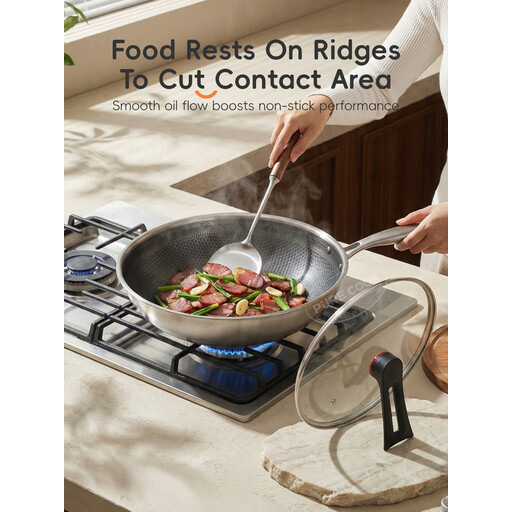
Why this fits the profile: The generous wok shape is designed for stir-frying, braising and larger portions. The multi-layer stainless steel construction suits anyone looking for a different type of pan to a classic shallow frying pan.
The product specifications mention induction, gas and electric ceramic hobs. Hand washing is recommended, which makes the care expectations clear.
32 cm, 304 stainless steel in a three-layer construction, glass lid and compatibility with multiple hob types according to the product description.
We’ve put together a full, up-to-date list of products that fully meet these strict selection criteria and current European safety regulations.
A dishwasher-safe frying pan can offer extra convenience, but hand washing is the safer choice for many models. Always follow the instructions on the product label and the current product page.
Look in the product specifications for “induction compatible” or “suitable for induction hobs”. An aluminium body alone isn’t enough; the pan needs a magnetic base. A magnet test can give an initial indication, but the official product information remains the deciding factor.
For one person, 20 to 24 cm is often practical. For a household of two to four people, 28 cm is more suitable. Also check the diameter of your induction zone, so the base and hob match up properly.
That doesn’t depend solely on the material. Use, temperature, utensils and cleaning all have a big influence. A ceramic coating can be PFAS-free according to the product description, but this layer too must be protected from overheating, scratches and thermal shock.
