
Vandaag of morgen in huis

Kwaliteit gegarandeerd

Welkomstaanbiedingen ontgrendelen: GRATIS bezorging | Tot 80% korting | Gratis 30 dagen JoyPlus-proefperiode
Download de app
A frying pan may seem like a straightforward purchase, but differences in material, coating, size and care can affect how enjoyable it is to cook with every day. A pan that works well on gas is not automatically suitable for induction. And a dishwasher-safe pan may still wear out more quickly if you regularly expose its coating to high temperatures.
So don't focus solely on terms such as “non-stick”, “healthy” or “durable”. Above all, check the product's technical specifications and limitations.
Some pans are suitable for gas, electric and ceramic cooking, but not induction. For example, the Tefal Easy Cook & Clean frying pan is suitable for gas, electric and glass-ceramic hobs, but according to the product information, not for induction.
Have you got an induction hob? Look specifically for induction frying pan or “induction compatible” in the specifications. Don't rely on the product title alone.
A non-stick frying pan can be useful for eggs, pancakes and dishes requiring little oil. However, the coating remains susceptible to scratches, metal utensils, abrasive sponges and overheating.
For a ceramic frying pan, the manufacturer may state that the coating is free from PFAS, PTFE or PFOA. Read this as a product specification, not as a general guarantee regarding cooking results or lifespan. According to the product descriptions of various Redchef models, these coatings are free from PFAS, PTFE and PFOA. Where possible, use wooden, silicone or plastic utensils.
A 20 to 22 cm pan is practical for one or two people. For a family, 26 to 28 cm is often more useful. A deep 32 cm frying pan offers extra capacity, but also takes up more space and requires a larger cooking zone.
Also check the diameter of the base. A wide rim does not always mean that the entire base of the pan will be heated effectively.
A stainless steel frying pan does not have a traditional non-stick coating and, when preheated correctly, can be suitable for cooking at higher temperatures. According to the product description, the PURECOOK Tri-Ply 304 Stainless Steel Large Frying Pan uses a three-layer construction with 304 stainless steel and an aluminium core. This combination is designed to distribute heat evenly.
Aluminium pans are usually lightweight and heat up quickly. The coating often determines how easy they are to use. The PURECOOK aluminium frying pan with a stone-effect coating is relatively light and, according to the product specifications, suitable for gas, induction and ceramic hobs. This pan is not dishwasher-safe and must be washed by hand.
A ceramic frying pan is worth considering if you are looking for a coating without intentionally added PFAS, PTFE or PFOA. Always check the exact product description. This is stated explicitly for the Redchef sets; according to the manufacturer, you should avoid metal utensils to protect the ceramic coating.
Check whether the pan is suitable for:
For a pan with a removable handle, pay attention to the conditions of use. According to the product information, the handle must be removed from the Redchef sets for certain oven or grill applications. A handle may also not be suitable for direct flames or prolonged exposure to high heat.
An oven-safe frying pan always has a maximum temperature. The Redchef sets state an oven temperature of up to 842 °F, while according to the specifications, the Tefal pan is suitable for oven use up to 175 °C. Always follow the lowest limit specified for the pan, lid and handle.
A frying pan with lid is useful for simmering, reducing sauces and covering dishes while they cook. A deep frying pan provides more room for stir-fries and stew-like meals, but is less compact in a small kitchen.
Also consider these care points:
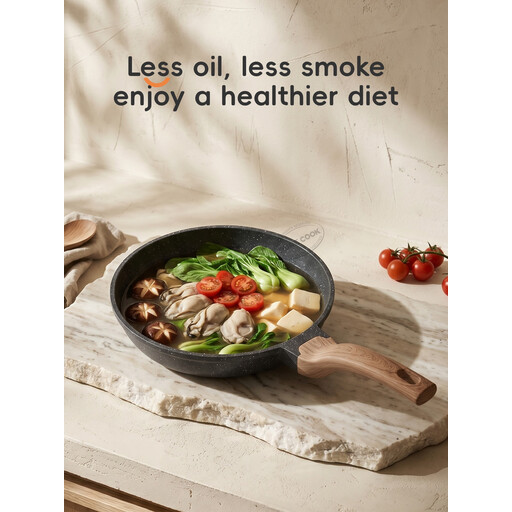
Why it suits this profile: The 24 cm aluminium pan is lightweight and suitable for everyday frying, stir-frying and small meals. According to the product specifications, it works on gas, induction and ceramic hobs.
The product information clearly states that this pan is not dishwasher-safe. Hand-washing and avoiding metal utensils are necessary to protect the coating.
Lightweight aluminium, a 24 cm size and compatibility with gas, induction and ceramic hobs.

Why it suits this profile: This 28 cm stainless steel frying pan with an aluminium core is designed for anyone looking for a pan without a traditional non-stick coating and who regularly cooks for several people.
The material construction and compatibility with all common hobs are specified. You are not reliant on a delicate coating, but you do need to use the correct cooking technique.
304 stainless steel, three-layer construction, glass lid and, according to the product information, dishwasher-safe and oven-safe up to 220 °C.
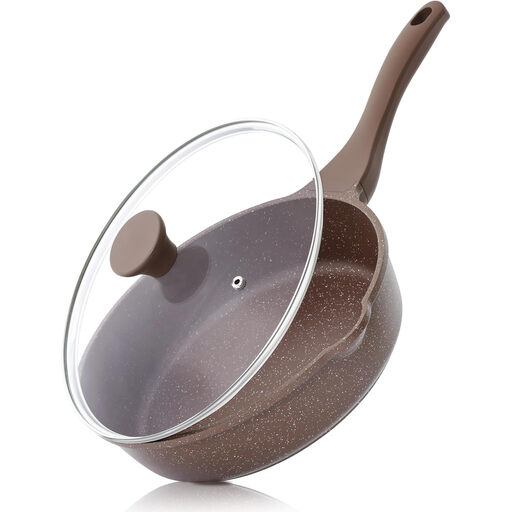
Why it suits this profile: The 3.5-quart deep sauté pan is suitable for frying, sautéing, stir-frying and simmering. According to the product information, the pan works on gas, electric and induction hobs.
The specifications state that it should be hand-washed, not placed in the dishwasher, and that it has a maximum temperature of 450 °F. This helps avoid incorrect expectations about care and oven use.
Deep design, lid, stay-cool handle and, according to the product description, a PFOA-free coating.
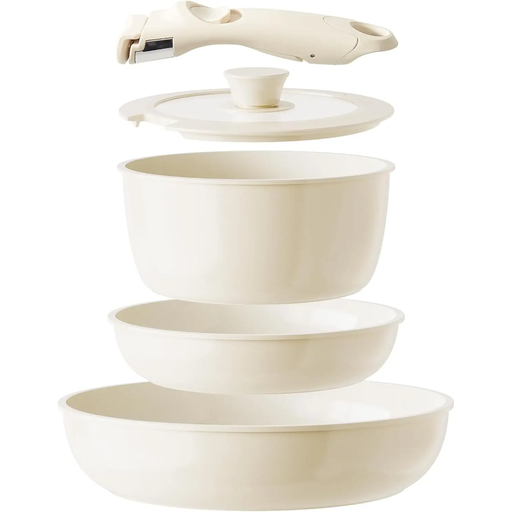
Why it suits this profile: The set contains two frying pans, a saucepan, a lid and a removable handle. Its stackable design is practical in a flat, campervan or kitchen with limited cupboard space.
According to the manufacturer, the set has a coating without intentionally added PFAS, PTFE, PFOA, lead or cadmium. The handle must be removed before oven use whenever the instructions specify this.
Five pieces, ceramic coating, stackable design and compatibility with gas, electric and induction hobs.
We've put together a complete, up-to-date list of products that fully meet these strict selection criteria and the applicable European safety regulations.
Choose a pan that explicitly states that it is induction-compatible. A magnetic base or an induction marking is essential. Also check the minimum diameter of the cooking zone, particularly with small 20 cm pans.
This depends on use, temperature and care. Do not use metal utensils, avoid heating an empty pan for extended periods and allow a hot pan to cool down gradually. If the coating is visibly damaged or starts to peel, replacing the pan is advisable.
A frying pan set can offer good value if you need different sizes and a saucepan. For a small kitchen, a set with a removable handle can save space. If you mainly cook for one person, a single 22 or 24 cm pan may be more practical than several unused pieces.
