
Vandaag of morgen in huis

Kwaliteit gegarandeerd

Welkomstaanbiedingen ontgrendelen: GRATIS bezorging | Tot 80% korting | Gratis 30 dagen JoyPlus-proefperiode
Download de app
A new frying pan might seem simple to choose – until you have to consider hob compatibility, diameter, non-stick coating and maintenance. A pan that’s described as versatile in the product description won’t automatically suit your kitchen. Equally, a large pan isn’t always practical for everyday use.
With these practical selection points, you can avoid buying the wrong pan and compare everything from an induction frying pan, non-stick frying pan, ceramic frying pan, aluminium frying pan, wok pan, grill pan and egg pan based on verifiable features.
Always check the full product description. A pan may be suitable for gas, electric and ceramic hobs, but not for induction. The Tefal Easy Cook & Clean 32 cm is a clear example: it’s suitable for gas, electric and ceramic hobs, but according to the product specifications it is not suitable for induction.
An induction frying pan needs a magnetically compatible base. If induction isn’t explicitly stated, don’t assume the pan will work.
Words like “stone”, “titanium”, “granite” or “ceramic” don’t always describe the full composition of the coating. Instead, look at:
A PFAS-free frying pan is not the same as a pan without a coating. A ceramic frying pan, for example, has a ceramic non-stick layer, while some aluminium pans use a different coating.
The diameter doesn’t tell you everything about the usable cooking space. A 24 cm pan is suitable for one or two portions, while 28 to 32 cm offers more room for a family. A larger pan does take up more storage space and can feel heavier.
Also check the rim height. A deep frying pan is more practical for sauces and larger quantities. For multiple ingredients at once, a wok pan or grill pan may be more suitable than a flat model.
For a frying pan for all hobs, the description must explicitly mention gas, electric, ceramic and induction. A magnetic stainless steel base or induction disc can enable induction compatibility. Also pay attention to the base diameter: a 32 cm pan may have a smaller effective base than your cooking zone.
An aluminium frying pan generally heats up quickly and is relatively light. A thicker or multi-layered base helps distribute heat more evenly. Stainless steel constructions are often heavier but can be suitable for higher heat tolerance. Don’t just look at marketing terms – check the stated material construction and weight.
A dishwasher can be convenient, but for many pans manufacturers still recommend hand washing to preserve the coating, handle or finish for longer. With a non-stick frying pan, it’s best to use wooden, silicone or plastic utensils. Don’t heat an empty pan for long periods, and let a hot pan cool down before rinsing it with cold water.
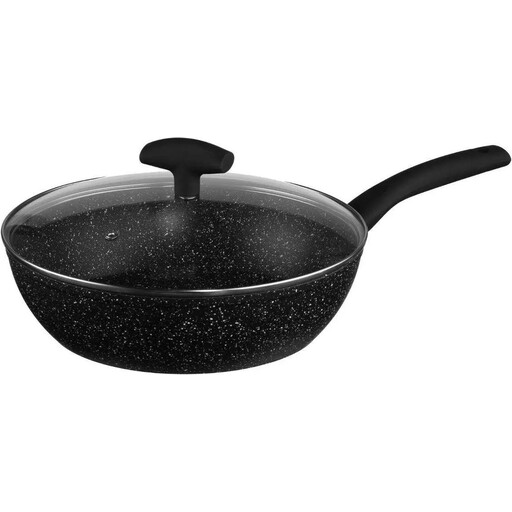
Why this fits the profile: The 28 cm diameter offers space for everyday meals and the glass lid is handy for simmering and cooking. According to the product description, this pan is suitable for all heat sources.
The hob compatibility, diameter and 2.5 litre capacity are clearly stated. PFAS-free is not applicable; if that criterion matters to you, choose a different model.
28 cm, glass lid, aluminium pan body and two non-stick layers according to the product specifications.
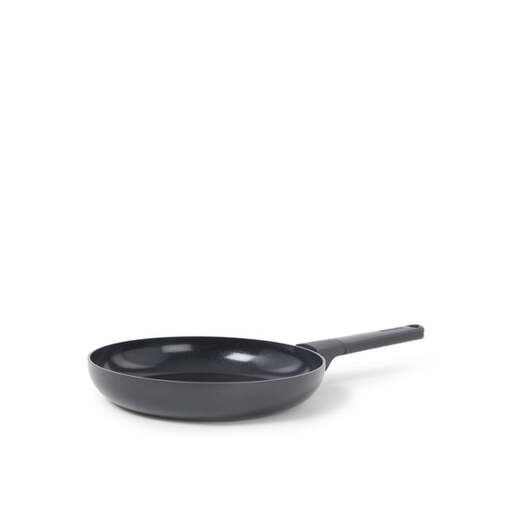
Why this fits the profile: This compact ceramic frying pan is suitable for gas, electric, ceramic and induction hobs. The size suits smaller households and everyday portions.
The specifications mention both the ceramic coating and PFAS-free composition, and list all four suitable heat sources.
24 cm, aluminium body, ceramic coating, dishwasher safe according to the product information and three-year manufacturer’s warranty.
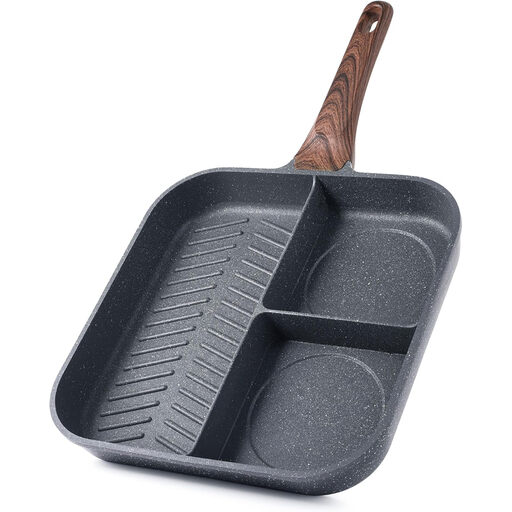
Why this fits the profile: The three compartments are designed for breakfast, meat, burgers, pancakes and vegetables without everything mixing together. The pan suits households that want to cook several items at once in a targeted way.
The specifications list induction, gas and electric compatibility and clearly state that the pan is not oven or dishwasher safe.
11 inch, three cooking compartments, 4.5 mm thick magnetic base and a coating that, according to the product information, is free from PFOA, PFOS, APEO, lead and cadmium.
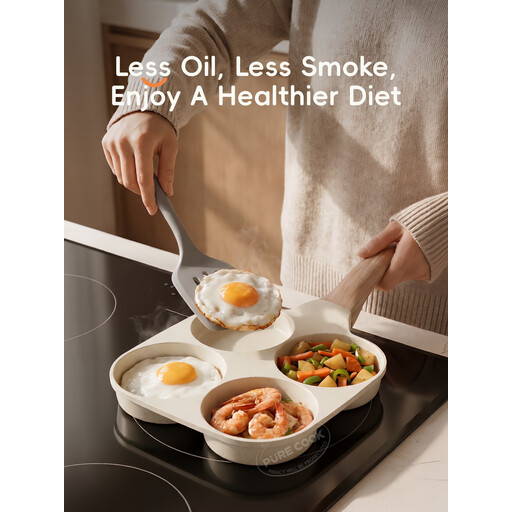
Why this fits the profile: The four compartments are practical for eggs, mini pancakes, burgers or breakfast sausages. This egg pan is suitable for induction, gas and ceramic hobs.
The 19 cm size, number of compartments and hand-washing instruction are clearly stated. This means you know in advance that it’s not a universal frying pan for large meals.
Four separate cooking compartments, aluminium alloy, wooden handle and compatibility with induction, gas and ceramic hobs.
We’ve put together a full, up-to-date list of products that fully meet these strict selection criteria and comply with current European safety regulations.
For one or two people, 20 to 24 cm is often sufficient. A 28 cm pan works well for most everyday family meals. Choose 30 to 32 cm when you’re cooking larger portions, but check that your cooking zone is big enough.
Choose a model where induction is explicitly listed as a suitable heat source. Also check that the base is flat and makes good contact with the cooking zone. A pan that is only suitable for gas, electric and ceramic hobs won’t automatically work on induction.
Use medium heat, don’t heat the pan when empty and choose soft kitchen tools. Wash the pan with a soft sponge and avoid abrasive cleaners. Even when a pan is dishwasher safe, hand washing according to the product information can help keep the coating and handle in good condition for longer.
