
Vandaag of morgen in huis

Kwaliteit gegarandeerd

Welkomstaanbiedingen ontgrendelen: GRATIS bezorging | Tot 80% korting | Gratis 30 dagen JoyPlus-proefperiode
Download de app
A frying pan may seem like a simple product, but small differences can have a big impact on how enjoyable everyday cooking is. A pan may be lightweight, heat up quickly and require very little oil, yet still prove unsuitable because of the wrong base, a delicate coating or a handle that cannot go in the oven.
As a Joybuy Product Recommendation Officer, I therefore start by checking verifiable specifications. Before buying a new pan, pay particular attention to these three common pitfalls.
Not every aluminium frying pan works on induction. Aluminium conducts heat well, but usually needs a magnetisable base to work on induction hobs. Always check whether the product information explicitly states induction-compatible.
The Tefal Easy Cook & Clean is one example. This pan is suitable for gas, electric, ceramic and glass-ceramic cooking, but explicitly not for induction. If you have an induction hob, this model is therefore not suitable, despite practical features such as its dishwasher-safe coating.
The terms PFAS-free frying pan, PFOA-free and PTFE-free do not automatically mean the same thing. PFOA is a specific substance within the broader PFAS group. Always check the manufacturer’s exact wording and the product documentation.
The product information for the Brabantia Dusk, Brabantia Onyx and Brabantia Nocta states that they have a PFAS-free ceramic coating. Other models may state, for example, that no PFOA, PFOS, lead or cadmium has been intentionally added. That is a different claim and should not automatically be interpreted as “completely PFAS-free”.
A non-stick frying pan is not only defined by the layer on the inside. The pan base, handle, maximum oven temperature and care requirements also affect its practical lifespan.
A dishwasher-safe frying pan can be cleaned in the dishwasher, but hand-washing with a soft sponge is often recommended to keep the coating looking good for longer. For ceramic and other non-stick coatings, wooden, silicone or plastic utensils are preferable. Metal can cause scratches.
A 24 cm frying pan is suitable for smaller households, omelettes, vegetables and meals for around one to three people. The base also often fits well on a cooking zone of approximately 18 to 20 cm.
A 28 cm pan provides more space for several ingredients. For large portions or a family, 32 cm can be useful, but a pan of this size takes up more room and may feel heavier. Do not look only at the diameter of the rim: the effective base diameter determines how well the pan matches your cooking zone.
An aluminium frying pan is generally lightweight and heats up quickly. This is convenient for everyday use and for anyone who regularly wants to move a pan with one hand. Forged or cast aluminium can offer different levels of durability and heat distribution compared with thin sheet material.
Stainless steel is more resistant to wear and suitable for higher temperatures, but requires more control while cooking. Hybrid models may combine an aluminium core with steel and a non-stick coating. According to the product information, the WMF Profi Resist uses multiple layers of aluminium and stainless steel, along with a honeycomb structure around the coating.
A ceramic frying pan uses a ceramic non-stick coating. Some models are described as PFAS-free; always check the specific product listing. Ceramic coatings generally perform best over low to medium heat and with careful cleaning.
If you want an ovenproof frying pan, check both the maximum temperature and the handle. According to the product information, the Brabantia Dusk is ovenproof up to 200 °C. The 28 cm Tefal Easy Cook & Clean is listed as ovenproof up to 250 °C, but is not suitable for induction. A wooden handle is practical on the hob, but is not automatically suitable for use in the oven.
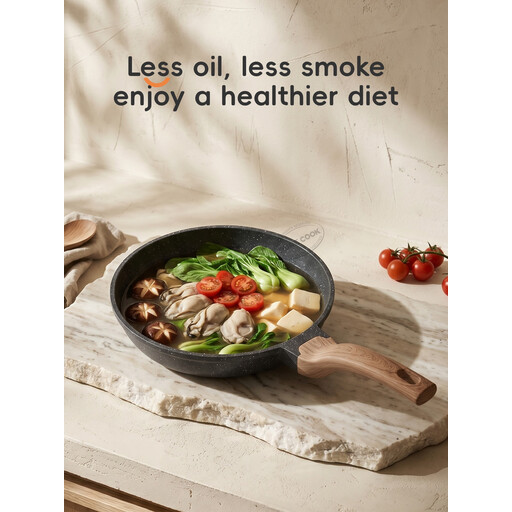
Why it suits this profile: This lightweight pan is designed for everyday frying and is ideal for households looking for a simple model suitable for induction, gas or ceramic cooking.
The specifications state a 24 cm size and compatibility with induction, gas and ceramic hobs. Please note: according to the product information, this pan is not dishwasher-safe.
Aluminium construction, wooden handle and a stone-effect non-stick coating. Hand-washing is required.
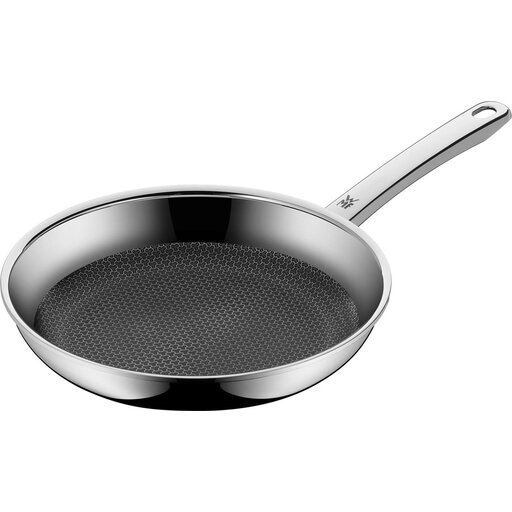
Why it suits this profile: The combination of aluminium and stainless steel is well suited to anyone looking for a more robust pan for frying and searing.
The product information states that it is induction-compatible and heat-resistant up to 260 °C. The pan is not dishwasher-safe, which you should bear in mind before buying.
24 cm, suitable for all heat sources and supplied with a five-year manufacturer’s warranty, according to the product information.
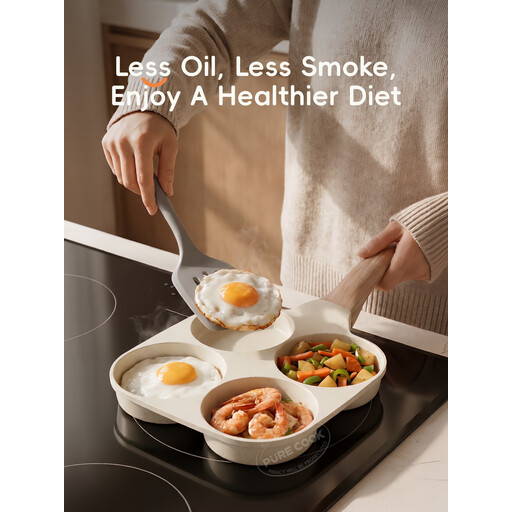
Why it suits this profile: The four compartments are designed for preparing breakfast foods such as eggs, mini pancakes, sausages or small burgers.
The pan has a clearly stated 19 cm size and a specific design. This means you are not buying a standard pan expecting it to keep four portions separate.
Lightweight aluminium, four compartments and suitable for induction, gas and ceramic hobs. Hand-wash only.

Why it suits this profile: This model combines a compact size with a ceramic coating and broad hob compatibility for everyday use.
According to the product information, the pan is PFAS-free, suitable for induction, gas, electric, ceramic and halogen hobs, and ovenproof up to 200 °C.
100% recycled forged aluminium, a double ceramic non-stick coating and dishwasher-safe construction. Hand-washing is recommended for a longer service life.
We have put together a complete, up-to-date list of products that fully meet these strict selection criteria and the applicable European safety regulations.
For one to three people, a 24 cm frying pan is often practical. Choose 28 cm for larger portions or when frying several ingredients at once. A 32 cm pan is particularly useful for families, but check that your cooking zone is large enough.
Only choose an induction frying pan when the product information explicitly states that it is suitable. Also check the diameter of the magnetic base. An aluminium pan without a suitable induction base will not be recognised properly by an induction hob.
This depends on the material, coating, cooking temperature and care. Low to medium heat, suitable utensils and hand-washing can help reduce wear. Replace the pan when the coating is visibly coming away or the handle is no longer securely attached.
