
Vandaag of morgen in huis

Kwaliteit gegarandeerd

Welkomstaanbiedingen ontgrendelen: GRATIS bezorging | Tot 80% korting | Gratis 30 dagen JoyPlus-proefperiode
Download de app
A frying pan may seem like a simple purchase, but there are big differences in materials, coatings, sizes and heat sources. A pan that works well on gas may be less suitable for induction. Terms such as ‘granite’, ‘titanium’ and ‘healthy cooking’ don’t always tell you much about how a pan performs day to day.
So focus on product specifications that you can check. This will help you avoid a pan that warps, heats up slowly or becomes difficult to clean after a few months.
A non-stick frying pan can be handy for cooking eggs, pancakes and fish, but its lifespan also depends on the base, the material and how you care for it. An aluminium pan heats up quickly, while a thicker construction is generally more stable on the hob.
If your pan has a non-stick coating, use wooden, silicone or nylon utensils where possible. Metal spatulas can cause scratches, even if the product description says the coating is scratch-resistant.
A frying pan described as suitable for all heat sources needs a magnetic base to work on induction. Also check whether it is suitable for gas, ceramic, electric and halogen hobs. Some models are compatible with these hobs but are not suitable for use in the oven or dishwasher.
Pay attention to the base diameter, too. A 28 cm pan may have a smaller effective heating area. On an induction hob, a well-fitting pan base helps distribute heat more evenly.
PFAS-free and PFOA-free do not mean the same thing. PFOA is one specific substance within the wider PFAS group. If a product page says that a coating is made ‘without intentionally added PFOA’, this is a more limited claim than an explicit statement that it is PFAS-free.
So check exactly what the manufacturer says. We repeat claims about coatings and materials as product information supplied by the brand, not as an independent guarantee of performance or safety. If you’re unsure, the full product specifications and care instructions should take precedence.
A frying pan set can be good value if you regularly cook different quantities. Just check that both sizes suit your hob and storage space.
Aluminium is lightweight and heats up quickly. Cast aluminium is generally more robust than thin sheet aluminium. Stainless steel is strong and suitable for high temperatures, but requires more care to prevent food sticking if it doesn’t have a full non-stick coating.
It’s often best to hand-wash a ceramic frying pan, even if it’s described as dishwasher-safe. Heat, harsh dishwasher detergent and temperature changes can put more strain on the coating.
Check the:
A pan that’s oven-safe doesn’t automatically have an oven-safe handle. So check the full product specifications.
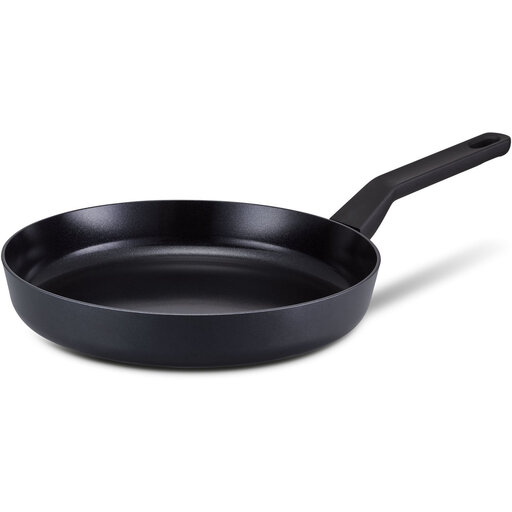
Why it suits this profile: This size is well suited to everyday cooking. According to the product description, the pan works on induction, gas, electric, ceramic and halogen hobs.
The product specifications state that it has a 100% PFAS-free ceramic coating and is suitable for several heat sources. Hand-washing is recommended to help the coating last longer.
24 cm diameter, recycled aluminium, ceramic coating and dishwasher-safe according to the product description.
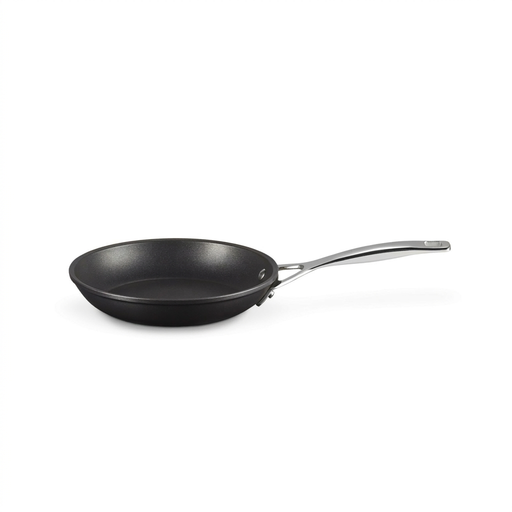
Why it suits this profile: This wide pan is suitable for larger portions, searing and sautéing. The manufacturer lists an aluminium body, a stainless steel handle and compatibility with all hobs, including induction.
The product specifications mention a reinforced non-stick coating and a PFOA-free coating. Always check the latest care instructions, and avoid using sharp metal utensils.
28 cm diameter, suitable for induction and oven use according to the product description, with a stainless steel handle.
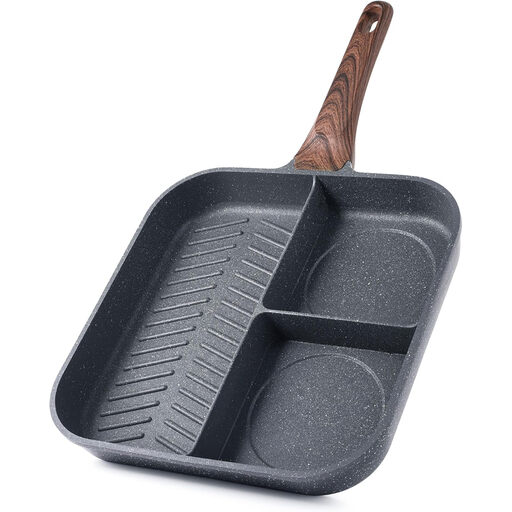
Why it suits this profile: The three compartments are handy for cooking breakfast, burgers, bacon or vegetables when you need to prepare different ingredients at the same time.
According to the product description, the pan has a magnetic stainless steel base for induction and other hobs. It is not oven-safe and should be washed by hand.
Three separate cooking zones, grill ridges, induction compatibility and a coating that, according to the product information, is free from PFOA, PFOS, APEO, lead and cadmium.
A deep frying pan with a lid is more practical for casseroles, sauces and larger quantities. For example, the SENSARTE 5-quart sauté pan has a glass lid and a deep shape. A wok measuring 30 to 32 cm is better suited to stir-frying and family-sized portions. A model such as the PURECOOK wok has a glass lid and a three-ply stainless steel construction, according to the product description.
For a compact kitchen, a frying pan set with a small and a large pan can be more efficient than buying several pans separately. Remember to consider your storage space and the diameter of your hob zones.
We’ve put together a complete, up-to-date list of products that meet these strict selection criteria and the applicable European safety regulations.
For one or two people, 20 to 24 cm is often enough. For families, 26 to 28 cm is usually a better fit. Choose 30 cm or larger if you’re cooking several portions at once, but check that the pan fits your hob zone.
It depends on the material, cooking temperature and how you care for it. Avoid metal utensils, don’t heat the pan when it’s empty and try to prevent sudden temperature changes. Replace the pan if the coating is visibly peeling, deeply scratched or food no longer releases evenly.
It can be, but ceramic refers to the coating and not necessarily the base. Check that the product description explicitly states that it’s compatible with induction. A magnetic base or stainless steel induction plate is important.
