
Vandaag of morgen in huis

Kwaliteit gegarandeerd

Welkomstaanbiedingen ontgrendelen: GRATIS bezorging | Tot 80% korting | Gratis 30 dagen JoyPlus-proefperiode
Download de app
A frying pan seems simple to choose – until the first eggs stick, the base warps or the pan doesn’t work on induction. Marketing terms such as ‘granite’, ‘titanium’ and ‘healthy cookware’ don’t tell you much on their own. The useful information is in the product specifications: material, coating, heat sources, diameter and care instructions.
For home cooks, keen cooks and families, these are the three main pitfalls to avoid:
An aluminium frying pan usually heats up quickly and is relatively lightweight. Cast or forged aluminium can provide a more stable shape than very thin sheet material. A base with a magnetic stainless-steel layer makes an aluminium pan suitable for induction.
Stainless steel with an aluminium core, as in a triple-ply construction, distributes heat differently from a pan with a traditional non-stick coating. This type of pan usually needs more care when it comes to temperature and cooking fat, but it’s a good option if you want to cook without a coating.
For any pan, check:
A non-stick frying pan is handy for eggs, pancakes and fish. However, terms such as ‘granite’ or ‘titanium’ don’t always describe the full composition. Check the stated coating type and information about the substances used.
When choosing a PFAS-free frying pan, check exactly what the manufacturer claims. ‘Made without intentionally added PFOA’ isn’t automatically the same as ‘PFAS-free’. The product information for the Brabantia Nocta, Brabantia Onyx, Brabantia Dusk, WMF Durado and white SENSARTE version states that they are PFAS-free or free from intentionally added PFAS. This remains a manufacturer’s product claim, so check the latest product specifications for the exact wording.
A ceramic frying pan often has a mineral-based coating. Use wooden, nylon or silicone utensils, and avoid heating the pan empty for a long time. If you’re looking for a ‘healthy frying pan’, you may prefer one with a clearly described coating. However, a pan isn’t a health product and no medical benefits should be attributed to it.
A 24 cm frying pan is practical for one to three people and takes up little space. For families or larger portions, 28 or 32 cm pans are more convenient. Just check that the pan sits securely on the hob ring.
An induction frying pan must be explicitly stated as suitable for induction. The Brabantia Nocta and Onyx are examples. According to the product information, the Tefal Easy Cook & Clean models in this selection are not suitable for induction, but they do work on gas, electric, ceramic and glass-ceramic hobs.
A lid is useful if you want to simmer food, retain moisture or reduce splashes. A frying pan with a lid, or a set with a sauté pan, can therefore be more versatile than a single shallow pan. Also check whether the handle is oven-safe and whether the lid knob gets hot.
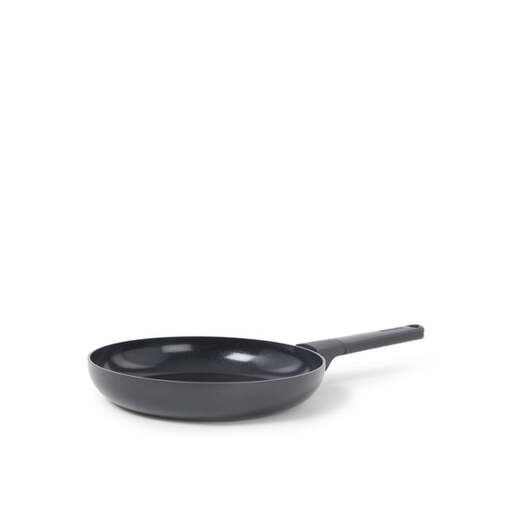
Why it suits this profile: A handy size for everyday frying, with broad compatibility across electric, gas, ceramic and induction hobs.
The product information identifies the coating as ceramic and states that it is PFAS-free. Induction compatibility is also explicitly confirmed.
24 cm, aluminium body, ceramic coating and dishwasher-safe according to the product specifications.
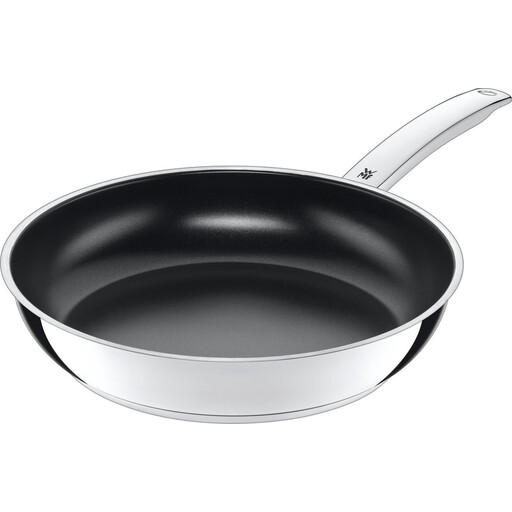
Why it suits this profile: A good choice if you’re looking for a compact pan with a stainless-steel body and ceramic coating for omelettes, vegetables and smaller portions.
The product information states that it is PFAS-free and suitable for all heat sources, including induction. The pan isn’t dishwasher-safe, which is clearly stated in the specifications.
304-like Cromargan 18/10 stainless steel according to the product description, ceramic coating and an ergonomic handle.
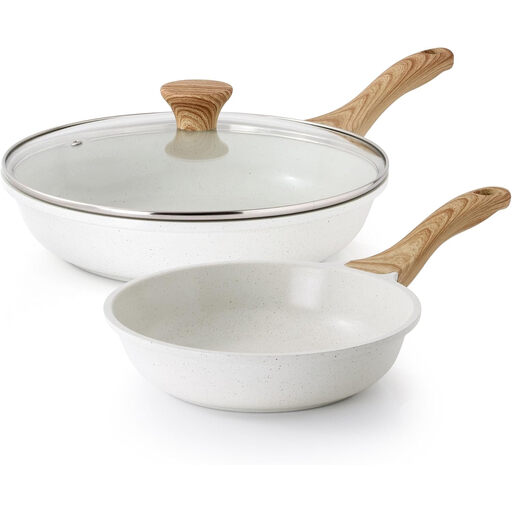
Why it suits this profile: A handy choice for households that want a choice of sizes and a lid for frying, sautéing, searing and simmering.
The set explicitly states that it is induction-compatible, has a ceramic coating and should be hand-washed. This makes it clear that the pan isn’t intended for the dishwasher.
Two sizes, a toughened glass lid, an aluminium construction and, according to the product information, no intentionally added PFAS or PTFE.
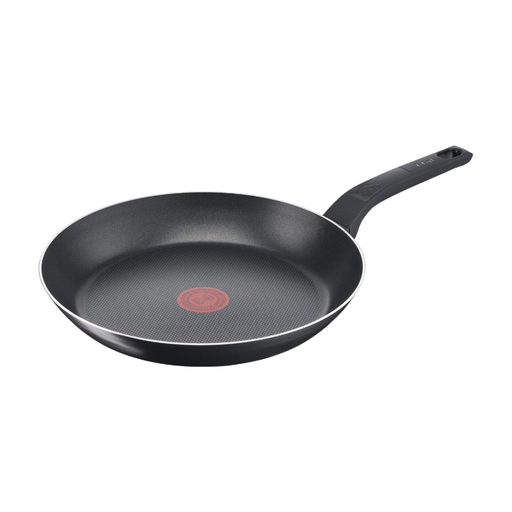
Why it suits this profile: The deep 28 cm model gives you room to cook larger quantities on a gas, electric or ceramic hob.
The product information clearly warns that this model isn’t suitable for induction. That helps prevent you from buying the wrong pan for induction cooking.
28 cm, deep shape, aluminium body, dishwasher-safe and oven-safe up to 250 °C according to the product specifications.
We’ve put together a complete, up-to-date list of products that meet these strict selection criteria and current European safety regulations.
How long a pan lasts depends largely on how you use it. Always follow the instructions for your specific model. These habits can usually help:
A 24 cm frying pan is suitable for smaller portions and meals for around one to three people. For a family or larger quantities, 28 cm and 32 cm pans are more practical. Check the diameter of the cooking surface, as the overall measurement may be slightly larger.
No. Ceramic describes the type of coating, while PFAS-free is a separate product claim. Check whether the manufacturer states this explicitly. Also look at whether the information says ‘PFAS-free’ or only that no PFOA or PFOS has been intentionally added.
Look in the product specifications for ‘suitable for induction’ or ‘induction compatible’. If in doubt, check the manufacturer’s information. An aluminium body alone isn’t enough; the pan needs a magnetically conductive base.
