
Vandaag of morgen in huis

Kwaliteit gegarandeerd

Welkomstaanbiedingen ontgrendelen: GRATIS bezorging | Tot 80% korting | Gratis 30 dagen JoyPlus-proefperiode
Download de app
A frying pan may seem straightforward, but you will quickly notice if you have made the wrong choice. The pan may not be suitable for induction, the base may heat unevenly, or the non-stick coating may stop working after a short time. Terms such as “durable”, “natural” and “PFAS-free” are also not always explained in the same way.
So pay particular attention to these three common pitfalls:
For one person or a small breakfast, a 20 to 22 cm frying pan can be practical. A 24 to 26 cm size is generally well suited to couples and smaller households. For families, stir-fries or larger portions, a 28 cm frying pan is a sensible choice.
A deep frying pan is suitable for dishes with sauce, vegetables, pasta or stews. A lid also helps retain heat and moisture. Do check whether the lid is included, as this is not standard with every pan.
An RVS frying pan or stainless steel frying pan is resistant to scratches and generally has no synthetic non-stick coating. In a multi-layer pan with an aluminium core, the heat may be distributed more evenly, according to the product description. Stainless steel does require preheating, enough cooking fat and the correct temperature to help prevent food from sticking.
A ceramic frying pan usually combines a metal pan body with a ceramic coating. Product information often states that this type of surface allows food to come away easily. Preferably use low to medium heat and wooden, silicone or nylon utensils to protect the coating.
If you are specifically looking for a PFAS-free frying pan, check the full product specifications. For some models, the supplier states that the coating is free from PFAS, PFOA and PTFE. This is a product claim made by the supplier; if in doubt, check the latest documentation and instructions for use.
For a frying pan for induction, the base must be explicitly described as induction-compatible. Also look at:
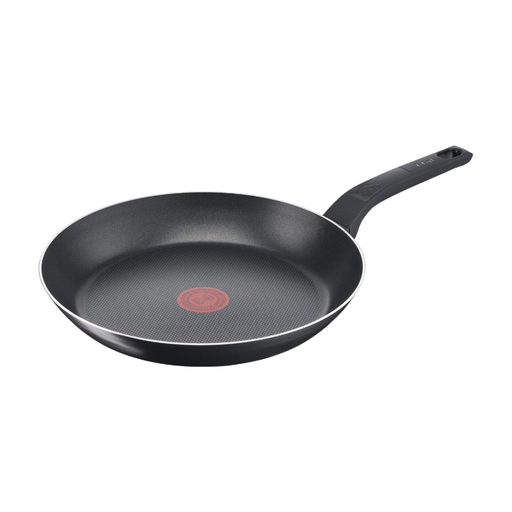
Why it suits this profile: The deep aluminium pan is designed for everyday frying and larger portions. The specifications state that it has a titanium non-stick coating, is dishwasher-safe and suitable for oven use up to 250 °C.
The size, oven limit and lack of induction compatibility are clearly stated. This helps prevent the wrong purchase, as long as you do not use an induction hob.
28 cm, deep shape, Thermo-Signal indicator and dishwasher-safe construction. Not suitable for induction.

Why it suits this profile: According to the product specifications, this 28 cm stainless steel frying pan has a three-layer construction, a glass lid and is compatible with induction, gas, ceramic hobs and ovens.
There is no traditional non-stick coating to maintain. However, the pan does require good temperature control, as well as checking the stated oven limit of 220 °F.
304 stainless steel, three-layer construction, lid and dishwasher suitability according to the product information.
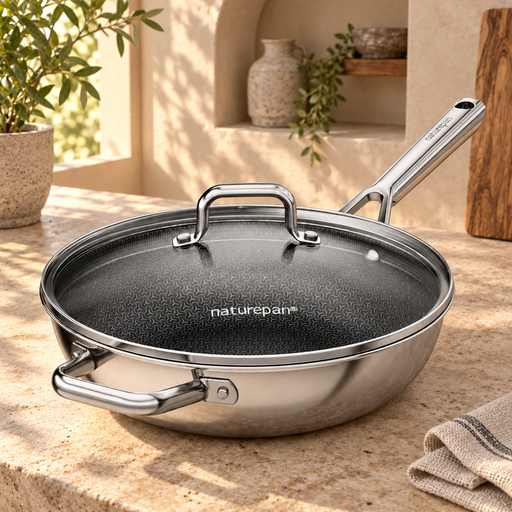
Why it suits this profile: The 7.8 cm depth is useful for stir-frying, sauces and stews. According to the product specifications, the pan is suitable for induction and oven use up to 230 °C without the lid.
The hob compatibility, depth, lid and oven limitation are clearly specified. Hand washing is recommended to help keep the ceramic coating in good condition for longer.
Induction-compatible, deep body, included lid and oven resistance up to 230 °C without the lid.
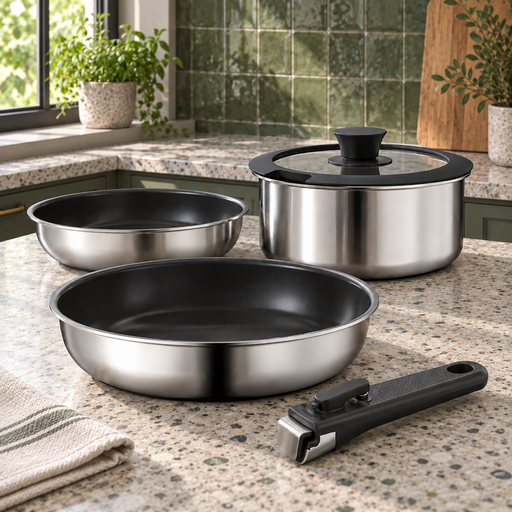
Why it suits this profile: The set includes two frying pans, a saucepan, a lid and a removable handle. This is practical for a campervan, student accommodation or a kitchen with limited cupboard space.
The set states that it is induction-compatible and has a removable handle. Always check that the handle is fully locked in place before use.
Five pieces, stackable design, dishwasher suitability and compatibility with induction, gas, electric and ceramic hobs.
We have put together a complete, up-to-date list of products that fully meet these strict selection criteria and the applicable European safety regulations.
A dishwasher-safe frying pan is convenient, but hand washing may be a sensible choice for coated models. Always follow the manufacturer’s care instructions.
Only choose a model that explicitly states it is induction-compatible. According to their product specifications, the Naturepan models, PURECOOK Tri-Ply pans and Sanho ceramic pans in this selection are suitable for induction. The Tefal Easy Cook & Clean models mentioned are not suitable for induction hobs.
Its lifespan depends on the temperature, frequency of use, utensils and cleaning method. Avoid overheating, metal spatulas and sudden changes in temperature. A stainless steel frying pan without a traditional coating may have different care requirements, but careful use remains important in all cases.
A 28 cm frying pan is practical for larger portions, vegetables, meat and stir-fries. Do check the diameter of the cooking zone, the weight and the available storage space. For one person or a compact kitchen, a 20 to 24 cm pan may be more convenient.
