
Vandaag of morgen in huis

Kwaliteit gegarandeerd

Welkomstaanbiedingen ontgrendelen: GRATIS bezorging | Tot 80% korting | Gratis 30 dagen JoyPlus-proefperiode
Download de app
A frying pan may seem simple to choose, until you need to consider your hob, the material, size, coating and maintenance. A pan that works well on gas is not automatically suitable for induction. And a large non-stick pan can be impractical if its handle is not oven-safe.
With this buying guide, you can compare the most important features of a frying pan. This helps you avoid a poor purchase and choose the right pan for everyday frying, searing, stir-frying or simmering.
Always check the official product specifications. An induction frying pan needs a magnetically compatible base. Some aluminium pans work on gas, electric and ceramic hobs, but not on induction. The 32 cm Tefal Easy Cook & Clean is a clear example: this pan is suitable for gas, electric, ceramic and glass-ceramic hobs, but specifically not for induction.
Also pay attention to the diameter of the base. On induction, a pan will generally work more efficiently when the base sits neatly over the cooking zone.
A non-stick frying pan can make it easier to cook foods such as eggs, fish or pancakes without them sticking. However, this does not mean that every coating can withstand high temperatures, metal utensils or abrasive cleaning. With a coated pan, preferably use wooden or silicone utensils and allow the pan to cool before washing it.
A PFAS-free frying pan, such as the Brabantia DUSK, uses a ceramic coating without PFAS, according to the product information. With other models, always check exactly what is stated about the coating. A brand claim about performance or durability should be read as information from the manufacturer, not as a universal guarantee.
A 24 cm frying pan is practical for smaller portions and households of up to around three people. A 28 cm frying pan offers more cooking space for vegetables, meat or several eggs. For larger quantities, a deep pan or electric frying pan may be more convenient.
Also consider the height of the sides. A low grill pan is suitable for creating grill marks, while a deep frying pan with a lid is better suited to stir-fries, sauces and slow-cooked dishes.
A multi-layer base, such as that found on a tri-ply pan, often combines stainless steel with aluminium. According to PURECOOK product information, the 304 stainless steel pan consists of stainless steel, an aluminium core and another layer of stainless steel. When buying, always check the complete material construction rather than relying solely on the marketing name.
Before buying, check these three points:
According to the product description, the Brabantia DUSK is suitable for all the hobs listed above, oven-safe up to 200 °C and dishwasher-safe. However, hand washing with a soft sponge is recommended to help preserve the ceramic coating for longer. According to the product specifications, the 24 cm WMF Profi is oven-safe up to 250 °C and dishwasher-safe.
Use this guide:
A large pan on a small cooking zone may heat unevenly. A smaller pan on a large induction zone may also work less efficiently.

Why it suits this profile: Its size is manageable for smaller households, and the pan is suitable for induction, gas, electric, ceramic and halogen hobs.
The product information clearly states which hobs it is suitable for, that it has a PFAS-free ceramic coating and that its maximum oven temperature is 200 °C.
24 cm, ceramic non-stick coating, oven-safe and dishwasher-safe according to the product specifications.
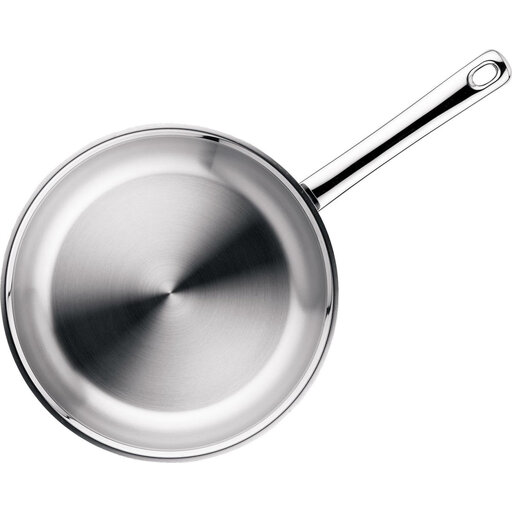
Why it suits this profile: This stainless steel frying pan is ideal for anyone looking for a coating-free pan for searing, frying and long-term everyday use.
The pan is suitable for all heat sources, including induction, and the product specifications mention a TransTherm base for even heat distribution.
18/10 Cromargan stainless steel, oven-safe up to 250 °C and dishwasher-safe according to the product information.
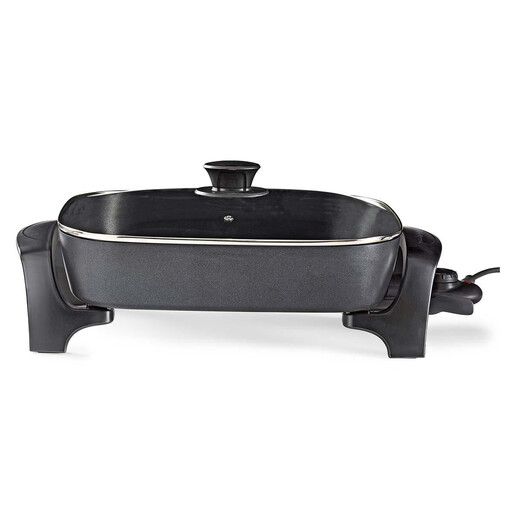
Why it suits this profile: The 7-litre deep pan is designed for large family meals, batch cooking and preparing food in places without a hob.
The pan has an adjustable thermostat and a detachable temperature control plug. The plug must not be immersed in water.
40 cm diameter, 7-litre capacity, 2200 W power, glass lid and ceramic non-stick coating according to the product specifications.
We have put together a complete, up-to-date list of products that fully meet these strict selection criteria and the applicable European safety regulations.
A frying pan with a lid is practical for simmering, reducing sauces and keeping dishes warm. Check whether the lid is included with the pan, as this is not standard with every model. According to the product information, the 28 cm PURECOOK Tri-Ply 304 comes with a glass lid and is suitable for several types of hob.
If you need several sizes, you could consider a frying pan set. Check whether all the pans have the same coating, base and hob compatibility. A set is not automatically better value if you regularly use only one size.
A grill pan with ridges is suitable for meat, vegetables and toasted sandwich-style dishes, but its cooking surface is less flat. The 23 x 27 cm Tefal Jamie Oliver grill pan has an aluminium construction, titanium coating and stainless steel induction base, and is dishwasher-safe according to the product information.
For one or two people, 20 to 24 cm is often sufficient. For a family or several portions, 26 to 28 cm is a sensible choice. Choose 30 cm or larger if you regularly prepare large quantities. Also check the diameter of your cooking zone.
This varies by model. Check the maximum temperature and the handle material. According to the product specifications, the Brabantia DUSK is oven-safe up to 200 °C, while the WMF Profi can be used up to 250 °C. Do not use a pan in the oven unless it is specifically described as oven-safe.
Its lifespan depends on the material, use and maintenance. A stainless steel or enamelled cast iron pan does not have a traditional non-stick coating that can wear away, but it can still be damaged through incorrect use. With a coated pan, you can extend its lifespan by avoiding overheating, metal utensils and abrasive cleaning products. Check the coating, base and handle attachment regularly.
