
Vandaag of morgen in huis

Kwaliteit gegarandeerd

Welkomstaanbiedingen ontgrendelen: GRATIS bezorging | Tot 80% korting | Gratis 30 dagen JoyPlus-proefperiode
Download de app
A frying pan might seem like a simple purchase, but the difference between a pan you enjoy using and one you regret buying often comes down to the details. Think of a coating that gets damaged quickly, a base that doesn’t work properly on induction, or a pan that’s too small for a family meal.
So don’t rely on terms such as “non-stick”, “granite” or “extra durable” alone. Always check the material, heat source compatibility, care instructions and exact dimensions. Use the points below to compare models based on verifiable product specifications rather than marketing claims.
Not every aluminium frying pan works on induction. A standard aluminium pan will usually need a suitable induction base. So check whether the product information explicitly states that it is suitable for induction.
For example, the 28 and 32 cm Tefal Easy Cook & Clean models are suitable for gas, electric, ceramic and glass-ceramic hobs, but according to the product specifications, not for induction. So an induction frying pan needs more than just an aluminium body: the base construction is what matters.
A non-stick frying pan needs to be used with care. Metal utensils, steel wool, heating the pan empty for too long and sudden temperature changes can all damage the coating. And “dishwasher-safe” doesn’t mean the coating will remain unchanged in the long term.
Check the care instructions. Some pans are dishwasher-safe, but hand washing is recommended to help the coating last longer.
A 20 cm frying pan is handy for one omelette or a small portion. For two to four people, a 24 cm frying pan or 28 cm frying pan is usually more versatile. A 32 cm frying pan offers more cooking space, but you’ll also need enough room on the hob and somewhere sturdy to store it.
A larger pan isn’t automatically more convenient. On a small cooking zone, the heat may not be distributed as evenly.
An aluminium frying pan usually heats up quickly and is relatively lightweight. That makes it handy for everyday frying and sautéing. However, aluminium needs a base or coating that’s compatible with your hob.
A stainless steel frying pan without a non-stick coating can last a long time and withstand high temperatures. Cooking technique matters more: according to the Maxcook Tri-Ply wok’s product information, the “hot pan, cold oil” method over a medium-low heat helps prevent food from sticking. Stainless steel needs a little more attention than a coated pan.
Multi-layer constructions, such as stainless steel-aluminium-stainless steel, are designed to distribute heat more quickly and evenly. This construction is listed in the product specifications for the PURECOOK Tri-Ply 304 models. Always check the instructions for preheating and cleaning.
If you’re looking for a PFAS-free frying pan, check the full product description. A ceramic coating isn’t automatically PFAS-free; the manufacturer must state this clearly.
The Brabantia Onyx and Brabantia Nocta are listed as having a PFAS-free ceramic coating, according to the product information. The Redchef Gemstone products also state in their product specifications that the ceramic coating is free from PFAS, PTFE, PFOA, Teflon, lead and cadmium. These are claims made by the brands concerned, so always check the latest packaging and specifications before buying.
“Healthy frying pan” isn’t an official product category. Instead, look for specific information about the coating, material, operating temperature and care instructions. Stop using a pan if the coating is visibly peeling or damaged.
A deep frying pan with a lid is handy for sauces, stews, stir-fries and larger quantities. A glass lid lets you keep an eye on your food without continually letting heat and moisture escape.
Check the maximum oven temperature, too. The product information for the 20 cm PURECOOK deep pan lists a glass lid and dishwasher-safe construction, while the 28 cm Redchef Gemstone is listed as oven-safe up to 450 °C in its product specifications. Only use pans at these temperatures if the latest instructions confirm they’re suitable, and check the handle material.
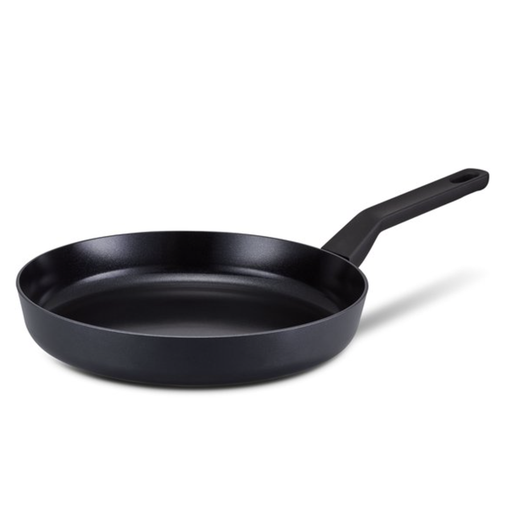
Why it suits this shopper: Its compact size is ideal for eggs, omelettes and small portions. According to the product information, this pan is suitable for induction, gas, electric, ceramic and halogen hobs.
The product specifications clearly list compatible heat sources and state that the pan has a PFAS-free ceramic coating. Hand washing is recommended to help the coating last longer.
20 cm diameter, aluminium body, ceramic coating and dishwasher-safe, according to the product information.
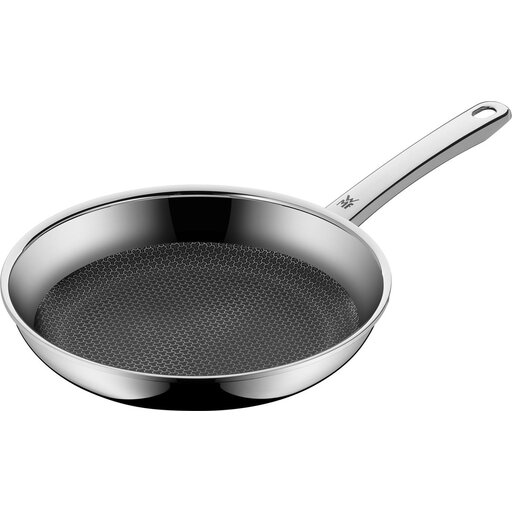
Why it suits this shopper: According to the product information, this pan combines an aluminium core with stainless steel and a PermaDur non-stick coating. Its size is well suited to everyday meals for several people.
The three-layer construction is clearly described. The pan isn’t dishwasher-safe and needs to be hand-washed, so you can factor the care requirements into your decision beforehand.
28 cm diameter, suitable for induction and other heat sources, and heat-resistant up to 260 °C according to the product specifications.
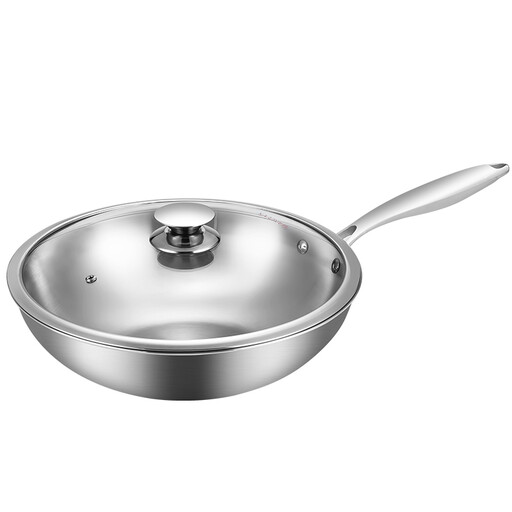
Why it suits this shopper: This wok is designed for stir-frying, searing and cooking at higher temperatures. According to the product information, it has no non-stick coating and works on induction, gas, electric and ceramic hobs.
With no coating, there’s no risk of metal utensils damaging one. Stainless steel still needs to be preheated correctly and hand-washed with a soft sponge.
304 stainless steel, composite base, glass lid and dishwasher-safe, according to the product information.
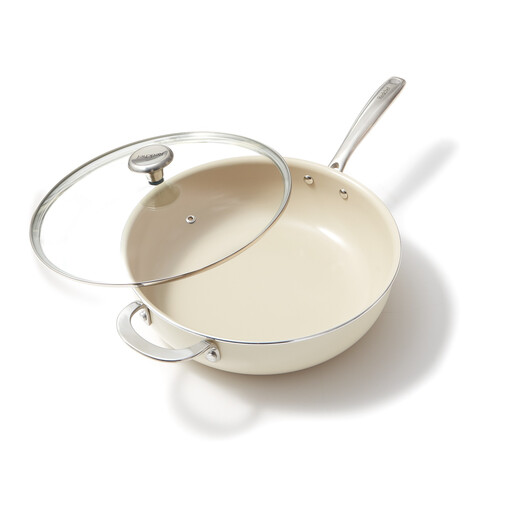
Why it suits this shopper: According to the product information, its deep shape, 5-quart capacity and glass lid make it suited to larger meals, sautéing, stewing and deep-frying.
The product specifications list compatible heat sources, the maximum oven temperature and care instructions. Hand washing is recommended to help the ceramic coating last longer.
Cast aluminium, ceramic non-stick coating, glass lid, suitable for induction, and dishwasher- and oven-safe according to the product information.
We’ve put together a complete, up-to-date list of products that meet these strict selection criteria and the applicable European safety regulations.
A 20 or 24 cm pan is handy for one person. A 28 cm frying pan suits most households and has room for several portions. Choose 32 cm if you often cook for a family, but check that the pan fits your cooking zone.
Choose a model that’s explicitly listed as suitable for induction in the product specifications. A ceramic or aluminium frying pan will only work on induction if its base is designed for it. Also check that the diameter matches your induction zone.
It depends on how you use it, the temperature and how well you care for it. Don’t use sharp metal utensils, avoid heating the pan empty for too long, and let it cool before washing. A stainless steel frying pan without a coating may need different care, but it won’t have a non-stick coating that can wear away. If the coating is visibly damaged or peeling, it’s best to replace the pan.
