
Vandaag of morgen in huis

Kwaliteit gegarandeerd

Welkomstaanbiedingen ontgrendelen: GRATIS bezorging | Tot 80% korting | Gratis 30 dagen JoyPlus-proefperiode
Download de app
A frying pan may seem like a simple purchase, but differences in size, base, coating and care can make a big difference to how enjoyable it is to cook with. A pan that works well for an omelette may be less suitable for a family meal or an induction hob.
So don’t focus only on terms such as ‘non-stick’, ‘ceramic’ or ‘durable’. Always check the product specifications. This helps you avoid buying a pan that’s too small, won’t work on your hob or becomes difficult to clean after a short time.
Not every aluminium pan works on induction. Look for an explicit mention of induction compatibility or check the description of the base. A universal base, such as the TransTherm base on the WMF NordicProfi-Frying Pan, is designed to work with several heat sources.
Also check the size of your cooking zone. A small 20 cm frying pan can be practical for one person, but it won’t always heat evenly on a large induction zone.
An non-stick frying pan still needs to be used with care. Metal utensils, heating it empty for too long and scouring pads can damage the coating. Even a dishwasher-safe pan may wear out more quickly if it’s repeatedly cleaned in the dishwasher.
Some models are described as dishwasher-safe, but hand washing is recommended to help preserve the coating. So always check both recommendations.
A 20 cm pan is compact, but offers less room for several ingredients. For a family or for batch cooking, a deep sauté pan, wok or electric frying pan is often more practical. As well as the diameter, check the height of the sides, capacity and available storage space.
Use this guide as a practical rule of thumb:
So a small 20 cm frying pan isn’t automatically a cost-effective choice if you usually cook for several people.
An aluminium pan usually heats up quickly and is relatively lightweight. Cast aluminium often has a sturdier, thicker construction. Stainless steel can last a long time, but requires more care to prevent food sticking and manage the temperature.
With a ceramic frying pan, check exactly what the description means. Often, it’s an aluminium pan with a ceramic coating, not a pan made entirely of ceramic. For PFAS-free models, the product information should state this clearly. For example, Brabantia describes the Onyx pan as having a 100% PFAS-free ceramic coating. This is a brand specification, not a general feature of every ceramic pan.
Terms such as ‘extra durable’ or ‘five times harder’ are also brand claims. According to Sanho, its diamond-titanium coating is harder and more durable than standard non-stick coatings. Treat claims like these as supplementary information and check the specific care instructions too.
Before you buy, check:
An electric frying pan works independently of a hob, but needs a power socket and a stable, heat-resistant surface. The Nedis pan, for example, has a detachable temperature control, which must not be immersed in water.
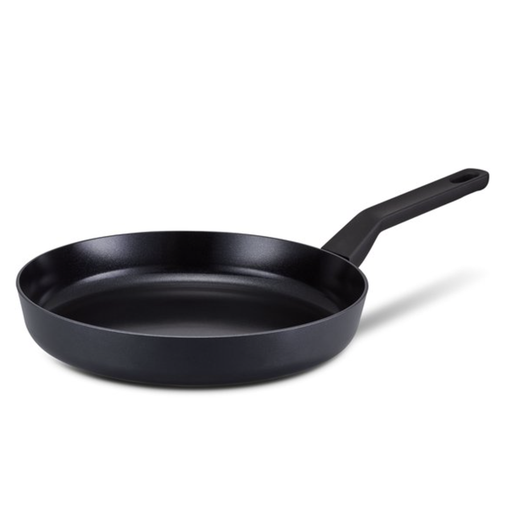
Why it suits this profile: Its compact size is practical for students, people living alone and smaller portions. According to the product information, it works on induction, gas, electric, ceramic and halogen hobs.
The specifications explicitly state that it has a PFAS-free ceramic coating and is suitable for induction. So you don’t have to make assumptions about these important features.
20 cm, 100% recycled aluminium according to the product description, ceramic coating and dishwasher-safe. Hand washing is recommended to help preserve the pan for longer.
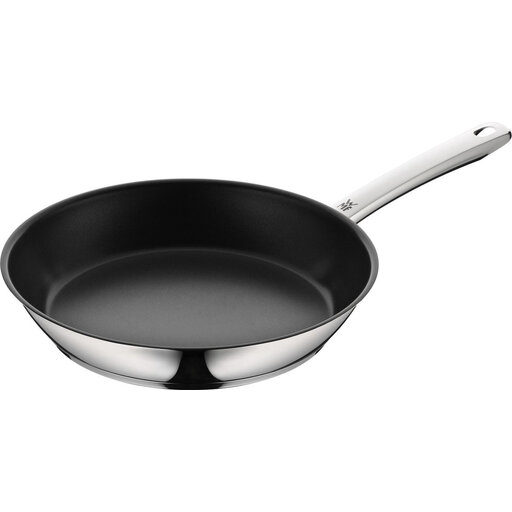
Why it suits this profile: This pan combines stainless steel, a PFOA-free non-stick coating according to the product information, and compatibility with all hobs. It’s also oven-safe up to 250 °C.
The product specifications clearly state which heat sources it works with, its maximum oven temperature and that it should be hand washed. This helps avoid incorrect expectations about using the dishwasher.
TransTherm universal base, stainless steel handle and oven-safe up to 250 °C. The product description says it must be hand washed.
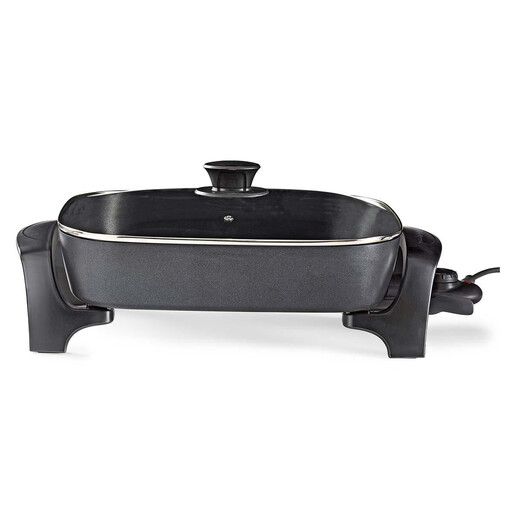
Why it suits this profile: Its generous 7-litre capacity and 2200 W power make it a good fit for families, batch cooking and dishes that need more room than a standard hob can provide.
The pan isn’t limited by the diameter of a hob cooking zone. Its thermostat is detachable, and the product specifications state that the pan and lid are dishwasher-safe.
7-litre capacity, adjustable thermostat, ceramic non-stick coating, glass lid and cool-touch handles. The temperature control must not be immersed in water.
We’ve put together a complete, up-to-date list of products that meet these strict selection criteria and the applicable European safety regulations.
A wok with a flat base is suitable for stir-frying, while a deep sauté pan offers more room for sauces, stews and one-pot meals. A frying pan with a lid is useful when you want to cook ingredients through without making a mess with splashes.
An electric pan with a capacity of 2 to 2.3 litres can be practical for students or smaller households. According to the product information, the IAGREEA Rapid Ramen Cooker has three settings and a capacity of 2.3 litres. The Plodon pan has two heat settings and a capacity of 2 litres. When choosing an electric pan, always check the power rating, EU plug, overheat protection and maximum fill instructions.
A 20 cm pan is often enough for one person. A 24 to 28 cm pan is more versatile for two to three people. Families and anyone who likes to cook ahead may want to look at a pan measuring 30 cm or more. A larger pan does take up more storage space and needs a suitably sized cooking zone.
That depends on the base, not just the ceramic coating. Check whether the manufacturer explicitly says it’s suitable for induction. Models such as the Brabantia Onyx, WMF Durado and various Sanho pans are listed as suitable for induction in their product information.
Its lifespan depends on how you use it, the temperature and how you care for it. Don’t heat the pan empty for too long, use wooden or silicone utensils and let it cool before cleaning. Replace the pan if the coating starts to peel or becomes damaged. Is a PFAS-free frying pan automatically suitable for healthy cooking?
PFAS-free describes the stated coating, but doesn’t tell you everything about how you cook. Read the product specifications and follow the instructions for use. Cooking with less oil can be practical, but a balanced meal depends on more than just the pan.
