
Vandaag of morgen in huis

Kwaliteit gegarandeerd

Welkomstaanbiedingen ontgrendelen: GRATIS bezorging | Tot 80% korting | Gratis 30 dagen JoyPlus-proefperiode
Download de app
A frying pan may seem like a simple purchase, until you have to choose between aluminium, stainless steel, ceramic, cast iron, a non-stick coating and different sizes. Terms such as “PFAS-free”, “all hobs” and “oven-safe” also deserve a closer look. A pan that works well on a gas hob is not automatically suitable for induction.
As a Joybuy Product Recommendation Officer, I filter the most important product specifications for you. This makes it easier to assess marketing claims and choose a frying pan that suits your hob, cooking style and cleaning routine.
An aluminium pan without a magnetic base will usually not work on induction. So check whether the product description explicitly mentions induction compatibility. One example is the 28 cm Tefal Easy Cook & Clean: according to the product specification, it is suitable for gas, electric and ceramic cooking, but not for induction.
A frying pan for all hobs generally has a magnetic stainless steel base or a multi-layer construction. Also pay attention to the base diameter. A 28 cm pan may have a smaller effective heating area.
PFOA is just one substance within the wider PFAS group. A product labelled “PFOA-free” is therefore not automatically a PFAS-free frying pan. Look for an explicit mention of “PFAS-free” or “without intentionally added PFAS”, and always check the official product information.
According to the product description, the Brabantia DUSK frying pan features a PFAS-free ceramic non-stick coating. Other models only mention PFOA, PFOS or a combination of the two. This distinction matters if avoiding PFAS is a specific priority for you.
A non-stick frying pan will generally remain usable for longer if you avoid metal utensils, do not overheat the pan when empty and avoid thermal shock. “Scratch-resistant” or “durable” does not mean that every type of use is suitable.
With ceramic and traditional non-stick coatings, hand-washing is often the wiser option, even if the product information states that the pan is dishwasher-safe. A damaged or flaking coating is a practical sign that it is time to replace the pan.
A stainless steel frying pan is suitable for searing and high temperatures, but requires more control over preheating and the amount of cooking fat used to limit sticking. A multi-layer pan with an aluminium core can distribute heat across the base more quickly.
According to the product description, the 28 cm PURECOOK Tri-Ply 304 uses a construction of stainless steel, aluminium and stainless steel. The manufacturer describes this as a structure designed to distribute heat quickly and evenly. This is a product specification, not a guarantee that every dish will cook without sticking.
Aluminium pans often heat up quickly and are relatively light. A ceramic frying pan often combines this material with a coating designed to help food release easily. Cast iron retains heat for a long time, but is heavier and less quick to manoeuvre.
Also check the weight. A large cast-iron pan can be considerably heavier than an aluminium model. A wide pan with a low rim is handy for frying and turning food, while a deep frying pan is better for sauces, simmering and dishes with lots of ingredients.
A frying pan with a lid is useful for simmering, reducing sauces and keeping food warm. Check whether the lid is included or needs to be purchased separately. When using the pan in the oven, check the maximum temperature for the pan, lid and handle.
According to the product information, the PURECOOK Tri-Ply 28 cm comes with a glass lid and is oven-safe up to 220 °F, which converts to approximately 104 °C. This is not the same as a pan suitable for high oven temperatures. The stated specifications for the Brabantia DUSK describe it as oven-safe up to 200 °C.
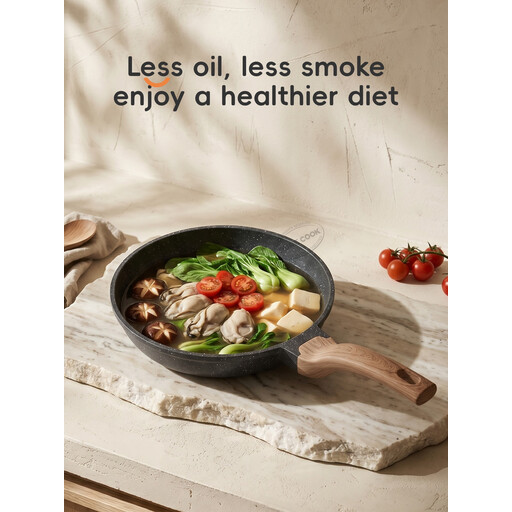
Why it suits this profile: A lightweight 24 cm pan for everyday frying, breakfast and smaller portions on induction, gas or ceramic hobs.
The product description explicitly states compatibility with induction, gas and ceramic hobs. The pan is not dishwasher-safe, so hand-washing is part of its care.
Aluminium body, stone-effect non-stick coating, wooden handle and a smooth pouring rim.
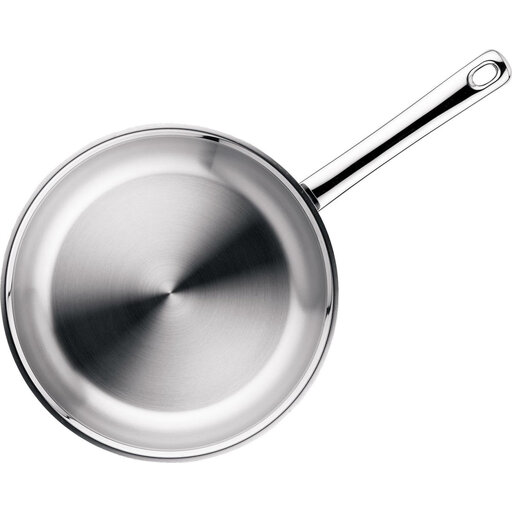
Why it suits this profile: A stainless steel frying pan for anyone who often sears meat, fish or vegetables and wants an oven-safe pan.
The specifications mention a TransTherm base, suitability for induction and all other common heat sources. The pan is oven-safe up to 250 °C.
18/10 stainless steel, dishwasher-safe, suitable for induction and supplied with a 2-year manufacturer’s warranty.

Why it suits this profile: A spacious frying pan with a lid for stir-frying, simmering and cooking for several people.
The three-layer stainless steel and aluminium construction, along with compatibility with gas, induction, electric and ceramic cooking, is clearly stated. However, check the limited oven temperature of 220 °F.
28 cm cooking surface, glass lid, product information stating that it is dishwasher-safe, and 304 stainless steel as the main material.
We have put together a complete, up-to-date list of products that fully meet these strict selection criteria and the applicable European safety regulations.
For one or two people, 20 to 24 cm is often sufficient. A 28 cm frying pan offers more room for family meals and stir-fries. Make sure the base matches the cooking zone, particularly with induction.
Choose a model that explicitly states that it is suitable for induction. Stainless steel is only suitable if the base is magnetic or contains a suitable induction layer. An aluminium pan without a magnetic base will not work on induction.
This depends on use, temperature and care. Do not use metal utensils, avoid overheating and wash the pan according to the instructions. Once the coating becomes visibly damaged or the pan warps, replacing it is advisable.
