
Vandaag of morgen in huis

Kwaliteit gegarandeerd

Welkomstaanbiedingen ontgrendelen: GRATIS bezorging | Tot 80% korting | Gratis 30 dagen JoyPlus-proefperiode
Download de app
A new frying pan seems like a simple purchase – until eggs start sticking, the base warps or the handle gets too hot. Your hob also plays a big part in the choice: induction requires a magnetic base, while gas, electric and ceramic hobs each have their own requirements.
So don’t rely on terms such as ‘granite’, ‘healthy’ or ‘super non-stick’. Check the product specifications and care instructions instead. That way, you can avoid the most common buying mistakes.
A pan may be described as suitable for gas and electric hobs, but that doesn’t automatically mean it will work on induction. Look for a magnetic stainless steel base or an explicit statement that the pan is induction-compatible. If you’re unsure, check the diameter of both the hob zone and the pan base.
A non-stick frying pan may be dishwasher-safe, but manufacturers often recommend hand-washing to help the coating last longer. Abrasive sponges, metal spatulas, high temperatures and leaving an empty pan on the hob can all shorten its lifespan.
‘PFOA-free’, ‘PFAS-free’ and ‘PTFE-free’ don’t mean the same thing, either. According to a brand’s product information, a coating may be made without intentionally added PFOA, but that doesn’t automatically mean the pan is completely PFAS-free. Check the exact claim rather than relying on the marketing name alone.
A 20 to 24 cm pan is handy for one or two portions, eggs and pancakes. For a family, 26 to 28 cm is often more practical. A large frying pan of around 30 cm gives you more room, but you’ll also need a hob zone to match and enough storage space.
Aluminium usually heats up quickly and is relatively lightweight. A die-cast aluminium pan may be described as resistant to warping, but you should still handle it carefully when temperatures change sharply. Stainless steel is sturdy and suitable for intensive use, but it still needs the right cleaning method if it has a non-stick coating or honeycomb structure.
An induction frying pan has a magnetic base. For gas, electric and ceramic hobs, a flat base is important for even heat transfer. If you use different types of hob, look for a frying pan suitable for all heat sources.
A ceramic frying pan is often chosen for a coating described in the product information as containing no PFAS or PTFE. When buying a PFAS-free frying pan, always check the brand’s exact wording. A manufacturer’s claim isn’t an independent finding, so be cautious about what you expect.
For traditional non-stick coatings, the product information usually recommends using silicone, wooden or nylon utensils. Even if a pan is described as scratch-resistant, sharp metal utensils can still cause damage.
A pan may be oven-safe, but the maximum temperature varies by model. Some pans have an oven-safe handle up to around 200–230 °C; with others, only the pan itself can go in the oven. Check before moving a dish from the hob to the oven.
A frying pan with a lid or a deep sauté pan is suitable for simmering, sauces and one-pot meals. A standard frying pan is usually more practical for frying and flipping food. Check the care instructions, too: some models are dishwasher-safe, while others should only be hand-washed.
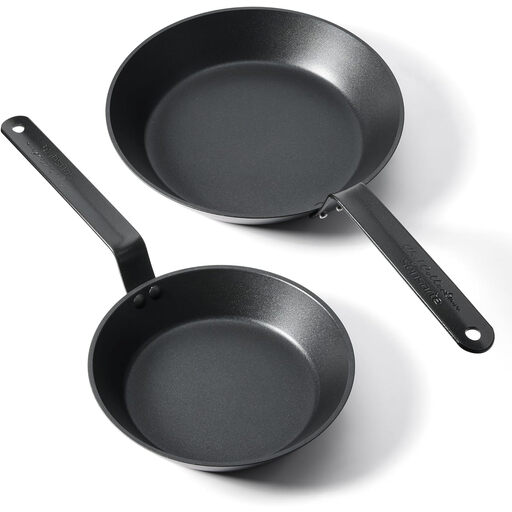
Why it suits this type of cook: The set includes 20 and 25 cm pans and is described as suitable for induction, gas, electric and ceramic hobs. It’s a practical choice if you’re looking for a basic set for everyday meals.
The listed specifications confirm induction compatibility and a coating made without PFOA or PFOS. Hand-washing is recommended to protect the coating.
Lightweight aluminium, deep sides, oven-safe up to 450 °F according to the product information, and suitable for a range of hobs.
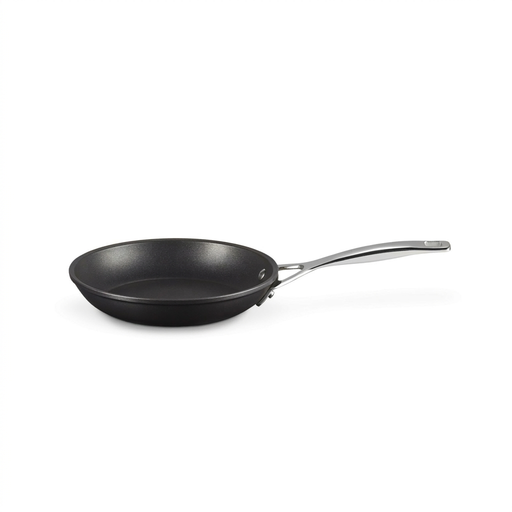
Why it suits this type of cook: The 28 cm diameter gives you plenty of room for family-sized portions, and the pan is described as suitable for induction and other hobs.
The specifications list a reinforced non-stick coating and a PFOA-free coating. Follow the instructions and use wooden, plastic or silicone utensils.
28 cm diameter, aluminium body, stainless steel handle, and oven- and dishwasher-safe according to the product description.
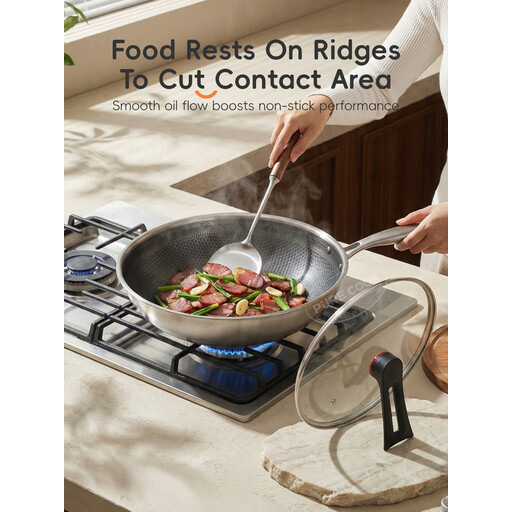
Why it suits this type of cook: This wok is designed for stir-frying, sautéing, stewing and cooking larger portions. The glass lid lets you keep an eye on your food without having to lift it each time.
The product information lists a three-layer 304 stainless steel construction, compatibility with induction, gas and ceramic hobs, and hand-washing as the recommended care method.
32 cm cooking surface, glass lid, honeycomb structure and compatible with metal utensils according to the product description.
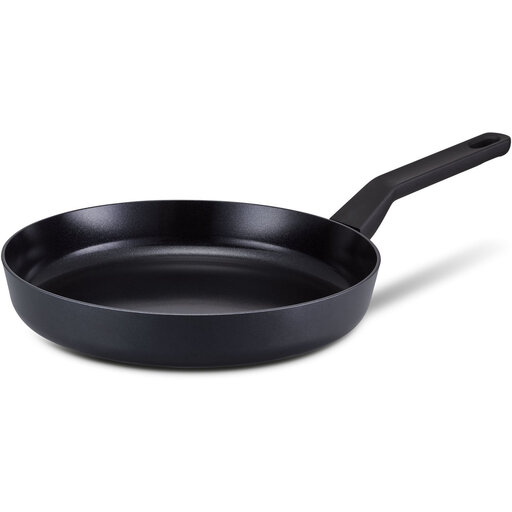
Why it suits this type of cook: This compact model is designed for everyday cooking in smaller households. It’s listed with a PFAS-free ceramic coating and is compatible with induction hobs.
According to the product information, the ceramic coating is 100% PFAS-free. Hand-washing and wooden, silicone or plastic utensils are recommended to help preserve the coating.
24 cm diameter, recycled aluminium, double ceramic non-stick coating, and suitable for gas, electric, ceramic and induction hobs.
We’ve put together a complete, up-to-date list of products that meet these strict selection criteria and current European safety regulations.
Choose a standard frying pan for eggs, meat, vegetables and pancakes. A sauté pan has higher sides, making it better suited to sauces, pasta and one-pot meals. A wok works well for stir-frying and larger quantities, while a ridged griddle pan is ideal for searing food and cooking heartier ingredients.
A frying pan set can be good value if you use different sizes. Just check that all the pans are compatible with your hob, have the same care requirements and share the same oven temperature limits. A set with lids is handy for simmering, but it’s often heavier and takes up more space.
It depends on how you use and care for it, and the temperatures it reaches. Don’t use metal utensils if the manufacturer advises against them, don’t heat the pan when it’s empty, and let it cool before washing. If the coating starts to peel or becomes visibly damaged, it’s best to replace the pan.
Choose a model that’s explicitly labelled induction-compatible. A magnetic stainless steel base is an important feature to look for. Also check that the base sits flat and is the right diameter for your induction zone.
No. Some ceramic models are described as PFAS-free in the product information, while others aren’t. Read the full list of materials and check whether the claim specifically refers to PFAS, PTFE, PFOA or a combination of these.
