
Vandaag of morgen in huis

Kwaliteit gegarandeerd

Welkomstaanbiedingen ontgrendelen: GRATIS bezorging | Tot 80% korting | Gratis 30 dagen JoyPlus-proefperiode
Download de app
A frying pan may seem simple, but you quickly notice when you have made the wrong choice. The pan may not be suitable for your hob, the base may warp or the non-stick coating may wear out sooner than expected. Terms such as “healthy”, “indestructible” and “suitable for all hobs” only mean something if you check the product specifications.
This buying guide helps home chefs, families and cooking enthusiasts compare frying pans by material, size, coating, care requirements and hob compatibility.
A pan may be suitable for gas, electric and ceramic hobs, but not for induction. This applies, for example, to the 28 and 32 cm Tefal Easy Cook & Clean models: according to the product information, they are suitable for gas, electric and ceramic hobs, but not for induction.
Therefore, always check explicitly whether “induction” is listed among the suitable heat sources. A magnetic stainless steel or induction disc on the base is important here.
“Non-stick” describes how a coating works, not necessarily what it is made of. For example, a ceramic frying pan may be marketed as a PFAS-free frying pan, while another non-stick coating may not make that claim.
Pay attention to the exact product label:
According to the product information, the Brabantia Onyx and Dusk are described as 100% PFAS-free. The SENSARTE models state that certain substances, including PFAS and PTFE, have not been intentionally added. Take this wording at face value and do not automatically compare it with a broader certification.
A 28 cm frying pan offers more cooking surface, but it is also heavier and requires a hob zone that is large enough. A 24 cm frying pan is often more convenient for one to three people. For an omelette, a meal for one or a small portion, 20 cm is more practical.
As well as the diameter, consider:
Aluminium generally heats up quickly and is relatively lightweight. A forged or cast aluminium pan is practical for everyday cooking, but the quality of the base and coating determines how long the pan remains pleasant to use.
Stainless steel, or a stainless steel frying pan, withstands high temperatures and often has no non-stick coating. According to the product description, the PURECOOK Tri-Ply 304 uses a construction made from stainless steel, aluminium and stainless steel. The aluminium core is designed to provide faster and more even heat distribution. With stainless steel, preheating the pan and using enough fat are important for reducing sticking.
Enameled cast iron retains heat for longer, but is considerably heavier. According to the product specifications, the 20 cm Le Creuset Signature Skillet weighs 1.51 kg. This can be useful for searing, but less practical if you often move the pan with one hand.
A non-stick frying pan is useful for eggs, pancakes and delicate fish. When using a ceramic or traditional coating, silicone, wooden or nylon spatulas are preferable. Even when a brand describes a coating as scratch-resistant, sharp metal remains an unnecessary risk.
According to the product information, Redchef advises against using metal utensils on the ceramic coating. The Brabantia Onyx and Dusk have a ceramic, PFAS-free coating with two layers, according to the product specifications. Washing by hand with a soft sponge can help extend a coating’s lifespan, even when dishwasher use is permitted.
Use this guide as a practical starting point:
A frying pan with a lid is useful for simmering, reducing sauces and dishes where moisture needs to be retained. Check that the lid is actually included; for some models, it is a separate accessory.
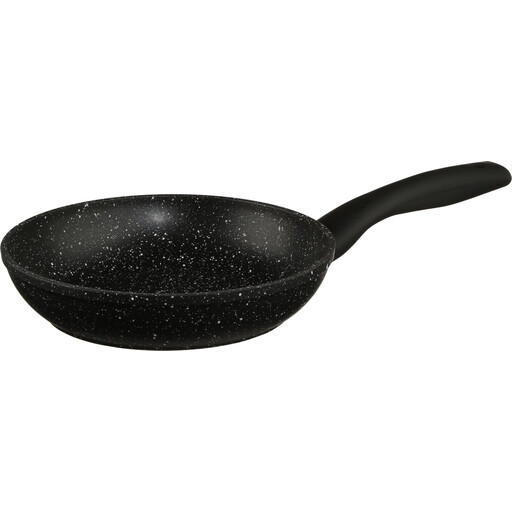
Why it suits this profile: The compact size and weight of 490 grams make it suitable for small portions and for anyone buying a versatile pan for the first time.
The product specifications list gas, induction, ceramic and electric hobs as suitable heat sources. The limited diameter is also clearly stated.
Aluminium body, two non-stick layers, a capacity of 1.9 litres and dishwasher-safe according to the product information. Hand washing is recommended.
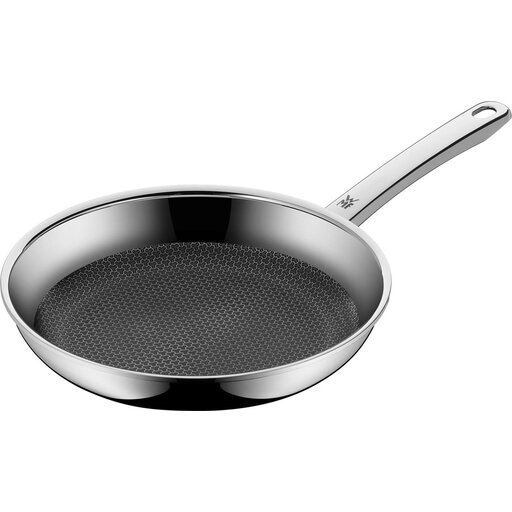
Why it suits this profile: This pan combines an aluminium core with stainless steel and a PermaDur non-stick coating. It is ideal for users who want to sear food as well as prepare delicate dishes.
Induction compatibility and a maximum heat resistance of 260 °C are specified. The pan is not dishwasher-safe, making this clear in advance.
Suitable for all heat sources according to the listing, with a three-layer construction and a 5-year manufacturer's warranty.

Why it suits this profile: The 28 cm size and glass lid are practical for families and for frying, stir-frying, simmering and preparing sauces.
The product specifications list gas, induction, electric, ceramic and halogen hobs, as well as oven use. The package contents specify one pan and one glass lid.
304 stainless steel with an aluminium core, dishwasher-safe according to the product information and oven-safe up to 220 °F as stated in the listing.
We have put together a complete, up-to-date list of products that fully meet these strict selection criteria and the applicable European safety regulations.
Allow a frying pan to cool down before washing it. A sudden change from hot to cold water can cause it to warp. Use a soft sponge and mild washing-up liquid. Even if a pan is dishwasher-safe, hand washing can help keep the coating and appearance in good condition for longer.
For a coated pan:
With a stainless steel frying pan, you can generally cook at higher temperatures, but preheating remains important. It is better to soak baked-on residue than to scrub it vigorously straight away.
Choose a model that explicitly lists induction among its suitable heat sources. A pan for all hobs will usually have a magnetic stainless steel base or induction disc. Also check that the diameter of the base matches the hob zone.
Not automatically. Ceramic refers to the type of coating. Check whether the manufacturer or seller explicitly states PFAS-free. This property is included in the supplied product information for the Brabantia Onyx, Dusk and Nocta; for other ceramic models, you should check the specifications individually.
This depends on how it is used, the temperature, the utensils and how it is cleaned. A coating can wear out more quickly due to high heat, metal spatulas, abrasive products and dishwasher use. Once the coating becomes visibly damaged or the handle comes loose, replacing the pan is safer than continuing to use it.
