
Vandaag of morgen in huis

Kwaliteit gegarandeerd

Welkomstaanbiedingen ontgrendelen: GRATIS bezorging | Tot 80% korting | Gratis 30 dagen JoyPlus-proefperiode
Download de app
A frying pan may seem like a simple product, but there are big differences between models. A pan may work on a gas hob but not an induction hob. A non-stick coating can be great for cooking eggs, but may be damaged quickly by high temperatures or metal utensils. Terms such as “ceramic”, “granite” and “PFAS-free” are not always used in the same way, either.
Use this buying guide to compare frying pans based on features you can check. That way, you can avoid a bad buy and choose a model to suit the way you cook, your household and your hob.
Diameter is not the whole story. A 24 cm pan is practical for one to three people, while a 28 to 32 cm model gives you more room to cook several portions. Check the base diameter too: a large pan with a small contact area may not heat as evenly on an induction hob.
A wide pan also takes up more room in a kitchen cupboard or dishwasher. So think about the portions you usually prepare before you buy.
A non-stick frying pan will not necessarily stay in the same condition for years. Metal utensils, scouring pads, heating an empty pan over a high heat and sudden changes in temperature can damage the coating. Even if a pan is dishwasher-safe, washing it by hand can help extend the life of the coating.
For a ceramic or other coated pan, use utensils made from wood, silicone or nylon where possible. Let the pan cool before washing it.
“PFAS-free”, “PFOA-free” and “Teflon-free” do not automatically mean the same thing. Check the full product information and see whether the claim applies to the coating. Some models state that certain substances have not been deliberately added; that is not the same as a full declaration of materials.
The information for the products below is based on the descriptions provided. Brand claims about materials and performance are therefore not presented as independently proven results.
An aluminium frying pan usually heats up quickly and is relatively lightweight. However, aluminium needs a suitable base to work on an induction hob. An integrated magnetic stainless steel layer can provide this.
A ceramic frying pan usually has a ceramic non-stick coating. According to Redchef’s product information, its Starlight models are PTFE-, PFOA- and PFAS-free. Brabantia states that its Onyx and Dusk models have a PFAS-free ceramic coating. Always check the exact version, as product specifications can vary between models.
A pan with a traditional non-stick coating can be a good choice for eggs, pancakes and fish. “Teflon-free frying pan” is not an official material category, though. Instead, look for the specific coating name and the substances listed.
Not every frying pan works on an induction hob. Check the specifications to see whether the pan is explicitly listed as suitable for:
According to its product information, the Tefal Easy Cook & Clean in 28 or 32 cm is not suitable for induction. By contrast, Redchef, Brabantia, SENSARTE and some PURECOOK models state that they are induction-compatible. Check the recommended cooking zone too, and centre the pan on the hob.
A multi-section egg pan is designed for specific uses, such as cooking several fried eggs, mini pancakes or small burgers. A round pan is more versatile for everyday cooking.
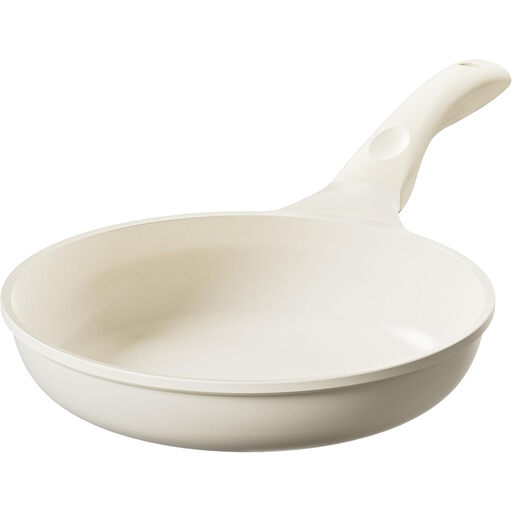
Why it suits this type of user: Its size is ideal for everyday portions and, according to the product information, the pan works on induction, gas and electric hobs. The ceramic coating makes it a good choice if you’re looking for a Teflon-free frying pan.
The hob compatibility is listed, so you don’t have to rely on the appearance or coating alone. Avoid metal utensils and overheating the pan.
24 cm size, ceramic coating and compatibility with induction, gas and electric hobs according to the product specifications.

Why it suits this type of user: According to Brabantia, this pan combines a body made from recycled forged aluminium with a PFAS-free ceramic coating. The stainless steel handle and oven safety up to 200 °C offer extra versatility.
The specifications state both the coating type and suitability for induction, gas, electric, ceramic and halogen hobs. Hand-washing is still recommended to protect the coating.
24 cm, PFAS-free ceramic coating according to the manufacturer, oven-safe up to 200 °C and suitable for induction.
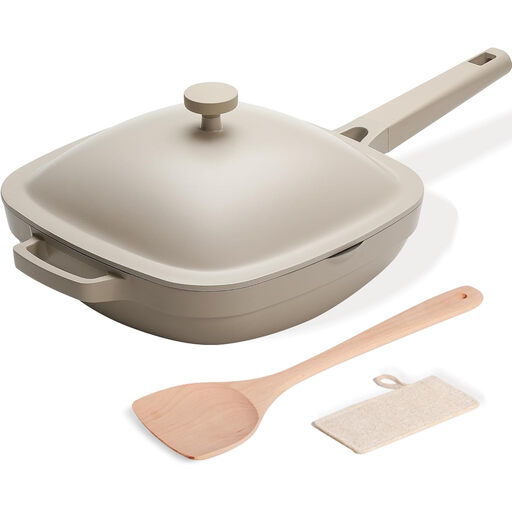
Why it suits this type of user: Its deep shape, 3.8 qt capacity and lid make it suitable for sautéing, stewing, stir-frying and meal prep. According to the product information, the pan works on all types of hobs.
The product information clearly states that this pan is not dishwasher-safe or oven-safe. This helps set the right expectations for frequent use.
Deep sauté pan with lid, 3.8 qt capacity, cast aluminium and two pouring spouts according to the product specifications.
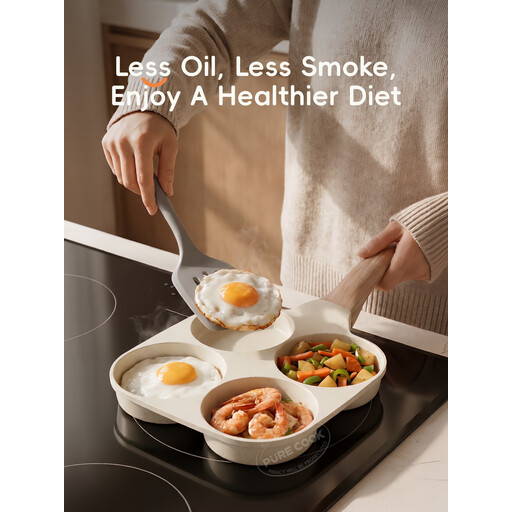
Why it suits this type of user: The four sections are designed for eggs, mini pancakes, sausages or small burgers. According to the product information, this egg pan is suitable for induction, gas and ceramic hobs.
Its specific design makes it clear what the pan is intended for. Hand-washing is recommended, so it may not be the best choice if you rely solely on a dishwasher.
Four cooking sections, a lightweight aluminium design and a wooden handle according to the product description.
We’ve put together a complete, up-to-date list of products that meet these strict selection criteria and the applicable European safety regulations.
A coating will usually last longer if you:
A dishwasher can be convenient, but always check the product specifications. Some models are dishwasher-safe, while others must be washed by hand.
A 20 cm pan is often enough for one person. A 24 cm pan is suitable for everyday portions for one to three people. Families may prefer a 28 or 32 cm pan, as long as their hob and storage space can accommodate it.
That depends on the base. Ceramic itself does not determine whether a pan works on an induction hob. Check whether the manufacturer states that it is induction-compatible. A magnetic steel layer in the base is usually needed.
Its lifespan depends on the coating, cooking temperature, utensils used and how well it is cared for. There is no set lifespan that applies to every pan. Replace it if the coating is visibly damaged or the base becomes warped.
