
Vandaag of morgen in huis

Kwaliteit gegarandeerd

Welkomstaanbiedingen ontgrendelen: GRATIS bezorging | Tot 80% korting | Gratis 30 dagen JoyPlus-proefperiode
Download de app
A frying pan may seem like a simple purchase, but you’ll soon notice if you choose the wrong one: food sticks, the base heats unevenly or the pan isn’t suitable for induction. Marketing terms such as ‘granite’, ‘ceramic’ and ‘PFAS-free’ don’t always tell the whole story either.
Joybuy’s Product Recommendation Officer has put together the key things to look out for. This will help you compare a frying pan based on verifiable features and choose a model that suits your hob, household and cooking style.
A granite frying pan usually doesn’t have a solid stone interior. In practice, it’s often an aluminium pan with a stone-effect coating. This can help food release easily, but the pan’s lifespan depends greatly on how you use, heat and care for it.
The same applies to a ceramic frying pan. Ceramic usually refers to the non-stick coating, not the entire pan. Always check the base material, recommended temperature and permitted utensils.
A 28 cm frying pan has room for several portions, but it also takes up more space on the hob. On a small induction zone, a large base may not heat as evenly either. A 24 cm frying pan is often practical for one or two people, while 28 to 30 cm is better suited to families or larger dishes.
Don’t just look at the overall size. The usable cooking surface may be smaller because of high sides or a wide rim.
A pan may be described as dishwasher-safe in the product information, while hand-washing is recommended to help preserve the coating for longer. Harsh detergents, high temperatures and contact with other dishes can put more strain on a non-stick coating.
For a non-stick frying pan, it’s best to use silicone, wooden or nylon utensils. Let a hot pan cool down before cleaning it with cold water.
Induction requires a magnetic base. Look for an induction frying pan with a magnetic stainless steel base, or one that is explicitly described as compatible with induction. A pan designed for gas isn’t automatically suitable for induction.
Also check whether the pan is suitable for:
A magnetic base makes an aluminium frying pan suitable for induction, but it doesn’t tell you the maximum oven temperature. This information should be listed separately in the product specifications.
An aluminium frying pan is relatively lightweight and heats up quickly. This makes it handy for everyday cooking and for anyone who regularly moves a pan with one hand. Forged and cast aluminium can differ in weight and shape retention.
A stainless steel frying pan usually doesn’t have a traditional non-stick coating. According to the product information, the PURECOOK models have a three-layer construction made from 304 stainless steel with an aluminium core. This type of construction is designed to distribute heat evenly, but cooking usually requires more attention to preheating and fat.
Enamelled cast iron retains heat for a long time and is suitable for searing. The trade-off is that a cast iron pan is heavier. According to the product details, the Le Creuset Signature Cast Iron Skillet, 20 cm, weighs 1.51 kg.
Don’t judge a PFAS-free frying pan by its product title alone. Check the exact wording:
According to the product information provided, the Brabantia Onyx has a 100% PFAS-free ceramic coating. Some SENSARTE models are described as having certain substances that have not been intentionally added. These phrases don’t mean the same thing and shouldn’t be used interchangeably.
If you often make pancakes, a dedicated pancake pan may be a better choice. For meat, vegetables and chargrilled lines, a grill pan is a more suitable option. A frying pan with a lid is handy for simmering, reducing sauces and cooking dishes where you want to retain moisture.
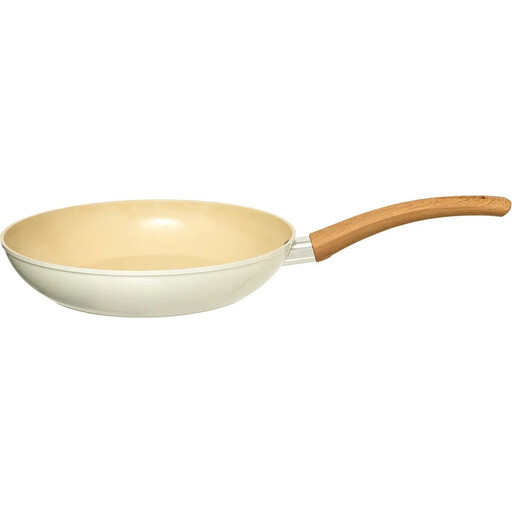
Why it suits this profile: The 24 cm diameter is practical for everyday cooking, and the 440-gram weight makes the pan easy to handle. According to the product information, it’s suitable for gas, induction, ceramic and electric hobs.
The product specifications clearly state the size, body material and compatible heat sources. Hand-washing is recommended to help preserve the two non-stick layers for longer.
Recycled aluminium, 24 cm diameter, two non-stick layers and a soft-touch handle.

Why it suits this profile: This 28 cm pan with a glass lid is a good fit if you want to fry, sear and simmer. According to the product description, its three-layer construction consists of stainless steel and an aluminium core.
The material construction, diameter and compatibility with gas, induction, electric and ceramic hobs are all listed. The lid makes it easier to keep an eye on food while it simmers.
304 stainless steel, three-layer base, glass lid and oven use according to the stated product specifications.
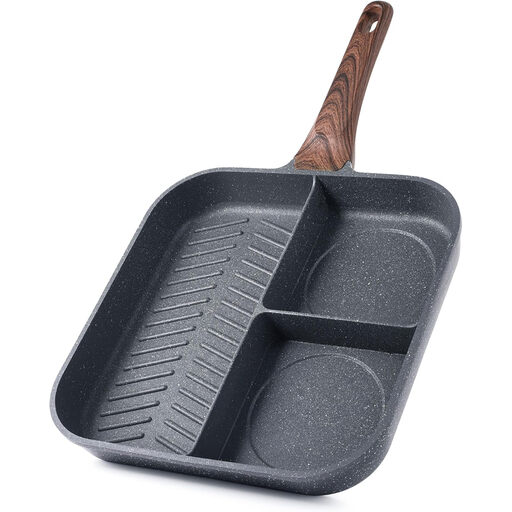
Why it suits this profile: The three separate sections are designed for breakfast, burgers, sausages, eggs and vegetables. This makes the grill pan a good choice when you want to cook several ingredients at once.
The product information explicitly states that the pan isn’t oven-safe or dishwasher-safe. This helps you understand its care and use requirements in advance.
Three cooking sections, non-stick coating, induction compatibility and raised grill ridges. Hand-washing is required.
We’ve put together a complete, up-to-date list of products that meet these strict selection criteria and the applicable European safety regulations.
A frying pan’s lifespan depends on more than just its brand or material. These habits can help:
A cookware set can be good value if you need several sizes. If you mainly need one pan for everyday use, buying a single frying pan means you won’t pay for pieces that end up unused in the cupboard.
Choose a model that explicitly lists induction as a compatible heat source. An aluminium pan will usually need a magnetic stainless steel base. Also check that the base is the right size for your induction zone.
It depends on the coating, how often you use it and how well you care for it. High heat, metal utensils, scouring pads and dishwasher use can speed up wear. Follow the manufacturer’s care instructions and stop using the pan if the coating is visibly damaged.
Yes, particularly for simmering, cooking vegetables and reducing sauces. A glass lid lets you keep an eye on your food without repeatedly lifting it. A lid is less essential for quick frying or making pancakes.
