
Vandaag of morgen in huis

Kwaliteit gegarandeerd

Welkomstaanbiedingen ontgrendelen: GRATIS bezorging | Tot 80% korting | Gratis 30 dagen JoyPlus-proefperiode
Download de app
Choosing a new frying pan seems straightforward until you consider the coating, base, size and care requirements. A pan that looks light and versatile in the shop may prove impractical at home: too small for a family meal, unsuitable for induction or difficult to clean.
Pay particular attention to these common pitfalls:
A stainless steel frying pan made from 304 or 18/10 stainless steel does not have a traditional non-stick coating. This makes it suitable for searing, deglazing and cooking at high temperatures, but you need to preheat it properly and use enough fat to reduce sticking.
An aluminium pan generally heats up quickly. Aluminium is often combined with a coating or a stainless steel induction base. A non-stick frying pan is practical for eggs, pancakes, fish and delicate ingredients. Ideally, use wooden, silicone or plastic utensils, and avoid heating the pan empty for prolonged periods.
A ceramic frying pan has a ceramic non-stick coating. Check that the product description explicitly states whether it is PFAS-free. “PFOA-free” does not automatically mean that a pan is free from all PFAS. Look for a clear claim such as “100% PFAS-free” or “free from intentionally added PFAS”, and treat this as a product specification provided by the brand.
Cast iron retains heat for a long time and is suitable for high-heat searing. However, a cast-iron pan is heavy and requires more care during use and cleaning.
Induction requires a magnetic base. Do not rely solely on an icon: check that the specifications state induction frying pan or “suitable for induction”. A pan for all hobs is only practical when the manufacturer clearly names the compatible heat sources.
A multi-layer base, such as stainless steel–aluminium–stainless steel, can distribute heat more quickly across the cooking surface. Also pay attention to the base diameter. A 24 cm frying pan may have a smaller effective base than the top rim suggests. On induction, a cooking zone works most efficiently when the base reasonably matches the size of the zone.
A frying pan with lid is useful for simmering, reducing sauces and dishes where moisture needs to be retained. Check that the lid is actually included; a product photo alone is not reliable confirmation. Also check the maximum oven temperature. Manufacturers may specify different limits for the pan, handle and lid.

Why it suits this profile: The 24 cm size is easy to manage for everyday meals, and according to the product description, the pan is suitable for induction, gas, electric, ceramic and halogen hobs.
The PFAS-free claim is explicitly stated in the product information. Oven use up to 200 °C and dishwasher suitability are also listed.
24 cm, recycled forged aluminium, ceramic coating and an RCS statement for recycled material.
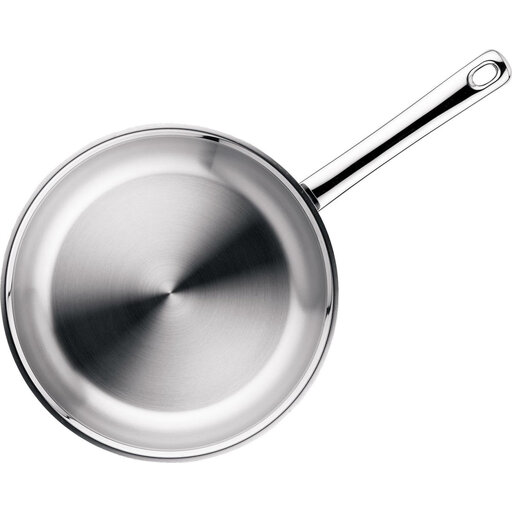
Why it suits this profile: This stainless steel frying pan is designed for searing and long-term use without a non-stick coating.
The specifications list 18/10 stainless steel, a TransTherm base, induction compatibility and an oven temperature of up to 250 °C.
Suitable for all heat sources, dishwasher-safe and featuring a pouring rim.

Why it suits this profile: The 28 cm size provides room for stir-fries, larger portions and dishes that need to simmer after searing.
The product information lists a three-layer stainless steel–aluminium–stainless steel structure, a glass lid and compatibility with gas, induction, electric, ceramic, halogen and oven cooking.
28 cm, lid included, dishwasher-safe and with no traditional non-stick coating listed.
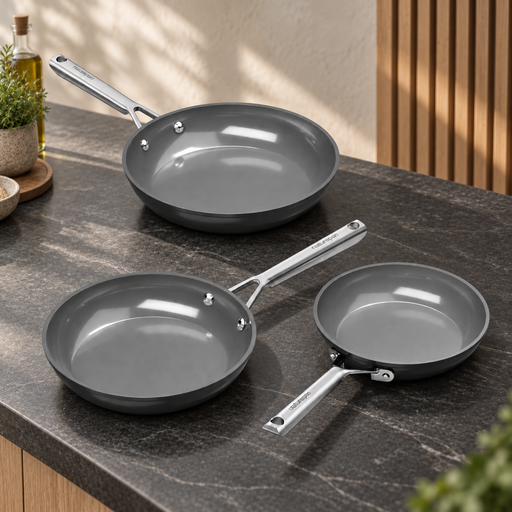
Why it suits this profile: The three sizes cover small portions, everyday cooking and larger meals.
The product description lists a PTFE-, PFAS- and PFOA-free ceramic coating and compatibility with induction, gas, ceramic and electric cooking.
Set of 20, 24 and 28 cm pans, oven-safe up to 260 °C and dishwasher-safe according to the product information.
Allow a pan to cool before washing it. For coated pans, use a soft sponge and avoid metal spatulas. Even when a pan is dishwasher-safe, hand washing can help keep the coating and appearance in good condition for longer. With stainless steel, gentle preheating helps; with ceramic and other non-stick coatings, medium heat is generally more practical than prolonged high heat.
Before buying, also check the handle, weight and storage space required. A heavy cast-iron pan is stable, but not everyone finds it comfortable for everyday use. A frying pan set may seem like good value, but makes less sense if you usually only use one size.
We have compiled a complete, up-to-date list of products that fully meet these strict selection criteria and the applicable European safety regulations.
For one or two people, 20 to 22 cm is often sufficient. A 24 cm frying pan is suitable for everyday portions for around two to three people. Choose 28 cm for larger quantities, provided your cooking zone and storage space can accommodate it.
Choose a model whose product information explicitly mentions induction. A stainless steel, aluminium or ceramic frying pan may be suitable for induction, but only if it has a magnetic base or an induction-compatible foundation.
This depends on how it is used, the temperature and how it is cared for. Avoid overheating the pan when empty, metal utensils and abrasive cleaning products. Once the coating is visibly damaged or has started to come away, replacing the pan is the wiser option.
