
Vandaag of morgen in huis

Kwaliteit gegarandeerd

Welkomstaanbiedingen ontgrendelen: GRATIS bezorging | Tot 80% korting | Gratis 30 dagen JoyPlus-proefperiode
Download de app
A frying pan may seem straightforward, but differences in size, hob compatibility and coating determine how enjoyable it is to use every day. A pan can look appealing and still be less suitable for your cooker, household or cleaning routine.
Pay particular attention to these three common pitfalls:
Below, you’ll find out which features to check before buying and which models suit different cooking situations.
The diameter determines how much you can prepare at once and how much space the pan takes up in the cupboard.
As well as the diameter, look at the base diameter. A wide pan on a small induction zone may heat more slowly or less evenly.
An aluminium frying pan generally heats up quickly and is relatively light. This makes aluminium suitable for everyday frying and sautéing. A thicker or forged aluminium body can also feel more stable than very thin sheet material.
A stainless steel frying pan is a good option for anyone who wants to cook without a traditional non-stick coating. Stainless steel does require suitable preheating and enough cooking fat to reduce sticking. A multi-layer base can help distribute heat evenly.
With a non-stick frying pan, check:
For claims such as “PFAS-free” or “PFOA-free”, you should check the specific product information. According to the product description, Brabantia states that the Onyx pan has a 100% PFAS-free ceramic coating. According to its own product information, Naturepan specifies a ceramic coating without PTFE, PFAS or PFOA. These are product specifications from the brands concerned and do not constitute a general guarantee for other pans.
An induction frying pan needs a magnetically suitable base. Always check this separately, even when the pan is made of aluminium. The outside may be aluminium while the base is suitable for induction.
The following features are also important:
When using a coated pan, wood, silicone or plastic utensils are preferable. Allow a hot pan to cool down before rinsing it; a sudden change in temperature can cause deformation.
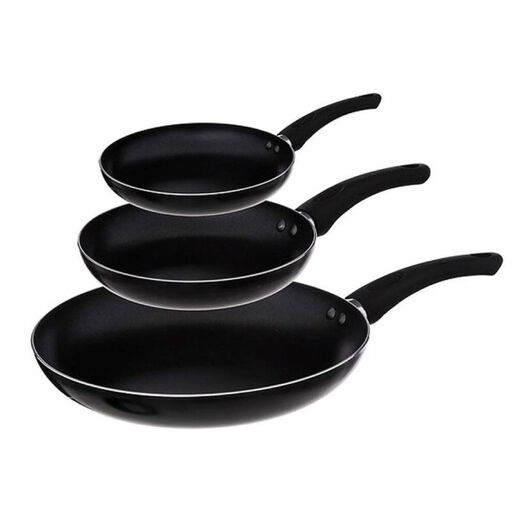
Why it suits this profile: Three popular sizes in one pan set offer flexibility for a household preparing different portions, without having to buy several individual pans straight away.
The product information lists gas, electric, ceramic and induction as suitable heat sources. Hand washing is recommended to help the two-layer non-stick coating last longer.
Aluminium body, three diameters, dishwasher-safe according to the product description, and a height of 6 cm.
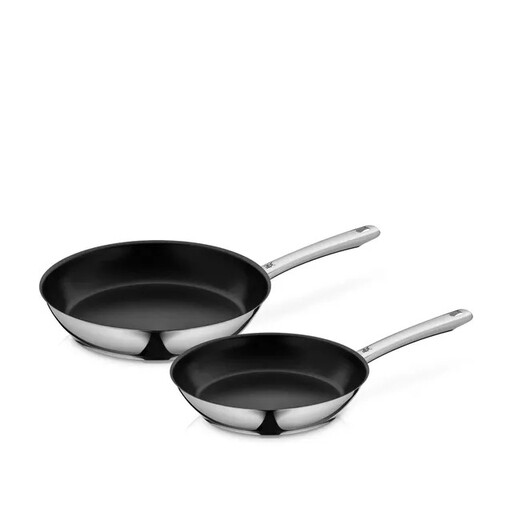
Why it suits this profile: This combination is designed for everyday cooking for two or more people, with a medium-sized and a larger pan for a range of dishes.
The stated 3-ply base is designed to distribute heat evenly. The product information lists compatibility with all hobs, including induction.
Cast aluminium body, 24 and 28 cm sizes and, according to the product information, a PFOA-free Croma non-stick coating.
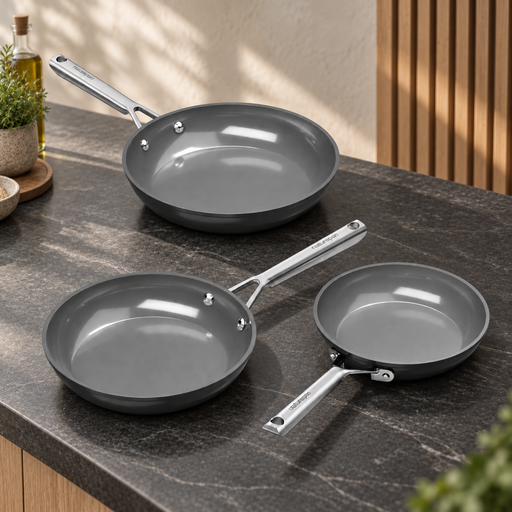
Why it suits this profile: The three sizes and ovenproof design suit home cooks who fry, sauté and regularly move dishes from the hob to the oven.
The specifications list induction, gas, ceramic and electric, plus a maximum oven temperature of 260 °C. To preserve the coating, metal utensils are not recommended.
Aluminium body, ceramic coating, dishwasher-safe according to the product information, and three practical diameters.
A frying pan will generally last longer if you follow the manufacturer’s instructions. Do not heat a coated pan while empty for extended periods and use a suitable cooking zone. With induction, a base that sits flat on the hob helps. Do not place a hot pan under cold water straight away.
For everyday care:
A damaged coating, loose handle or warped base is a reason to stop using the product. The statutory guarantee in the European Union for the products mentioned is at least two years; additional rights may apply under the relevant Dutch regulations.
We’ve put together a complete, up-to-date list of products that fully meet these strict selection criteria and the applicable European safety regulations.
Choose a model whose product information explicitly mentions induction. With aluminium pans, the base is the key factor. Place the pan flat on the cooking zone and, ideally, use a zone that is approximately the same size as the base diameter.
For one person, 20 cm is often sufficient. A 24 cm frying pan is suitable for everyday meals for one or two people. For families or larger portions, 28 cm provides more room to cook. A frying pan set with 20, 24 and 28 cm sizes means you won’t always have to make do with a pan that is too small or too large.
No. “Dishwasher-safe” means that, according to the product information, the pan can be cleaned in the dishwasher. Manufacturers often still recommend hand washing, as dishwasher detergents, heat and prolonged moisture can put greater strain on the coating and handle. Always check the care instructions for the model you choose.
