
Grower or seller taking regular product photos
Wants to capture the colours of fruit and vegetables consistently under the same lights, and is able to adjust the lighting and white balance.


For regular product photography, controllable lighting and consistent white balance matter more than a particular camera brand. If you want to capture small details such as skin texture or seeds, the magnification of the lens actually supplied with the camera is what matters most. Then choose a camera body to suit your preferred framing and workflow. Check your lights for colour casts and banding before treating extra camera features as the solution.
Wants to capture the colours of fruit and vegetables consistently under the same lights, and is able to adjust the lighting and white balance.
Wants to bring skin texture, seeds and other small features into close view, and therefore pays attention to lens magnification and depth of field.
Photographs whole products or simple compositions, balancing the size and cost of the camera, lens and lighting.
First choose between a simple setup, an interchangeable macro lens or a compact alternative. Then match your lens choice to the details you want to capture.
Choose this if: you mainly photograph whole products, baskets or overhead compositions and want to adjust the framing.
Bear in mind: a standard zoom does not automatically offer the same magnification as a dedicated macro lens. Check which lens is included in the kit.
Choose this if: small details such as skin texture or seeds need to fill the frame. Check the lens mount and working distance.
Bear in mind: macro magnification is a property of the lens, and a separate macro lens increases the cost of the kit. Canon specifies a maximum of 1:2 for the RF 35mm F1.8 MACRO IS STM; Fujifilm specifies 1:1 for the XF30mmF2.8 R LM WR Macro.
Choose this if: you would rather not change lenses and want a compact setup for small details. OM SYSTEM highlights the TG-7’s macro features.
Bear in mind: the product information does not demonstrate better colour reproduction under your artificial lighting. Compare test shots taken with your own lights.
| What to consider | What to look for | Who it matters to |
|---|---|---|
| Consistent colours | Check for adjustable white balance and RAW shooting; test the lights you actually use. | When comparing product colours across repeated shots, I want to minimise changes in colour cast; around 33% of consumers prioritise consistent colours. |
| Small details | Check the lens’s maximum magnification, lens mount and which lens is included in the kit. | When I want to fill the frame with small textures, I focus on the lens’s magnification; around 27% of consumers give detail reproduction top priority. |
| Flicker and banding | Take test shots using the intended light, shutter mode and shutter speed; check the images for banding. | If my lights could cause visible banding or exposure differences, I want to check this with test shots first; around 20% of consumers put this risk at the top of their list. |
| Size of the setup | Check exactly what the kit includes and whether you will need a separate lens for close-ups. | When I want a simple, complete setup, I weigh up an integrated lens against the extra choice offered by an interchangeable lens; around 20% of consumers prioritise simplicity and ease of use. |
Magnification is a feature of the lens. A camera body or kit therefore does not automatically include a lens that can magnify small details significantly.
Before buying, check the exact lens in the box, the mount and the stated maximum reproduction ratio.
A higher stated sensor resolution will not automatically produce consistent colours when the artificial lighting or white balance changes.
First test a fixed lighting setup and white balance. Then compare camera bodies for the framing you need.
Sony explains that flickering light sources can cause visible bands in certain shots taken with a focal-plane shutter.
Take test shots under the lights you plan to use, and check the manual for the exact model to see which shutter and anti-flicker options are available.
The EOS R50 is an RF mirrorless camera for anyone looking for a setup they can expand.
The Z50II is a Nikon Z DX camera, for which you can choose a compatible macro lens separately.
The X-T5 is an X-mount camera body that you can pair with a separately chosen macro lens.
The Alpha 7 III is a full-frame E-mount option; Sony offers separate full-frame macro lenses for it.
The TG-7 is a compact alternative with an integrated lens, for anyone who wants to take close-ups without changing lenses.
These Joybuy cameras are general-purpose photography options. Check that the included lens and camera features suit your fruit and vegetable photography and lighting.
 No image available
The product title describes this model as a camera for photography; check whether its fixed lens and operation suit the close-ups you want to take.
1-inch CMOS sensor, 4K/240fps, 2× lossless zoom, 3-axis stabilisation and 107 GB of built-in storage.
 No image available
The product title lists photography as one of its uses; check whether the model suits your preferred framing and close-up distance.
1-inch CMOS sensor, 4K/120fps video, 3-axis stabilisation and a rotatable touchscreen.
 No image available
The product title mentions photography and video; before buying, check that the controls and lens suit the details you want to capture.
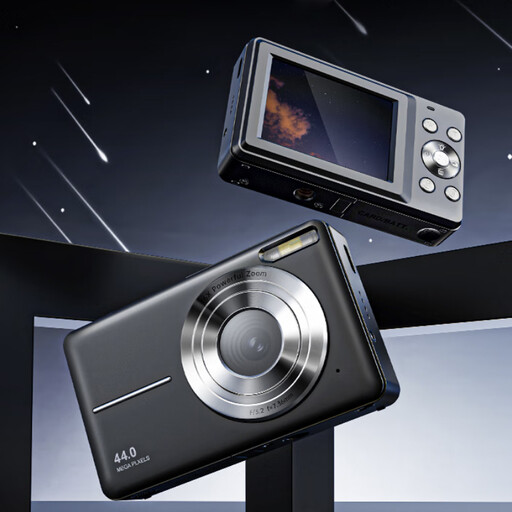
The title lists 44 MP and 16× digital zoom.
 No image available
The included zoom lens offers a range of focal lengths for framing whole products or compositions; it is not specified as a macro lens.
24.2 MP APS-C sensor and E PZ 16–50mm zoom lens.
 No image available
The zoom lens offers a range of focal lengths for whole products and compositions; check whether its magnification is sufficient for small details.
24.2 MP APS-C sensor; 16–50mm f/3.5–5.6 OSS II lens.
Keep your lighting setup as consistent as possible and check the white balance whenever the lighting changes. For mixed light sources, Nikon advises switching off any unnecessary lights and notes that RAW gives you more flexibility than JPEG for making corrections later.
Not necessarily. A standard zoom lens may be enough for a full composition, while small surface details may need greater magnification. Canon makes the same distinction between overhead shots and close-up macro photography; check what the kit includes if you want to take both.
Take test shots with the lights and shutter settings you plan to use, and check the images for banding. Sony says flickering light can cause banding in shots taken with a focal-plane shutter; consult the manual for your exact model to find the available solutions and modes.
As a consumer, you are entitled to a product that is of satisfactory quality. According to the Dutch government, a faulty product may entitle you to a free repair, replacement or refund; the Netherlands does not have one fixed statutory guarantee period for all products. An additional manufacturer’s guarantee does not replace your statutory rights.
According to ACM ConsuWijzer, online consumer purchases are generally covered by a statutory cooling-off period that ends 14 days after delivery. Check the applicable terms for trying out and returning the camera; this right is separate from the remedies available if it is faulty.