First, choose a field of view that lets the whole fruit arrangement fit within the space available for your shot. A dedicated macro lens is most useful for small details such as berries and peel textures when you want to show them large. Check the mount and the working space in front of the lens before choosing a model. To keep several layers of fruit in focus, a stable set-up, suitable lighting and, if needed, focus stacking are also important.
Who is a macro lens for?
Online shop owner photographing whole fruit
You mainly need a clear overview shot and want to know whether the whole composition will fit in frame before buying extra magnification. Canon Netherlands also mentions a 35mm lens as an option for overhead food shots featuring ingredients and accessories.
Detail photographer
You want to show small fruit details at a larger scale as well as taking an overview shot. Magnification, the mount and the space available to light your subject all influence your choice of lens. Manufacturer information from Canon Netherlands, Nikon Netherlands, Sony Netherlands, SIGMA and OM SYSTEM describes the features of the macro models mentioned here.
Photographer of layered arrangements
You want to keep several layers of fruit in focus, so a controlled set-up and depth of field matter more than simply choosing the highest magnification. Canon Netherlands explains depth of field, while Nikon Netherlands outlines focus stacking for macro photography.
What should you look for when choosing?
| What to consider |
What should you check? |
Who is this important for? |
| Framing the whole arrangement |
Compare the field of view on your own camera and measure the available distance between the camera and the arrangement. |
If I mainly want to show the whole arrangement clearly, it needs to fit in the space I have; around 33% of consumers prioritise suitable framing for an overview shot. |
| Magnifying small details |
Check the maximum magnification and the working distance at the magnification you want to use. |
If you want to show berries or peel textures at a larger scale, pay particular attention to magnification and the space available for lighting and styling; around 27% of consumers prioritise magnifying details. |
| Keeping several layers in focus |
Consider the aperture control, available lighting and whether a stable set-up for taking several focus-shifted shots will work for you. |
If I want fruit at different distances to appear sharp at the same time, I also need to consider my set-up and depth of field; around 20% of consumers prioritise keeping the different layers in focus. |
| Mount and purchase terms |
Check the exact camera body, lens mount and model variant. If you’re buying for business use, also review consumer protection and VAT terms. |
If you need a compatible lens and clarity on the purchase terms, check the system and intended use before ordering; around 20% of consumers make this their first priority. |
Common buying mistakes
-
Choosing a macro lens for every shot of the arrangement
A macro lens can magnify small details considerably, but a complete food composition may need a wider field of view.
First, check whether your current lens can capture the arrangement and the background you want. Then decide whether detail photography warrants a separate lens.
For overview shots, you may need a second lens or more room to shoot.
-
Confusing minimum focusing distance with the clear space in front of the lens
This distance doesn’t necessarily tell you how much room there is between the front of the lens and the fruit for lighting and styling. Working distance depends on the magnification you use.
Check the working distance at the magnification you want to use, then plan where to place your lights around it.
-
Choosing based only on brand or focal length
A lens will only fit if its mount and version are compatible with your camera body. For example, the SIGMA range covered here has separate Sony E and L-mount versions.
Before ordering, compare the full model name and mount with those of your camera.
-
Assuming consumer protection or VAT reclaim applies automatically to business purchases
According to ACM ConsuWijzer, consumer protection depends in part on how the contract is used. The Dutch Tax Administration sets conditions for reclaiming VAT on business expenses.
Check separately how you’ll use the lens, which purchase terms apply and whether the tax rules cover your circumstances.
Brands and relevant macro lenses
Canon
Worth considering if you use an EOS R camera and are looking at an RF macro lens for detail shots. Canon Netherlands also discusses wider compositions for food photography.
- Canon Netherlands states that the RF 100mm F2.8L Macro IS USM has a maximum magnification of 1.4× and a minimum focusing distance of 0.26 m.
- Maximum magnification isn’t automatically useful for a complete arrangement; check that you have enough room to frame the composition you want.
Nikon
Worth considering if you have a compatible Nikon Z camera and want to photograph details at life size.
- Nikon lists a 1:1 reproduction ratio and a Z mount for the NIKKOR Z MC 105mm f/2.8 VR S.
- For overview shots, the field of view and the space available for shooting are still important considerations.
Sony
Worth considering if you use Sony E and are looking for an FE macro lens for close-ups.
- Sony specifies a 1:1 magnification ratio, optical stabilisation and a minimum focusing distance of 0.28 m for the FE 90mm F2.8 Macro G OSS.
- Sony gives different fields of view for full-frame and APS-C. Stabilisation doesn’t guarantee that the whole arrangement will be in focus.
Sigma
A 105mm macro lens range for cameras with a Sony E or L mount; check which version you need.
- According to SIGMA, the 105mm F2.8 DG DN MACRO | Art offers 1:1 magnification and a working distance of 141 mm at that magnification.
- The mounts listed are Sony E and L-mount; don’t assume compatibility with other mounts.
OM SYSTEM
Worth considering if you use Micro Four Thirds and are looking for a macro lens for detailed shots.
- OM SYSTEM lists 1:1 magnification, a minimum focusing distance of 0.19 m and a weight of 185 g for the M.Zuiko Digital ED 60mm F2.8 Macro.
- Minimum focusing distance is not the same as the clear working distance in front of the lens.
Joybuy picks for fruit photography
This selection includes a Sony E 50mm lens for product and close-up photography, and a Sony E 11mm APS-C lens for wider overview shots. Both have a different role from a 1:1 macro lens designed to capture very small details.
 Image unavailable
Sony E 50mm f/1.8 OSS Black
The product information mentions product and close-up photography; check that the field of view suits your arrangement and available shooting space.
The stated magnification is lower than that of a 1:1 macro lens. So don’t choose this lens expecting it to fill the frame with small fruit details.
View at Joybuy
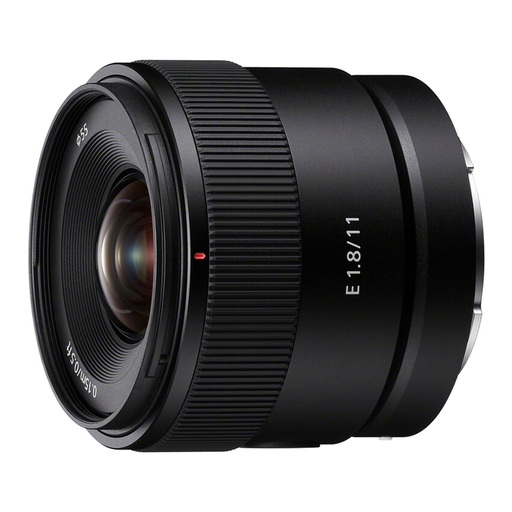 Image unavailable
Sony E 11mm F1.8 APS-C Wide Angle Prime Lens (SEL11F18)
The wide field of view suits complete arrangements and overhead shots when you need plenty of room to frame the composition.
This isn’t a 1:1 macro lens. Check whether you’ll also need another lens for small fruit details.
View at Joybuy
Frequently asked questions
Do you need 1:1 magnification to photograph a whole fruit arrangement?
Not necessarily. Canon Netherlands mentions a 35mm field of view as a possible option for wider food compositions, while a dedicated macro lens is mainly useful for details. Check the framing on your own camera and in the space available to you.
Is the minimum focusing distance the space between the front of the lens and the fruit?
No. Before positioning your lights, check the working distance in front of the lens at the magnification you’ll be using. For example, SIGMA gives a working distance of 141 mm at 1:1 for its 105mm DG DN Macro; the minimum focusing distance of another model isn’t directly comparable.
How can you keep several layers of fruit in focus at once?
First, consider your aperture settings and, if necessary, use a stable set-up with enough light. For still fruit, you can combine shots taken at different focus points; Nikon Netherlands describes this technique as focus stacking.
Is a lens for your online shop automatically covered by Dutch consumer protection?
Not automatically. ACM ConsuWijzer states that consumer protection doesn’t apply if a contract is used mainly or exclusively for business purposes. Your specific circumstances and the purchase terms matter, so check them before relying on consumer protection rules.
Can you always reclaim VAT on a lens bought for business use?
No. According to the Dutch Tax Administration, VAT reclaim on business expenses is subject to conditions; VAT on costs for exempt or non-taxable activities cannot be reclaimed. You should also assess any private use under the applicable rules.


