Start by considering the space around your worktable, then decide whether you mainly want to photograph the whole arrangement or small fruit details. A mirrorless camera with a suitable zoom lens gives you room to change your framing; for close-ups, the magnification and working distance of the specific lens also matter. For still arrangements, a stable set-up and controllable lighting may be more important than extra camera features.
Who is this guide for?
Arrangement photographer working at a small table
You want to frame the whole still life from different angles without having to stand far from the table. A still-life photography workshop from Cameranu shows how a range of compositions can be explored in a limited set-up.
Photographer focusing on fruit details
You want to capture texture, pips or cut surfaces clearly. In that case, the lens is especially important: Canon Netherlands distinguishes between close focusing and the magnification offered by a true macro lens.
Workshop participant dealing with changing light
You share the shooting space and want to take usable, editable photos in different lighting conditions. Canon Netherlands' guide to white balance explains how artificial light can affect colour reproduction.
What should you consider when choosing?
Mirrorless camera with standard zoom lens
Choose this option if: you mainly photograph complete arrangements and vary your framing, for example when you can't stand far from the worktable.
Bear in mind: being able to focus close up is not the same as having high macro magnification. Canon Netherlands lists a maximum of 0.25× for the RF-S 18-45mm in manual focus mode.
Mirrorless camera with close-up or macro lens
Choose this option if: small details, such as the texture or cut surface of fruit, are often your main subject.
Bear in mind: working distance varies from lens to lens, and a short distance between the lens and subject can limit the space available for lighting and composition. Nikon lists a maximum reproduction ratio of 0.67× for the NIKKOR Z DX MC 35mm f/1.7, with 7.2 cm between the front of the lens and the subject at the closest focusing distance.
Existing camera or compact camera
Choose this option if: you want to practise framing and exposure first, and aren't yet sure whether your current camera is limiting you.
Bear in mind: check that the camera can focus close enough and that you can adjust its light and colour settings; a different camera won't automatically solve changing window light.
| What to consider |
What to look for when buying |
Who is this important for? |
| Framing the whole arrangement |
Check the zoom range of the included lens and whether you can get the framing you want from the space available. |
If I don't have much room to step back from the shared worktable, I still want to fit the whole arrangement into the frame. Around 25% of consumers prioritise this. |
| Texture and small details |
Compare the maximum reproduction ratio and working distance for the specific lens; also check the lens mount. |
If I mainly want to photograph skin, pips or cut surfaces, I want to know how large those details will appear in the frame. Around 25% of consumers prioritise fruit details. |
| Changing light and colour |
Check whether you can adjust white balance and exposure and, if you want to edit your photos, shoot in RAW. Also consider whether there's room for a tripod or light source. |
If the light changes during the workshop, I want to be able to assess colour casts and adjust my settings accordingly. Around 25% of consumers focus mainly on light and colour. |
| A complete kit for shared use |
Check whether you're buying a body on its own or a kit, which lens is included, and which battery and memory card you'll need. |
When I share a camera with others, I want to know in advance whether the kit is complete for the planned shots. Around 25% of consumers prioritise simple, shared use. |
Common pitfalls
-
Confusing a short focusing distance with macro magnification
Magnification varies from lens to lens. The Canon RF-S 18-45mm lists a maximum of 0.25× in manual focus mode; that's not the same as 1:1 macro magnification.
Decide in advance how large you want a fruit detail to appear in the frame, then compare the magnification and working distance of the exact lens you're considering.
-
Comparing camera bodies only
A body without a suitable lens won't automatically make a complete kit for the arrangement or detail you want to photograph. Canon, Nikon, Sony and Fujifilm use different lens mounts.
Check whether you're buying a body or a kit, which lens is included, and whether it fits the camera's mount.
-
Choosing a different body to deal with changing light
Window light changes with the time of day and conditions; artificial light can affect colour reproduction. A different body is no substitute for a suitable lighting set-up.
First assess the position of the light, white balance and stability of your set-up. Then consider whether there's a camera feature you're missing.
Camera brands to consider
Canon
The EOS R50 with an RF-S standard zoom is one option for complete still lifes and varying your framing.
- Canon lists an RF mount for the EOS R50 and a maximum magnification of 0.25× for the RF-S 18-45mm in manual focus mode.
- That kit zoom isn't a 1:1 macro lens. Check that this is the lens included in your chosen kit. Source: Canon Netherlands.
Nikon
The Z50II with a compatible Z lens is one option if fruit details are a key part of your photography.
- Nikon lists a Z mount for the Z50II. For the separate NIKKOR Z DX MC 35mm f/1.7, Nikon lists a maximum reproduction ratio of 0.67×.
- These lens specifications don't automatically apply to every Z50II kit. Check the lens you choose and the available working distance. Source: Nikon Netherlands.
Sony
The ILCE-6400 is an APS-C mirrorless camera with an E mount, allowing you to choose a zoom or close-up lens separately.
- Sony lists approximately 24.2 effective megapixels and RAW shooting for the ILCE-6400.
- These body specifications don't tell you how much a specific kit lens magnifies. Check the exact lens version. Source: Sony Netherlands.
Fujifilm
The X-S20 with an X mount is one option if in-body image stabilisation is a factor alongside still photography.
- Fujifilm lists 26.1 effective megapixels, RAW shooting and five-axis image stabilisation. The stated compensation of up to 7.0 stops applies under Fujifilm's test conditions with an XF35mmF1.4 R.
- Stabilisation doesn't determine how close a particular lens can focus. Check which lens is included in the kit. Source: FUJIFILM X Series Netherlands.
Cameras at Joybuy
This selection includes compact cameras and mirrorless cameras with zoom lenses for framing fruit arrangements. Check which lens or zoom function is included with each camera.
 No image available
Komery W6, 12× optical zoom
The stated optical zoom gives you a way to adjust the framing of a fruit arrangement.
The product title lists 4K, Wi-Fi and 64 MP.
View at Joybuy
 No image available
DJI Osmo Pocket 3 Creator Combo
The product information mentions still images and a rotating touchscreen for viewing your composition.
The title lists a 1-inch CMOS sensor, 4K/120fps video and 3-axis stabilisation.
View at Joybuy
 No image available
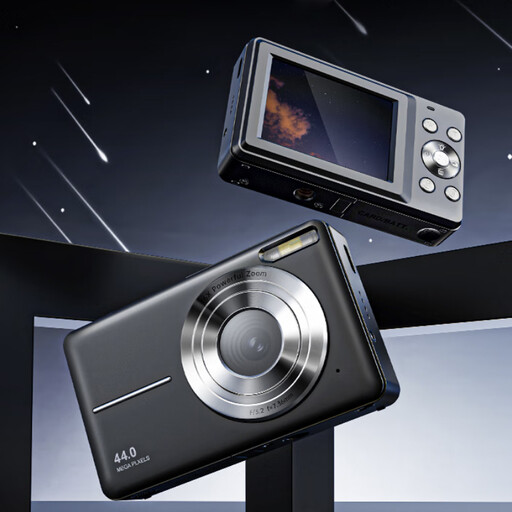
Songdian compact camera, 4K, 44 MP
Its compact size may suit anyone who wants to take a camera along for different framing options.
The product information lists autofocus and 16× digital zoom.
View at Joybuy
 No image available
Sony ZV-E10 with 16–50 mm zoom lens
The stated zoom lens gives you room to vary the framing of an arrangement.
The product information lists a Sony E mount and a 16–50 mm lens.
View at Joybuy
 No image available
Sony Alpha A6100 with 16–50 mm f/3.5-5.6 OSS II
The stated kit lens gives you room to vary the framing of an arrangement.
The product information lists an APS-C sensor, touchscreen and electronic viewfinder.
View at Joybuy
Frequently asked questions
Do you need a macro lens straight away to photograph the whole arrangement?
Not necessarily. First check whether the chosen zoom lens can capture the whole arrangement from where you're standing. For small fruit details, compare the magnification and working distance of a suitable lens; being able to focus close up doesn't automatically mean 1:1 macro.
How should you get started if the light changes during the workshop?
Start with a fixed set-up and assess the light falling on the fruit. Adjust the white balance if needed; for still arrangements, a tripod can help keep the camera steady. RAW gives you more scope for editing, but it won't fix unsuitable lighting.
What should you do with your camera and lens after the workshop?
Store your camera, lens and memory card carefully, and check the battery and available storage before your next session. A Dutch still-life photography workshop lists empty memory cards and fully charged batteries as items to bring; that's workshop advice, not a general legal requirement.
Should you buy extra cover for a camera?
Not automatically. According to the Dutch government, your statutory guarantee may still be relevant after a manufacturer's guarantee or additional cover you've bought has expired; if there's a problem, contact the seller. Check what extra cover actually offers.
Can you publish workshop photos if other participants are recognisable?
First consider how you intend to use the photos. The Dutch Data Protection Authority treats images of recognisable people as personal data and distinguishes between strictly private use and wider sharing. Publishing recognisable attendees for business or organisational purposes requires a lawful basis; consent may be appropriate, but it isn't the only possible lawful basis. Photograph only the fruit, or make sure other people aren't recognisable if their presence isn't necessary.


