
Students who buy their own fruit and groceries
You’re looking for a reliably cool place to store covered, pre-cut melon alongside your everyday food. The Netherlands Nutrition Centre recommends storing cut melon covered in the fridge.


For pre-cut melon, you need a fridge with room for a covered container, and you should be able to check its temperature once it is in place: the Netherlands Nutrition Centre recommends 4 °C. A mini fridge suits you if you only need a little extra chilled storage; an under-counter fridge offers more space, while a freezer compartment is mainly useful if you also store frozen food.
You’re looking for a reliably cool place to store covered, pre-cut melon alongside your everyday food. The Netherlands Nutrition Centre recommends storing cut melon covered in the fridge.
You’re weighing up a compact fridge against an under-counter model with more room for groceries. Measure the available space first, then consider how much chilled storage you actually need.
You want to know whether a freezer compartment is worth sacrificing some of the chilled storage you need for melon and other groceries. Compare the fridge capacity separately from the total capacity.
Choose this if: you need very little extra space and check in advance that your covered melon and other chilled items will fit.
The trade-off: the mini fridge we looked at has less capacity than the under-counter models; check the actual temperature once it is in place.
Choose this if: chilled storage for fruit and everyday groceries matters more to you than having your own freezer compartment.
The trade-off: an under-counter fridge takes up more space than a compact appliance and has no freezer compartment.
Choose this if: you want to store frozen food as well as chilled items.
The trade-off: some of the total capacity is taken up by the freezer, so compare the fridge capacity separately.
| What to consider | What should you check? | Who should pay extra attention? |
|---|---|---|
| Fridge temperature | Check there is room for a covered container. Once the fridge is in place, use a fridge thermometer to measure the temperature in the middle of the bottom shelf after half a day or overnight. Adjust it towards 4 °C if needed. | I want to store covered melon at a temperature I can check. That’s why around 33% of consumers prioritise reliable cooling. |
| Dimensions and fridge capacity | Measure the space available and compare the external dimensions, fridge capacity and layout. For a model with a freezer compartment, check separately how much room is left for chilled food. | In a small kitchen, the appliance needs to fit and have room for melon and everyday groceries. For around 27% of consumers, getting both is the main priority. |
| Energy consumption | Compare the energy label and stated annual consumption in kWh for the exact models, as well as the fridge capacity you need. | I want to take the stated annual consumption into account without choosing a fridge that doesn’t offer enough chilled storage. Around 20% of consumers put energy consumption first. |
| Noise | Compare the stated noise levels of the exact models and think about where you’ll put the appliance. | If the fridge is close to where I study or sleep, noise matters more. Around 20% of consumers make keeping the area quiet their main priority. |
The position of a dial doesn’t confirm that the fridge is at the right storage temperature. The Netherlands Nutrition Centre recommends a fridge temperature of 4 °C.
Once the fridge is in place, use a fridge thermometer to measure the temperature in the middle of the bottom shelf. Leave the thermometer there for half a day or overnight, then adjust the fridge if needed.
For a fridge with a freezer compartment, the total net capacity includes the freezer space too. So that figure doesn’t tell you how much room there is for chilled melon and other groceries.
Compare the fridge capacity and layout separately before deciding whether a freezer compartment is useful for you.
The EU energy label helps you compare energy efficiency, but it won’t tell you whether the dimensions and layout suit your needs. Since 1 March 2021, the European Commission has used a scale from A to G for household fridges.
As well as checking the label and stated annual consumption in kWh for the exact model, compare its fridge capacity and external dimensions, and consider whether you need a freezer compartment.
The PR185FR is a compact mini fridge for anyone looking for a little extra chilled storage.
The models we looked at include an under-counter fridge without a freezer compartment and one with a freezer compartment.
The KK550 we looked at is an under-counter fridge without a freezer compartment, with more chilled storage than the mini model we reviewed.
The KTR15NWEB we looked at is an under-counter fridge without a freezer compartment and has a door-open alarm.
This selection includes compact mini fridges and under-counter models, with and without a freezer compartment. For each model, check that your container will fit and that the fridge reaches the temperature you want in your setup.
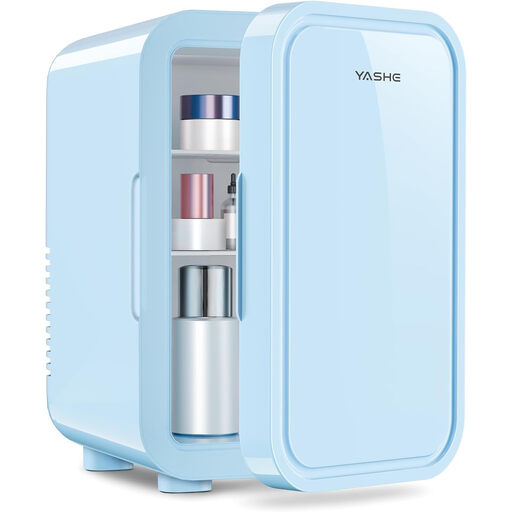 Image unavailable
Suitable if you need very little chilled storage; check whether the covered melon and other chilled items will fit in the 6-litre capacity.
The product name lists 220–240 V AC/DC. The product description mentions cooling and heating modes and a removable shelf. Check the temperature in your setup before storing melon in it.
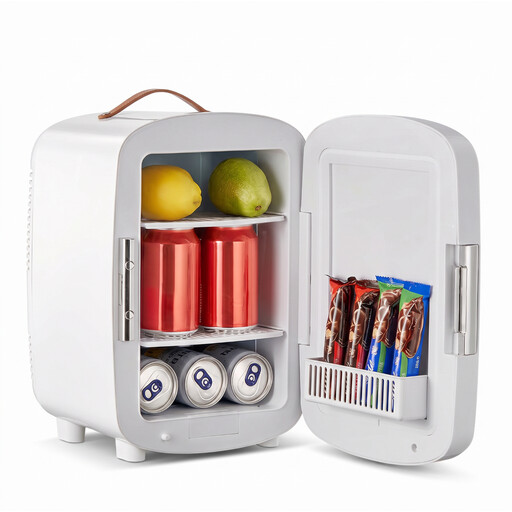 Image unavailable
A compact option if you’re looking for a little chilled storage. Check that a covered container will fit in the 10-litre capacity and whether the fridge reaches the right storage temperature.
The product name lists a viewing window, cooling and heating functions, AC/DC power and a noise level of 38 dB.
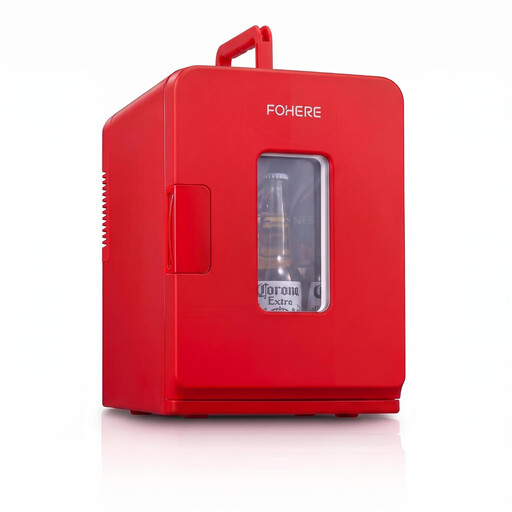 Image unavailable
The 15-litre capacity gives you more room than the smaller mini fridge in this selection, but it’s still limited if you want to store melon alongside other groceries.
The product description says the cooling mode can reach 8–16 °C below the ambient temperature. This means the temperature it reaches also depends on the surroundings, so check it with a thermometer before storing melon inside. The description also mentions a heating mode up to 65 °C and power via 220–240 V AC or 12 V DC.
 Image unavailable
An under-counter model for anyone looking for more chilled storage than a mini fridge can offer. Check the external dimensions and layout to make sure there’s room for your covered melon.
The product description lists 88 litres of fridge capacity, three adjustable glass shelves, a salad drawer and mechanical temperature control. The product name lists energy class E.
 Image unavailable
A good fit if you want to store frozen food as well as chilled groceries. Bear in mind that the freezer compartment takes up some of the total capacity.
The product description lists 95 litres of fridge capacity and 14 litres of freezer capacity, along with glass shelves, a salad drawer, door shelves and a reversible door hinge. The product name lists energy class C.
Store cut melon covered in the fridge. The Netherlands Nutrition Centre recommends a fridge temperature of 4 °C; use a thermometer to check whether your fridge reaches it.
Place a fridge thermometer in the middle of the bottom shelf and leave it there for half a day or overnight. Compare the reading with the Netherlands Nutrition Centre’s recommended temperature of 4 °C and adjust the fridge if needed.
No, a fridge is all you need for cut melon; the Netherlands Nutrition Centre recommends storing it covered and chilled. Choose a freezer compartment only if you also want to store frozen food, and check how much fridge space will be left.
Compare the label for the exact model. According to the European Commission, EU energy labels for household fridges have ranged from A to G since 1 March 2021. Also check the stated annual consumption in kWh and the fridge capacity.
According to the Dutch government, you should contact the seller to find a solution. There is no fixed statutory warranty period in the Netherlands; what you can reasonably expect from the product is taken into account when your claim is assessed.