
Buying for a narrow fridge space
You’re measuring more than just the external dimensions: you also need to allow for ventilation and make sure the door and drawers can open. Manufacturers may list different widths on the same product page.


First, measure the available space, including ventilation clearance and room to open the door. Then choose a fridge with enough fridge space for a sealed container and a temperature setting of 4 °C. A slim under-counter fridge without a freezer compartment keeps all its storage space free for chilled groceries, while a freezer compartment takes up some of that space. An integrated fridge is only an option if the housing niche and door fitting are suitable. The Netherlands Nutrition Centre advises keeping cut vegetables in a sealed container and says that firm raw vegetables without dressing can be kept in the fridge for two days after opening.
You’re measuring more than just the external dimensions: you also need to allow for ventilation and make sure the door and drawers can open. Manufacturers may list different widths on the same product page.
You want to keep carrot sticks neatly in a sealed container and set the fridge to the recommended temperature. The Netherlands Nutrition Centre advises setting the fridge to 4 °C and storing food in a well-sealed container.
You’re looking for one compact appliance for chilled groceries and frozen food, and want to know how much fridge space will remain alongside the freezer compartment.
Choose this if: you have limited width and mainly want to store chilled groceries.
Keep in mind: there’s less fridge space overall, and you’ll need to allow room for ventilation and to open the door.
Choose this if: you need a freezer compartment as well as space for chilled groceries, and the external dimensions fit.
Keep in mind: compare the fridge capacity separately; the total capacity doesn’t tell you how much room will be left for containers.
Choose this if: a model that’s 54–56 cm wide will fit and fridge space matters more to you than freezer space.
Keep in mind: even a few extra centimetres could get in the way of positioning the fridge or opening the door.
Choose this if: you already have a suitable housing niche and the door fitting works with your kitchen.
Keep in mind: housing niche dimensions and fitting type aren’t the same as the external dimensions of a freestanding model.
| What to consider | What should you check? | Who should prioritise this? |
|---|---|---|
| Fit | Measure the width, depth and height; check the required ventilation clearance and whether the door and drawers can open fully. Check the exact width of the Inventum KK471W: Inventum lists both 47,2 and 47,5 cm. | If I only have a narrow space, I want to know whether the fridge will fit with enough ventilation clearance and room for the door to open fully. Fit is the main priority for around 36% of consumers. |
| Storing carrot sticks | Check whether a sealed container will fit in the fridge compartment. The Netherlands Nutrition Centre advises setting the fridge to 4 °C and storing cut vegetables in a well-sealed container. | I want to be able to chill cut carrot sticks in a sealed container and set the fridge to the recommended temperature. Around 29% of consumers prioritise storing cut raw vegetables. |
| Fridge and freezer space | Compare the stated fridge and freezer capacities separately, and check that the shelves and salad drawer will still be accessible. | I need freezer space as well as room for chilled groceries, but I want to know how much fridge space will be left for containers. The fridge and freezer layout is the main priority for around 21% of consumers. |
| Energy use in everyday use | Compare the stated annual energy consumption in kWh between models that actually fit. Milieu Centraal notes that annual energy use is a useful point of comparison. | I want to compare suitable models by their stated annual electricity consumption and running costs. Energy use and running costs are the main consideration for around 14% of consumers. |
The external width doesn’t tell you whether there’s enough ventilation clearance or whether the door and salad drawer can open fully and be used easily. The manufacturer also lists two different widths for the Inventum KK471W.
Measure the available space and confirm the exact external dimensions and required clearance for your chosen model with the manufacturer or retailer.
A fridge that doesn’t fit properly could mean extra work to position or exchange it.
A vegetable compartment doesn’t change the storage advice for cut raw vegetables. The Netherlands Nutrition Centre advises storing cut vegetables in a well-sealed container in the fridge; for firm raw vegetables without dressing, it recommends using them within two days of opening.
Use a sealed container, set the fridge to the recommended 4 °C and follow the storage advice for cut raw vegetables.
Total capacity doesn’t show how much space is available for chilled groceries and containers. A freezer compartment takes up some of the appliance’s space.
Compare the stated fridge and freezer capacities separately, and choose a freezer compartment if you actually need the space.
According to the Dutch Government, a product must be fit for purpose, and the retailer must provide a solution if something goes wrong. The Netherlands has no fixed statutory warranty period; an extended warranty doesn’t replace your rights with the retailer.
Check exactly what additional cover a service plan or warranty offers before choosing it.
Freestanding slim under-counter models, including the KK471W without a freezer compartment and the 55 cm-wide KV550 with a freezer compartment.
Under-counter models without a freezer compartment, including the TLT4702W for those who prioritise chilled storage.
Freestanding under-counter models without a freezer compartment, such as the TSE1424N, for spaces that can accommodate an appliance 54 cm wide.
Freestanding under-counter models without a freezer compartment, such as the KKV856WIT, if an appliance 56 cm wide will fit.
An integrated option for a suitable existing housing niche, such as the IRBSd 5121 with a sliding door fitting.
These models are compact, freestanding fridges for small spaces. The range includes options without a freezer compartment, as well as models with a separate freezer or chiller compartment. Compare the usable fridge space and external dimensions with the space you have available.
 No image available
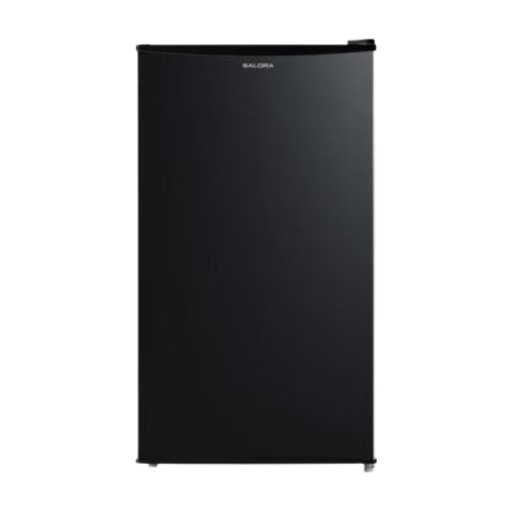
Worth considering if you’re looking for a compact freestanding model without a freezer compartment.
The product information lists a width of 48 cm, a capacity of 88 litres, energy class E, a salad drawer, adjustable shelves and a reversible door.
 No image available
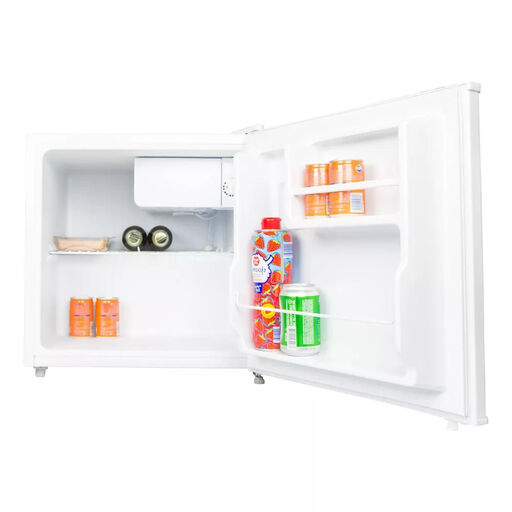
An option if you need a freezer compartment in a narrow space and the available fridge space is enough for you.
The stated total capacity of 80 litres comprises 68 litres of fridge space and a 12-litre freezer compartment. The product information lists a width of 47,2 cm, energy class F, a salad drawer and a reversible door.
 No image available
A compact option if you’re looking for 43 litres of fridge space. Check beforehand that there’s enough room for your containers and groceries.
The product information lists a width of 47,2 cm and a reversible door. According to the description, the freezer compartment is only intended for temporarily storing frozen products, not for freezing food. It also states that the room where the appliance is kept must be at least 10 °C.
 No image available
An option if you want a separate chiller compartment and its layout suits the food you want to keep chilled.
The product information lists a capacity of 90 litres, dimensions of 449 × 485 × 842 mm and three adjustable glass shelves. It gives a temperature range of 0–10 °C for the fridge compartment and −5 to 5 °C for the separate chiller compartment. Check the actual fridge temperature and use the fridge compartment, set to the recommended 4 °C, for carrot sticks.
 No image available
Worth comparing if you’re looking for a compact model with a salad drawer and adjustable shelves.
The product information lists a capacity of 92 litres, a width of 47 cm, a salad drawer, adjustable glass shelves and a reversible door. According to the product information sheet, the recommended setting for the fridge compartment is 4 °C; the stated ambient temperature range is 16–38 °C. Energy class E is also listed.
For firm raw vegetables without dressing, the Netherlands Nutrition Centre recommends keeping them in the fridge for two days after opening. Store freshly cut vegetables in a well-sealed container; the advice for whole raw carrots isn’t necessarily the same as for cut sticks.
The Netherlands Nutrition Centre advises setting your fridge to 4 °C. Check the actual temperature: a temperature range or fresh-food drawer alone doesn’t prove that your food is being kept at that temperature.
Don’t assume that you can. Check the ventilation clearance for each model and make sure the door and drawers can open fully. For an integrated fridge, the housing niche dimensions and door fitting must also be suitable.
For models that fit in your kitchen, compare the stated energy consumption in kWh per year. Milieu Centraal also advises choosing a size that suits your needs; the label alone can’t calculate your personal electricity bill.
According to the Dutch Government, a product must be fit for purpose, and the retailer must provide a solution if something goes wrong. The Netherlands has no fixed statutory warranty period; an extended warranty doesn’t replace your rights with the retailer.