
Cook with a narrow kitchen
Wants to chill fresh herbs and everyday groceries without the appliance blocking the available space or walkway. The Consumers' Association highlights size and layout among the factors to consider when choosing a fridge.


Start by measuring the available width, depth and height, then check that both the fridge and its open door will fit in your kitchen. An under-counter fridge without a freezer compartment keeps the focus on chilling; choose a model with freezer space only if you need it, and compare the fridge and freezer capacities separately. The Netherlands Nutrition Centre recommends a fridge temperature of 4 °C; use a fridge thermometer to check that the fridge compartment reaches this temperature.
Wants to chill fresh herbs and everyday groceries without the appliance blocking the available space or walkway. The Consumers' Association highlights size and layout among the factors to consider when choosing a fridge.
Is looking for a practical place to store fresh herbs at the bottom of the fridge. The Netherlands Nutrition Centre advises wrapping leftover herbs in damp kitchen paper and storing them at the bottom.
Wants to freeze leftover herbs, so needs to decide whether a freezer compartment, fridge-freezer or separate freezer will suit the space available and their needs. The Consumers' Association describes under-counter models with and without a built-in freezer compartment.
Suitable for: a low, narrow space and a household that does not need freezer space in this appliance.
Trade-off: you cannot freeze food in the fridge itself.
Suitable for: anyone who needs a freezer compartment as well as a compact fridge.
Trade-off: the freezer compartment takes up space that would otherwise be available for chilled groceries.
Suitable for: a kitchen with limited floor width but enough height, if you need both fridge and freezer space.
Trade-off: check that the extra height and depth will fit in the space and through the doorway.
| Buying concern | What to check before buying | Who it matters to |
|---|---|---|
| Will the fridge fit in the kitchen? | Measure the space available and the route to it; compare the width, depth and height, and check the model’s installation instructions. | If I have limited space, I want to be sure the appliance will fit and that the doorway is wide enough. Around 36% of consumers cite available space as their main buying concern. |
| Will herbs be easy to store? | Check the interior layout and the space at the bottom. The Netherlands Nutrition Centre advises wrapping leftover herbs in damp kitchen paper and storing them at the bottom. | I want to be able to store herbs at the bottom and check the fridge temperature. Around 29% of consumers put herb storage first. |
| Do you need freezer space? | Decide whether you already have a freezer, and if you are considering a fridge-freezer, compare the fridge and freezer capacities separately. | If I want to freeze leftover herbs and other food, I need to know how much freezer space is actually available. Around 21% of consumers cite freezing as their main buying concern. |
| What about energy use and noise? | Compare the stated annual energy use in kWh and noise level in dB(A) of models that physically fit. Milieu Centraal also recommends taking the size and energy label into account. | As well as a suitable size, I want to consider energy use and noise. Around 14% of consumers put these practical considerations first. |
A narrow fridge may be too deep or block the walkway when its door is open.
Measure the available width, height and depth, as well as the doorway. Then check the installation instructions for the model you have chosen.
In a model with a freezer compartment, not all the capacity is available for fresh food.
Compare the fridge and freezer capacities separately, and choose a freezer compartment only if you need one.
The description of a drawer alone does not mean herbs will stay fresh for longer; storage method and temperature matter too.
Follow the storage advice for each herb and use a fridge thermometer to check that the fridge compartment is around 4 °C.
The Dutch manufacturer’s website describes the TSE1424N as a freestanding under-counter fridge without a freezer compartment.
Liebherr Netherlands lists the Rc 1400 Pure as an under-counter model with a total capacity of 125 l.
ETNA describes the KKV956WIT as a freestanding under-counter fridge without a freezer compartment.
The products below are selected for compact cooling in a narrow kitchen: under-counter models without a freezer compartment, plus a narrow fridge-freezer for anyone who also wants to freeze food.
 Image unavailable
An under-counter model to consider if you want compact refrigeration and do not need a freezer compartment in this appliance.
The product name lists a capacity of 88 litres and energy label E.
 Image unavailable
An under-counter model to compare if you are looking for a compact fridge for a small kitchen.
The product name lists a width of 54 cm and energy label E.
 Image unavailable
A compact fridge to consider if you want a separate chiller compartment alongside the main fridge space.
The product name lists a capacity of 90 litres, a chiller box and energy label E.
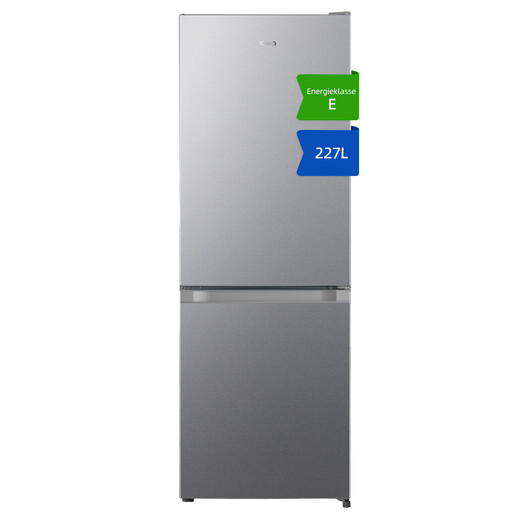 Image unavailable
A fridge-freezer to consider if you need freezer space as well as room for chilled groceries.
The product name lists a total capacity of 227 l, split into 153 l of fridge space and 74 l of freezer space, a width of 54 cm and energy label E. Low Frost and a reversible door are also mentioned.
 Image unavailable
A compact under-counter model to consider if you do not need a freezer compartment in your fridge.
The product name lists a capacity of 92 l, a width of 47 cm, a chill drawer, 7 temperature settings, energy label E and a reversible door.
The Netherlands Nutrition Centre advises wrapping leftover fresh herbs in damp kitchen paper and storing them at the bottom of the fridge. For packaged products, also check the label and use-by date.
The Netherlands Nutrition Centre recommends 4 °C. Check the actual temperature with a fridge thermometer; the selected setting is not the same as a temperature reading inside the fridge compartment.
Do not assume so without checking. Measure the whole space and consult the installation instructions for the exact model to find out how much clearance it needs; the external dimensions alone do not confirm that the setup is suitable.
Compare the stated annual energy use in kWh on the EU energy label of models that will actually fit. An energy class on its own does not show the stated energy use of a specific appliance.
Fridges have an energy label, and the European Commission uses a scale from A to G for household fridges. Do not treat an old A+++ rating as equivalent to the same class on today’s scale.