Start by making sure you have enough usable fridge space for the mushrooms and other chilled ingredients. A compact under-counter model may suit a small amount of food, while a larger stock requires more room. The Netherlands Nutrition Centre recommends setting your fridge to 4 °C; use a fridge thermometer to check the actual temperature. Then compare the external dimensions, layout and stated annual energy consumption. An extra cooling function is no substitute for checking the temperature.
Who is this buying guide for?
Cookery workshop host with fresh ingredients
You want to keep mushrooms chilled and separate from strong-smelling ingredients, and be able to check the temperature while you cook. The Netherlands Nutrition Centre recommends setting your fridge to 4 °C.
Organiser with a small kitchen
You’re looking for fridge space that fits in your workshop venue and can hold your containers and other chilled ingredients. The Consumers’ Association lists size and capacity as factors to consider when choosing a fridge.
Organiser running regular workshops
You use your fridge more often and want to weigh up its size, stated annual energy consumption and noise level. Milieu Centraal and the European Commission highlight energy use as a point of comparison; the EU energy label also includes noise information.
What should you look for?
First, consider temperature control and how much space your supplies need. Then check whether the appliance will fit in the space available and how often it will be running.
| What to consider |
What to look for |
Who is this relevant to? |
| Fridge temperature |
Set the fridge to 4 °C and use a fridge thermometer to check the actual temperature. |
If I want to keep fresh mushrooms chilled during the workshop, I need to know what temperature they actually reach. Around 36% of consumers prioritise reliable refrigeration. |
| Space and layout |
Compare the fridge capacity and shelf heights with the dimensions of your containers and packaging. |
If I have several containers and other chilled ingredients, I need enough usable space, not just a high capacity in litres. Around 29% of consumers give storage space top priority. |
| Size and placement |
Measure the height, width and depth of the available space, and check that the door can open easily. |
If the workshop kitchen is short on space, the fridge needs to fit without blocking access to the supplies. Around 21% of consumers start by considering the space available. |
| Energy consumption |
Compare the EU energy label and stated consumption in kWh per year; also consider whether you need an extra fridge outside workshop hours. |
If I use an extra fridge regularly, I want to avoid leaving it running unnecessarily. Around 14% of consumers focus mainly on energy consumption. |
Common buying mistakes
-
Assuming the selected setting means the fridge is at 4 °C
The setting doesn’t show the temperature the food actually reaches. The Netherlands Nutrition Centre recommends checking it with a fridge thermometer.
Check the temperature after setting up the fridge, and check it again if its position or use changes.
-
Looking only at the capacity in litres
A fridge may seem to have enough capacity, but your containers might not fit neatly on the shelves.
Measure the available space and your containers, then compare them with the external dimensions and layout of the exact model.
-
Leaving an extra fridge running all the time for occasional workshops
A fridge that’s left running between workshops still uses electricity. Milieu Centraal recommends switching on a second fridge only when you need it.
First, work out whether your existing fridge space is sufficient. If not, compare the stated annual energy consumption of models that meet your space requirements.
-
Assuming household food storage advice covers all business requirements
If your workshop falls under the rules for food businesses, different food safety requirements may apply.
Check whether your activity is covered by those rules. If it is, follow the applicable food safety plan, hygiene code and product information.
Relevant brands to consider
Inventum
Inventum offers, among other options, a compact model with 94 litres of fridge space and a larger model with 131 litres. These models cater for different storage needs.
- Inventum says the KK550 has adjustable shelves and a super-cooling function.
- An extra cooling function doesn’t prove that the food will stay at 4 °C during every workshop; check the temperature yourself.
ETNA
The KKV956WIT is an under-counter model with 133 litres of fridge space.
- ETNA says this model has two height-adjustable shelves.
- ETNA lists an energy rating of C and consumption of 58 kWh per year; the stated annual energy consumption isn’t a measurement of how much energy it uses during a workshop.
Bosch
Bosch describes the KTR15NWEB as an under-counter model with 134 litres of fridge space and no built-in freezer compartment.
- Bosch lists a door alarm and SuperCooling for this model.
- Bosch lists an energy rating of E and consumption of 91 kWh per year. Check the actual fridge temperature even when using an extra cooling function.
Liebherr
Liebherr describes the Rd 1400 Pure as an under-counter model with a total capacity of 125 litres and external dimensions of 85 × 55 × 60,7 cm.
- Liebherr lists a noise level of 34 dB and a door alarm for this model.
- Check that the stated capacity and external dimensions suit your supplies and the space available.
Fridges for workshop supplies
These product picks focus on compact under-counter fridges for chilled workshop supplies. Compare their capacity and layout with your containers, and check the actual temperature after setting the fridge.
 No image available
Bella BKK090.1BE under-counter fridge, 88 L, black
A compact option to consider if you need to chill a small amount of food for a workshop.
The product information lists 88 litres of fridge space, an adjustable temperature control and three adjustable glass shelves. Energy rating E.
View at Joybuy
 No image available
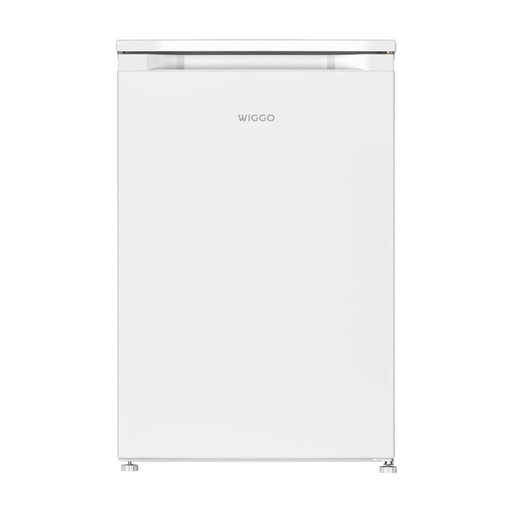
Wiggo WL-BTT88E(W), 129 L, white
Consider this model if you run regular workshops and want to factor in stated annual energy consumption and noise level.
The product information lists 129 litres of fridge space, two adjustable glass shelves, a crisper drawer, a width of 54 cm, a noise level of 39 dB and energy consumption of 92 kWh per year.
View at Joybuy
 No image available
Wiggo WL-TT82D(W), 107 L, white
An option to compare if you’re looking for an under-counter model with space for workshop supplies and other ingredients.
The product information lists a capacity of 107 litres and mechanical temperature control, along with a glass shelf, crisper drawer and door shelves. Energy rating D; reversible door.
View at Joybuy
 No image available
TCL RF120DWE0, 90 L, with chiller box
Consider this compact fridge if its stated capacity and shelf layout suit the packaging you want to chill.
The product information lists 90 litres of fridge space, a separate chiller box, three adjustable glass shelves and mechanical temperature control.
View at Joybuy
 No image available
CHiQ JR92DSE, 92 L, 47 cm wide, silver-coloured
A model to consider if kitchen space is limited and you need adjustable shelves.
The product information lists 92 litres of fridge space, a separate chill drawer, seven temperature settings, adjustable glass shelves and a reversible door. Energy rating E.
View at Joybuy
Frequently asked questions
How long can I keep fresh mushrooms for the workshop?
The Netherlands Nutrition Centre recommends keeping mushrooms in the fridge for 2 to 3 days in a paper bag or plastic container. For opened raw mushrooms, the Storage Guide recommends 3 days; if the packaging is unopened, follow the instructions on the label too. Don’t use mushrooms that are limp, mouldy or smell sour.
How can I tell if the fridge is at the right temperature?
The Netherlands Nutrition Centre recommends setting your fridge to 4 °C. Use a fridge thermometer to check whether it actually reaches that temperature. Place the thermometer in the middle of the bottom shelf, leave it there for half a day or overnight, and adjust the fridge if the temperature reading is too high.
Do I need an HACCP plan or NVWA registration for a cookery workshop?
It depends on the activity and whether it falls under the rules for a food business, not on the fridge model. According to the NVWA, a business that prepares, processes or sells food must work with a food safety plan or an approved hygiene code. The NVWA also says that businesses supplying food directly to consumers must register. It’s not possible to determine whether a workshop counts as such a business based on the description alone.
What fridge temperature applies if the workshop is covered by business food safety rules?
Follow the relevant product information and food safety plan. According to the NVWA, for prepacked food you should first follow the storage temperature on the label. If there isn’t one, the NVWA specifies 7 °C or below. For unpackaged perishable food, the NVWA specifies refrigeration at 7 °C or below, depending on the product. This differs from the Netherlands Nutrition Centre’s general recommendation to set your fridge to 4 °C.
How do I compare the energy consumption of fridges?
Compare the stated energy consumption in kWh per year for models that meet your refrigeration and space requirements. Actual consumption may differ from the stated figure; also consider whether you need an extra fridge between workshops.


