
Student keeping leftovers for tomorrow
You want reliable cooling and space for sealed containers, but you don’t necessarily need a freezer compartment. The Netherlands Nutrition Centre recommends keeping cooked vegetables in the fridge for two days.


For leftovers you plan to keep until the next day, choose a fridge that fits your available space and has room for sealed containers. Once it’s in place, check that the fridge compartment stays at around 4 °C. If you want to store portions for longer, compare models with a freezer compartment by looking at the separate fridge and freezer capacities: the freezer takes up space that could otherwise be used for chilled containers. For suitable models, also check the stated annual energy consumption and noise level, but remember these are product specifications, not measurements taken in your kitchen.
You want reliable cooling and space for sealed containers, but you don’t necessarily need a freezer compartment. The Netherlands Nutrition Centre recommends keeping cooked vegetables in the fridge for two days.
You want to keep cooked vegetables for longer, so you’re weighing up fridge space against the capacity and suitability of a freezer compartment. The Netherlands Nutrition Centre suggests freezing as an alternative for longer-term storage.
You need to balance the fridge’s external dimensions and space for containers with its noise level and energy consumption. Milieu Centraal recommends checking a fridge’s annual energy consumption in kWh.
The percentages refer to consumers looking for a fridge for cooked vegetables in a student kitchen. Start by checking the temperature and usable fridge space; only choose a freezer compartment if you want to freeze portions.
| What to consider | What should you look for? | Who is this important for? |
|---|---|---|
| Temperature and food storage | Once the fridge is in place, measure the temperature in the fridge compartment; the Netherlands Nutrition Centre recommends 4 °C. | I want to be sure the fridge compartment is cold enough, not just that the thermostat is set correctly. Around 33% of these consumers prioritise reliable cooling. |
| Size and layout | Measure the space and doorway; check the external dimensions, door clearance, shelves and fridge capacity. | In a small or shared kitchen, I want my sealed containers to fit alongside my housemates’ food. Around 27% of these consumers prioritise size and layout. |
| Freezer space | Compare the fridge and freezer capacities separately, and check whether the specific compartment is suitable for freezing food. | If I want to keep portions for longer than they would last in the fridge, I need a suitable freezer compartment, while still leaving enough room for chilled containers. Around 20% of these consumers prioritise freezing. |
| Energy consumption and noise | For models with the right size and features, compare the stated energy consumption in kWh per year and check the stated noise level. | If the fridge is on for long periods or close to where I sleep or study, I want to take energy consumption and noise into account. Around 20% of these consumers prioritise running costs. |
The Inventum KV550’s stated capacity of 113 litres includes 16 litres of freezer space; the manufacturer lists 97 litres of fridge space.
Compare the fridge and freezer capacities separately, and check whether your containers will fit on the available shelves.
The set or displayed temperature may not match the temperature actually reached inside the fridge compartment.
Once the fridge is in place, check the temperature with a fridge thermometer and adjust it towards 4 °C if needed.
Not every freezer compartment is suitable for freezing food, and a small compartment limits how many portions you can store at once.
Check the rating for the exact model and compare the freezer capacity with the portions you want to keep.
The energy label shows annual consumption in kWh, but actual consumption also depends on how and where the fridge is used.
First choose a size and layout that suit your kitchen, then compare the stated annual consumption of those models.
Bosch offers both under-counter models without a freezer compartment and a model with one; compare the separate fridge capacity to see whether there’s room for your containers.
The Inventum KV550 is an under-counter model with a separate freezer compartment.
The ETNA KKV956WIT is an under-counter model without a freezer compartment.
The Beko TSE1285N is a freestanding under-counter model. Its stated width may be worth considering if space is limited in your kitchen.
This selection includes compact fridges for leftovers, with and without a separate freezer compartment.
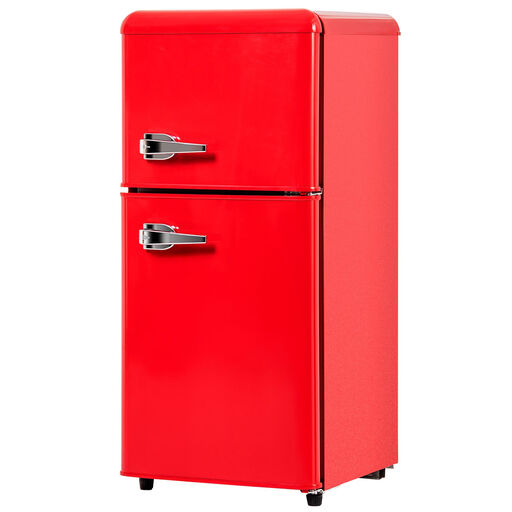 No image available
Separate fridge and freezer compartments make this a good option if you want to chill leftovers and freeze portions too.
38 l fridge space and 22 l freezer space; seven temperature settings; stated energy consumption of 102 kWh per year; energy label E.
 No image available
An under-counter model without a freezer compartment, for keeping sealed containers chilled.
88 l capacity; three adjustable glass shelves and a salad drawer; energy label E.
 No image available
This model has fridge space for containers and a separate freezer compartment for portions you want to freeze.
95 l fridge space and 14 l freezer space; two glass shelves and a salad drawer; energy label C.
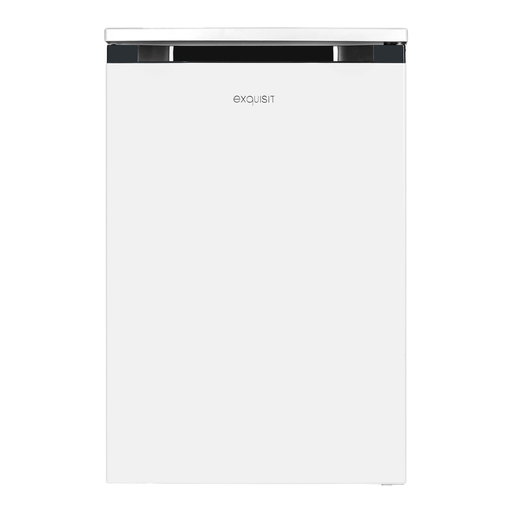 No image available
Separate fridge and freezer compartments are useful if you want to chill containers as well as freeze portions.
107 l fridge space and 13 l freezer space; rotary temperature control; energy label C; the product name states a five-year guarantee.
 No image available
The stated width can help you work out whether this under-counter model will fit in a small kitchen.
54 cm wide; 129 l capacity; two glass shelves, a salad drawer and a temperature control; energy label E.
The Netherlands Nutrition Centre recommends keeping cooked vegetables in the fridge for two days. If you want to keep them for longer, it suggests freezing them instead; you’ll need a suitable freezer compartment for this.
Use a fridge thermometer to measure the temperature in the fridge compartment, and set the fridge to the 4 °C recommended by the Netherlands Nutrition Centre. A set or displayed temperature doesn’t prove that the appliance is actually reaching it.
No, not every freezer compartment is designed for freezing food. Check the star rating for the exact model and see whether the separate freezer space is large enough for the portions you want to store.
The label shows details including the efficiency class and annual energy consumption in kWh. Compare consumption across models with the right size and features for you; your actual electricity costs also depend on your tariff and how you use the fridge.
For fridges covered by EU labelling rules, the current scale has run from A to G since 1 March 2021, according to the European Commission. Check the label for the exact model and also look at its stated annual energy consumption.