
People who regularly make fruit salad
You’ll want to keep a covered container chilled and check after putting it in the fridge that the temperature really is 4 °C. The Netherlands Nutrition Centre recommends this temperature for your fridge.


Choose a fridge that can fit your covered fruit salad and the rest of your shopping, then use a thermometer to check that the fridge compartment is at 4 °C, as recommended by the Netherlands Nutrition Centre. A model without a freezer compartment gives you the full stated capacity as fridge space. Choose one with a freezer compartment only if you also want to freeze other food, then compare the dimensions and stated annual energy consumption.
You’ll want to keep a covered container chilled and check after putting it in the fridge that the temperature really is 4 °C. The Netherlands Nutrition Centre recommends this temperature for your fridge.
You’ll need to weigh up the fridge’s external dimensions and the doorway against its fridge capacity and the shelf space your container of fruit salad will take up.
You may want a freezer compartment as well as fridge space, but you’ll need to assess the fridge and freezer capacities separately. Freezer space doesn’t count as space for fresh fruit salad.
First, check that the fridge and your covered container will fit in the space available. Then decide whether you need a freezer compartment as well as fridge space. For models that fit, compare the annual energy consumption and stated noise level.
| What to consider | What to look for | Who this matters to |
|---|---|---|
| Temperature for fruit salad | Check the temperature with a fridge thermometer and adjust the setting to 4 °C if needed. | If I regularly store fresh fruit salad, I want to know whether my fridge is actually cold enough. Around 33% of consumers put checking the storage temperature first. |
| Fit and fridge space | Measure the available space, doorway and container; compare the fridge capacity separately from any freezer capacity. | In a small kitchen, I want the appliance to fit and my covered container to fit on a shelf. Around 27% of consumers make fit and usable fridge space their top priority. |
| Energy consumption | For models that fit, compare the stated annual energy consumption in kWh as well as the energy rating. | If the fridge is always on, I want to take its annual energy consumption into account, rather than looking at the rating alone. Around 20% of consumers put energy consumption at the top of their list. |
| Freezer compartment | Check whether you need one, and look at the fridge and freezer capacities separately. | If I also want to freeze other food, I’ll look for that feature in the same appliance, without counting fridge space for salad as freezer space. Around 13% of consumers name freezing capability as their main requirement. |
| Noise | Compare the stated dB rating of the models you’re considering, especially if you have an open-plan kitchen or studio flat. | In an open-plan living space, I want to know the noise level stated by the manufacturer for the model. Around 7% of consumers make noise their top priority. |
Total capacity may include both fridge and freezer space. Fresh fruit salad belongs in the fridge compartment. For example, the ETNA KVV856WIT has a stated capacity of 107 l for the fridge and 13 l for the freezer.
Compare the fridge capacity separately and check that your covered container will fit on a shelf.
The selected setting doesn’t prove that the fridge has reached the temperature you want. The Netherlands Nutrition Centre recommends 4 °C and points out that the temperature can vary inside the fridge.
After setting up the fridge, take a reading on the bottom shelf with a fridge thermometer and adjust the setting if needed.
The energy rating takes the appliance’s volume into account, so it doesn’t show the absolute annual energy consumption on its own. The Consumers’ Association therefore recommends comparing the energy consumption of suitable models too.
Check the stated kWh per year on the EU energy label as well as the rating.
The KK550 is an under-counter fridge without a freezer compartment, for anyone mainly looking for fridge space.
The TS190340N is an example of a slim, freestanding under-counter fridge.
The KVV856WIT is an under-counter fridge with a freezer compartment.
The Re 1000 Pure is a compact under-counter fridge with a total capacity of 92 l, according to Liebherr.
The KTR15NWEB is an under-counter fridge without a freezer compartment.
This selection includes under-counter fridges with and without a freezer compartment, as well as a fridge-freezer, for households that want to keep fruit salad and other shopping chilled.
 No image available
An under-counter fridge without a freezer compartment, for anyone who wants to use all the available capacity as fridge space.
 No image available
A compact appliance for anyone who wants a separate freezer compartment as well as fridge space.
 No image available
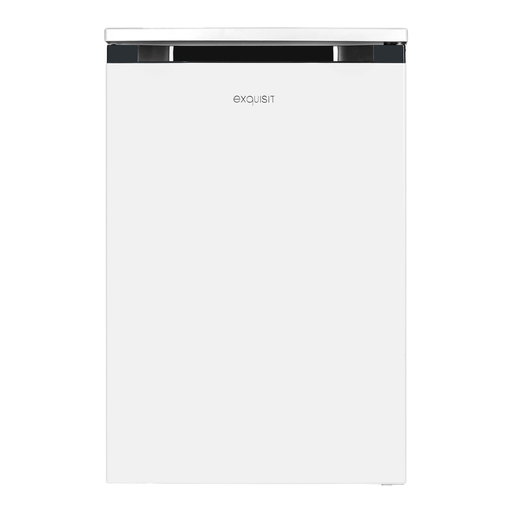
An under-counter fridge for anyone who wants to combine fridge space for shopping with a freezer compartment.
 No image available
A fridge-freezer for anyone looking for more fridge and freezer space than an under-counter model offers. Measure the available space first.
 No image available
An under-counter fridge with no freezer compartment specified, for anyone mainly looking for fridge space for everyday shopping.
The Netherlands Nutrition Centre recommends 4 °C. Use a fridge thermometer to check the bottom shelf after the door has been kept shut for half a day or overnight, and adjust the fridge if needed. The selected setting isn’t a temperature reading.
For opened, fresh fruit salad, the Netherlands Nutrition Centre’s storage guide recommends keeping it covered in the fridge for up to two days. If you’ve bought a ready-made product, also follow the instructions on the packaging.
No, fresh fruit salad needs fridge space, not a freezer compartment. Choose a freezer compartment if you also want to freeze other food, and compare the fridge and freezer capacities separately.
The EU energy label shows, among other things, the energy rating, annual energy consumption, the capacities of the fridge and freezer compartments, and the noise emission. The European Commission explains these label details. For models with different capacities, compare the kWh per year too.
Use a thermometer to check that the fridge compartment is at 4 °C, and adjust the setting if needed. Keep fruit salad covered. Inventum describes the KK550 as having adjustable shelves, which you can arrange to suit your container and the rest of your shopping.